Best 1300 Watt Power Supply for RTX 4090 Rigs
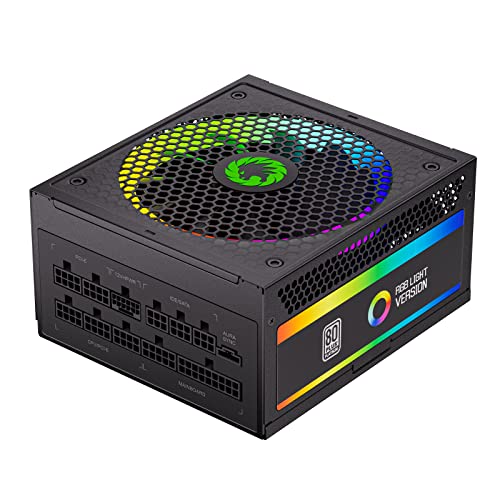
Five 1300W PSUs, ranked. What actually decides a 1300 watt buy, why the efficiency badge misleads, and which unit fits a single-GPU RTX 4090 or 5090 rig.

By Samuel HarrisUpdated 15 min read
On this page
- Best 1300 watt power supply at a glance
- How I narrowed the field to five
- What actually decides a 1300 watt buy
- 1. GAMEMAX RGB-1300 — Best overall
- 2. MSI MPG Ai1300TS PCIE5 — Best premium
- 3. GAMEMAX RGB-1300 White — Best upgrade
- 4. MSI MEG Ai1300P PCIE5 — Best minimal setup
- 5. Super Flower Leadex VII XG 1300W — Best for pros
- Platinum, Titanium or Gold: does the badge matter?
- How many 12V-2x6 connectors do you really need?
- What the listings do not tell you
- GAMEMAX RGB-1300 vs MSI MPG Ai1300TS: which wins?
- The verdict
- FAQ
The best 1300 watt power supply for most single-GPU flagship builds is the GAMEMAX RGB-1300, an 80 Plus Platinum, ATX 3.0 unit with a 12VHPWR 16-pin connector rated to 600W and a 10-year manufacturer warranty. If you are wiring a dual-GPU rig or an overclocked RTX 5090, the MSI MPG Ai1300TS with its dual native 12V-2x6 cables and 80 Plus Titanium rating is the better buy. Most 1300W shoppers compare efficiency badges. That is not what decides it.
Best 1300 watt power supply at a glance
| Pick | Efficiency | 12V-2x6 cables | Price |
|---|---|---|---|
Best overall GAMEMAX RGB-1300 |
80 Plus Platinum | One, 600W claim | Check Price |
Best premium MSI MPG Ai1300TS PCIE5 |
80 Plus Titanium | Two, 600W each claim | Check Price |
Best upgrade GAMEMAX RGB-1300 White |
80 Plus Platinum | One, 600W claim | Check Price |
Best minimal setup MSI MEG Ai1300P PCIE5 |
80 Plus Platinum | One, native 12V-2x6 | Check Price |
Best for pros Super Flower Leadex VII XG |
80 Plus Gold, Cybenetics Platinum | One, 16-pin PCIe Gen 5 | Check Price |



How I narrowed the field to five
I started with the criteria a 1300W buyer actually applies, then weighted them, then let the listings sort themselves.
Three criteria did the cutting, roughly in order of weight:
- ATX 3.0 or 3.1 compliance with a native 12VHPWR or 12V-2x6 connector. A 1300W buyer in 2025 is powering an RTX 40-series or 50-series card. A PSU that needs a dual 8-pin adapter for the GPU is a compromise you should not accept at this power tier.
- A published warranty of at least ten years. Every finalist here clears that bar. It is a real proxy for how the manufacturer models its own failure rate.
- A recognised efficiency rating, whether that is 80 Plus Platinum, Titanium, or a Cybenetics equivalent. Efficiency badges do not tell you a PSU is good, but their absence at 1300W is a red flag.
Why those three? Because a bad 1300W buy fails in one of two ways. Either the connector fails under a 5090's transient spikes, or the unit degrades and the warranty is already void. Both risks are visible in the listing before you buy.
The best 1300 watt power supply for you is the one that clears all three, then matches your case, your cable preferences and your budget. The five below all clear the bar. They differ on everything after it.
What actually decides a 1300 watt buy
The obvious specification is wattage, and at this tier every unit says 1300W on the box. The real deciding criterion is transient response and GPU cable count, not efficiency.
Here is the trick with a modern high-end GPU. An RTX 4090 or 5090 does not draw its rated wattage in a smooth line. It draws in millisecond spikes that can briefly hit two to three times the average. ATX 3.0 and 3.1 were written precisely to handle those spikes, and both revisions require the 12V-2x6 connector on the PSU side. That is why every pick here advertises ATX 3.0 or 3.1 compliance and a 600W-capable GPU cable.
The second question is how many of those cables you need. A single flagship GPU wants one. A dual-GPU workstation wants two. Only the MSI MPG Ai1300TS advertises two native 12V-2x6 cables in this set. Every other pick supplies one.
The efficiency badge, Platinum versus Titanium versus Gold, is real but small at 1300W. The gap between a Platinum unit at 92% and a Titanium at 94% is roughly 26W of heat under a heavy load. That is worth paying for if you run the machine ten hours a day. It is not worth paying for if you game two evenings a week.
1. GAMEMAX RGB-1300 — Best overall
The GAMEMAX RGB-1300 hits every ATX 3.0 checkbox at the lowest price position in this set, which is why it wins the default slot.
Best for: a single-GPU RTX 4090 or 5090 build that needs ATX 3.0 headroom without paying premium prices Skip it if: you want two native 12V-2x6 cables or 80 Plus Titanium efficiency
This is the cheapest of the five here, and it is the cheapest by a clear margin. GAMEMAX claims 80 Plus Platinum certification with 92% or higher efficiency under typical loads, an ATX 3.0 and PCIe 5.0 layout with a 12VHPWR 16-pin connector rated to 600W, and 100% Japanese capacitors. The unit measures 3.39 x 6.69 x 5.91 in, which fits any standard ATX case. The warranty is a 10-year manufacturer term.
The case for the RGB-1300 as the best 1300 watt power supply comes down to what you get for the money. Every other pick in this set is either newer, quieter, or slightly more efficient, and the ones that are quieter or more efficient cost noticeably more. If you are building a single-GPU rig around a 5090 and you want the 600W 12V-2x6 cable, you are paying for the same core spec in every unit here. The trade-off is that you get 80 Plus Platinum rather than Titanium, and one 12V-2x6 cable rather than two. For a single-GPU build, neither trade-off matters.
Pros:
- Cheapest of the five with full ATX 3.0 support
- 12VHPWR connector rated to 600W per GAMEMAX
- 10-year manufacturer warranty
- Fully modular flat black cables
- 25 ARGB lighting modes with Aura Sync
Cons:
- Only one 12V-2x6 cable, so unsuitable for dual-GPU builds
- 80 Plus Platinum, not Titanium
- No published weight in the listing
2. MSI MPG Ai1300TS PCIE5 — Best premium
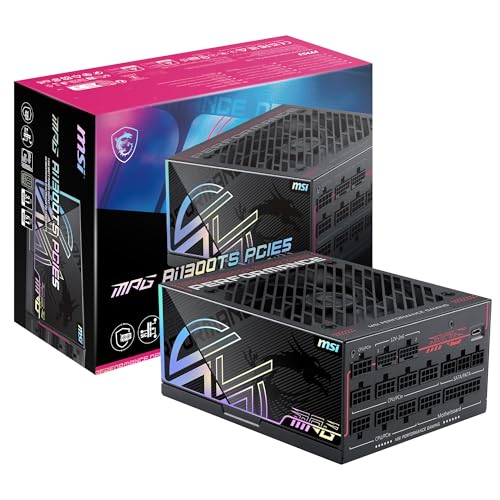
The MSI MPG Ai1300TS is the only unit here with dual native 12V-2x6 cables and 80 Plus Titanium certification, and it carries a 12-year warranty.
Best for: a dual-GPU or overclocked flagship rig where efficiency and a 12-year warranty justify the outlay Skip it if: your build only draws one 12V-2x6 cable
This is the most expensive pick here, and it earns the position. MSI claims up to 94% efficiency at the 80 Plus Titanium rating, dual native 12V-2x6 PCIe connectors each rated at 600W for PCIe 5.1 GPUs, and server-grade SiC MOSFETs in the interleaved PFC stage that MSI says improve efficiency and thermals together. The unit weighs 10.1 lb and measures 3.4 x 5.9 x 7.48 in. The warranty is 12 years, two years longer than every other pick in this set.
MSI also advertises a GPU Safeguard+ system that monitors the 12V-2x6 current in real time and warns of abnormal readings. That matters more than it sounds. The 12VHPWR connector's early reputation was built on melted cables under sustained heavy load, and a current sensor on the PSU side is the sort of feature you buy once and never think about again.
The trade-off is straightforward. If your build has one GPU, you are paying for a second 12V-2x6 cable you will not use. If your build has two, or if you plan to swap in a hungrier card in three years, the MSI is the safer floor.
Pros:
- Two native 12V-2x6 cables at 600W each per MSI
- 80 Plus Titanium, up to 94% efficiency per MSI
- 12-year warranty, longest in the set
- 135 mm fluid-dynamic bearing fan
- GPU Safeguard+ current monitoring
Cons:
- Most expensive pick in the set
- Second 12V-2x6 cable wasted on single-GPU builds
- Depth of 7.48 in tight for some SFF cases
3. GAMEMAX RGB-1300 White — Best upgrade
The white variant of the GAMEMAX RGB-1300 matches the specs of our winner in a white shell for a small step up in price.

Best for: a white-themed ATX 3.0 build with RGB lighting synced to the motherboard Skip it if: your case is compact and 15.6 in of depth will not fit
This is the second-cheapest here, and it is functionally the same unit as the winner in a white finish. GAMEMAX again claims 80 Plus Platinum with 92% or higher efficiency, ATX 3.0 and PCIe 5.0 support, a 12VHPWR 16-pin connector to 600W, and a 10-year warranty. The listed dimensions of 5.12 x 15.6 x 10.6 in look larger than the black model. That reflects the packaged box, not the PSU itself, but it is worth measuring your case's cutout before you commit. The model number is RGB-Smart 1300 PRO.
The reason it sits at number 3 rather than tied with the winner is that a white PSU is an aesthetic choice, not a capability choice. If your case is a Lian Li O11 in white or an equivalent build, this is the natural pick, and the small price step is worth it to avoid a black brick behind glass. If your case is closed or your cables run through a shroud, you are paying for a colour you will not see.
Pros:
- Matches the winner's spec sheet in white
- 12VHPWR connector to 600W per GAMEMAX
- 10-year warranty
- 25 ARGB modes with 5V motherboard sync
- Fully modular
Cons:
- Listing dimensions imply a longer body, check case clearance
- Only one 12V-2x6 cable
- White shell yellows over years in some builds
4. MSI MEG Ai1300P PCIE5 — Best minimal setup
The MSI MEG Ai1300P is the quiet, RGB-free option for a build that values a clean interior over lighting effects.
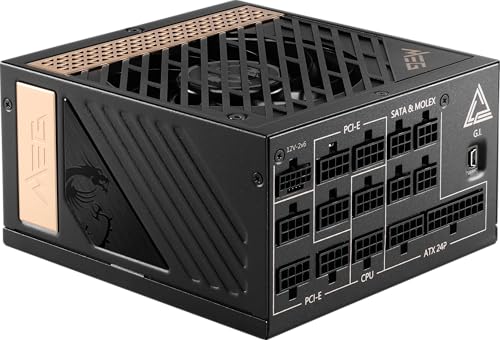
Best for: a clean, low-noise RTX 40-series build that skips RGB entirely Skip it if: you want ARGB or the newest ATX 3.1 revision on paper
The MEG Ai1300P sits at the second-highest price position and swaps Titanium for Platinum, dual cables for single, and drops the RGB. In exchange you get sleeved cables rather than flat ribbons, an emphasis on low-noise operation, and 100% Japanese 105°C capacitors. MSI lists it as ATX 3.1 and PCIe 5.1 ready with a native 12V-2x6 cable. The unit weighs 3.31 lb and measures 12.9 x 8.27 x 6.18 in, with the model number 306-7ZP4A11-CE0. The warranty is 10 years.
Skip this one if your build style leans toward glass side panels and synchronised lighting. The MEG Ai1300P is deliberately understated, and the sleeved cables are the visual concession it makes. What you get for the price is MSI's engineering with none of the ARGB overhead, which is a real category for anyone who has spent an hour disabling lights on a motherboard header. In practice, this is the PSU for a workstation that happens to game, not a gaming rig that happens to render.
Pros:
- Sleeved cables rather than flat ribbon
- Low-noise design per MSI
- 100% Japanese 105°C capacitors
- Native 12V-2x6 cable
- 10-year warranty
Cons:
- No RGB, no lighting sync
- 80 Plus Platinum rather than Titanium
- Listed depth of 6.18 in wider than some competitors
5. Super Flower Leadex VII XG 1300W — Best for pros
The Super Flower Leadex VII XG trades an efficiency badge for the tightest voltage regulation figure in this set.

Best for: a workstation or render box where tight voltage regulation matters more than an efficiency badge Skip it if: you need 80 Plus Platinum or Titanium on the label for a spec sheet
This is the mid-price pick, sitting between the two GAMEMAX units and the two MSI units. Super Flower publishes 80 Plus Gold with 87%, 90%, and 87% efficiency at 20%, 50%, and 100% rated load, plus Cybenetics Platinum certification with 89% to 91% overall efficiency at 115V input and 91% to 93% at 230V. The listing also claims tight voltage regulation of ±0.5% on the 12V, 5V and 3.3V rails. The unit measures 3.4 x 5.9 x 5.9 in with a 10-year warranty and the model number SF-1300F14XG.
The voltage-regulation figure is the point. A ±0.5% tolerance is unusually tight and matters most for machines that run heavy sustained loads: render nodes, CAD workstations, machine-learning boxes at home. For those users, a Gold badge with tight regulation is a better buy than a Platinum badge with loose regulation. For a gaming-only build, this is over-specification, and the Platinum GAMEMAX at a lower price position covers the same ground.
Pros:
- ±0.5% voltage regulation per Super Flower
- Cybenetics Platinum in addition to 80 Plus Gold
- Compact 5.9 in depth for tight cases
- Full modular with ribbon cables
- ATX 3.1 and PCIe 5.1 ready per Super Flower
Cons:
- 80 Plus Gold rather than Platinum on the primary badge
- Ribbon cables less flexible than sleeved for some routing styles
- Mid-price for spec sheet a gamer will not use
Platinum, Titanium or Gold: does the badge matter?
Not as much as the label suggests. Here is the shape of it.
An 80 Plus Platinum unit at 1300W is claimed at roughly 92% efficient under typical load. Titanium is claimed at up to 94%. Gold is roughly 87% to 90%. The absolute gap between Platinum and Titanium at 1300W is small: about 26W of heat that the Titanium unit does not have to dissipate. Across a year of heavy daily use that is real electricity. Across a year of evening gaming it is negligible.
What the badge really tells you is how much the manufacturer spent on the primary side of the PSU. Titanium requires better MOSFETs, better transformers, tighter tolerances. That expense usually correlates with better transient response, quieter fan curves and longer service life, and those matter more day to day than the raw efficiency number.
Two rules of thumb:
- If the machine runs eight or more hours a day under real load, buy Titanium and treat the badge as the tie-breaker.
- If it runs a few hours in the evening, Platinum is the correct stop, and Gold with Cybenetics Platinum on top is a legitimate substitute.
How many 12V-2x6 connectors do you really need?
One for each flagship GPU. That is the rule.
An RTX 4090 or 5090 takes a single 12V-2x6 cable, and modern ATX 3.0 and 3.1 PSUs supply it natively rather than through an adapter. Two cables matter only if you have two GPUs, which for a home build means a machine-learning rig or a video workstation, not a gaming PC.
- One GPU, gaming or single-workstation load: one 12V-2x6 cable is enough. The GAMEMAX RGB-1300, the GAMEMAX RGB-1300 White, the MSI MEG Ai1300P and the Super Flower Leadex VII XG all cover this.
- Two GPUs, or a strong likelihood of adding one within the warranty period: two cables. The MSI MPG Ai1300TS is the only pick here that supplies two natively.
- Any adapter setup: avoid. If a PSU needs a dual 8-pin to 12V-2x6 adapter to power your GPU, buy a different PSU.
The reason to care is heat and margin. A native 12V-2x6 cable is engineered end to end for the current it carries. An adapter joins wires that were engineered for a different circuit, and the join is where the failures happen.
What the listings do not tell you
Three things the product pages leave out that will affect your build.
First, fan behaviour at idle. Most 1300W PSUs run their fan on a hybrid curve that stops the fan entirely below a load threshold, usually somewhere around 40% to 50% of rated capacity. On a 1300W unit that threshold is roughly 500W to 650W, which almost no desktop reaches at idle. In practice this means every unit here will run silently on your desktop and only spin up under a game or render.
Second, cable length. None of the five listings publishes a cable-length spec. In a full-tower case this rarely matters. In an oversized case such as a Corsair 7000D or a Lian Li V3000, it can, especially for the CPU EPS cable, which has to reach the top-left of the motherboard. Assume the included cables are sized for a mid-tower and check reviews before buying if your case is unusual.
Third, coil whine. No PSU listing warns you about it, and no manufacturer will guarantee its absence. It is a lottery, silicon by silicon. The 12-year MSI warranty is the closest thing to insurance here, because coil whine is often accepted as a valid RMA reason at that tier.
GAMEMAX RGB-1300 vs MSI MPG Ai1300TS: which wins?
The two poles of this set are the cheapest pick and the most expensive. Both are legitimate answers.
The GAMEMAX RGB-1300 wins on value. It gives you every ATX 3.0 requirement, an 80 Plus Platinum badge, a 12VHPWR cable to 600W, a 10-year warranty and ARGB with motherboard sync, at the lowest price position in this set. For a single-GPU RTX 4090 or 5090 gaming build, there is no capability the MSI adds that you will use.
The MSI MPG Ai1300TS wins on headroom. Its dual native 12V-2x6 cables cover a future dual-GPU move that the GAMEMAX cannot. Its 80 Plus Titanium badge and SiC MOSFETs will trim a real amount of heat from a machine that runs sustained loads. Its 12-year warranty is two years longer than any other pick here. Its GPU Safeguard+ current monitor is a genuine safety layer at the 12V-2x6 connector.
The cutoff is your use case. Single-GPU gamer: GAMEMAX. Dual-GPU workstation, or someone who runs heavy loads for hours a day, or someone who wants the longest warranty on the shelf: MSI. Anyone in between should read the mid-tier picks, which is what they are for.
The verdict
The GAMEMAX RGB-1300 is the best 1300 watt power supply for the shopper this article is written for: a single-GPU RTX 4090 or 5090 builder who wants full ATX 3.0 compatibility, a 600W 12V-2x6 cable and a 10-year warranty, without paying for a Titanium badge or a second GPU cable. It sits at the cheapest price position in this set and matches every other pick on the specs that decide the category.
The MSI MPG Ai1300TS is the right buy if any one of three conditions is true. If you run two GPUs, its dual native 12V-2x6 cables are the only match in this set. If your machine draws heavy load for eight or more hours a day, its 80 Plus Titanium rating saves real electricity. If you want the longest warranty available, its 12 years beats every other pick by two.
Between those poles, the GAMEMAX RGB-1300 White is the winner in a white shell, the MSI MEG Ai1300P is the quiet no-RGB option, and the Super Flower Leadex VII XG is the tight-regulation pick for a workstation. None of the five is a mistake. The choice is about your case, your workload and your patience for RGB, not about which unit will fail first.
FAQ
Is a 1300 watt power supply overkill for gaming?
A 1300 watt power supply is overkill for a single mid-range GPU, but appropriate headroom for a flagship RTX 4090 or 5090 build. The 5090's rated draw sits around 575W, and its transient spikes push briefly higher. A 1300W unit at Platinum runs its fan curve quietly at 50% load and leaves margin for a CPU overclock or a future upgrade.
Is the GAMEMAX RGB-1300 worth it over the MSI?
The GAMEMAX RGB-1300 is worth it over the MSI premium pick if you are running one GPU and do not need a Titanium efficiency badge. GAMEMAX claims the same ATX 3.0 support, the same 600W 12VHPWR cable and the same 10-year warranty at a much lower price position. Choose the MSI only for dual GPUs, sustained heavy loads, or the 12-year warranty.
What does ATX 3.0 or 3.1 mean for a 1300W PSU?
ATX 3.0 and 3.1 mean the PSU is engineered to handle the millisecond current spikes that modern flagship GPUs produce, and includes the 12VHPWR or 12V-2x6 native connector that plugs directly into an RTX 40-series or 50-series card. Every pick here meets one of the two revisions. Avoid any 1300W unit that does not.
Will a 1300W PSU fit my case?
Most 1300W PSUs fit any standard ATX case with a bottom-mounted PSU shroud. The picks here range from 5.9 in to roughly 7.5 in in depth. In a compact ATX or small form factor case, measure the PSU cutout and add roughly one inch for cable clearance behind the unit. The MSI MPG Ai1300TS at 7.48 in deep is the tightest fit in this set.
GAMEMAX RGB-1300 vs Super Flower Leadex VII XG?
GAMEMAX RGB-1300 vs Super Flower Leadex VII XG comes down to badge or regulation. The GAMEMAX carries 80 Plus Platinum with 92% efficiency and RGB lighting, at the lowest price position here. The Super Flower carries 80 Plus Gold plus Cybenetics Platinum, with a ±0.5% voltage regulation claim on all three rails and no RGB. Gamer picks GAMEMAX; workstation picks Super Flower.
Start with your GPU and work backwards. If you are building around a single RTX 4090 or 5090 and you want to spend as little as possible on a PSU that will still see the machine through a full warranty cycle, the GAMEMAX RGB-1300 is the default answer. If you are building anything more demanding, the price step up to the MSI MPG Ai1300TS buys you a second 12V-2x6 cable, a Titanium efficiency badge, and the longest warranty on this list. Neither choice is a compromise. The mistake is buying a 1300W unit without a native 12V-2x6 cable, and none of the five here makes that mistake.