Best Compact Budget Graphics Card for a Small Desktop

Six low-profile and short-PCB cards ranked for tight cases and tight wallets, from a 0.9 lb RTX 3050 down to a slot-powered GT 730 for office builds.

By Samuel HarrisUpdated 15 min read
On this page
- Best compact budget graphics card at a glance
- How I screened the shortlist
- What actually decides a compact budget card?
- 1. ASUS Dual GeForce RTX 3050 6GB GDDR6 OC Edition — Best overall
- 2. ASUS GeForce GT 1030 2GB GDDR5 — Best warranty
- 3. SOYO GeForce GT 740 4GB DDR3 Low Profile — Best budget pick
- 4. ARDIYES GT 740 4GB GDDR5 Low Profile — Best upgrade
- 5. QTHREE GeForce GT 730 4GB — Best minimal setup
- 6. MOUGOL AMD Radeon RX 580 8GB GDDR5 — Best for pros
- Will these fit a slim or SFF case?
- Modern GPU or old Kepler card: which is the smarter buy?
- What the listings do not tell you
- The verdict
- FAQ
The best compact budget graphics card is the ASUS Dual GeForce RTX 3050 6GB OC Edition: a 7.9 in, 0.9 lb dual-fan card that carries a 3 year warranty and current-generation ray tracing. If your case only takes a low-profile bracket, the ASUS GeForce GT 1030 2GB GDDR5, at 6.8 x 2.7 in, is the better buy. Choose wrong here and the card either will not physically fit, or it will bottleneck the CPU it was meant to help.
Best compact budget graphics card at a glance
| Pick | Length | Warranty | Price |
|---|---|---|---|
Best overall ASUS Dual GeForce RTX 3050 6GB GDDR6 OC Edition |
7.9 in | 3 years | Check Price |
Best warranty ASUS GeForce GT 1030 2GB GDDR5 |
6.8 in low profile | 3 years | Check Price |
Best budget pick SOYO GeForce GT 740 4GB DDR3 Low Profile |
Low profile (not listed) | 3 years | Check Price |
Best upgrade ARDIYES GT 740 4GB GDDR5 Low Profile |
Low profile (not listed) | 90 days | Check Price |
Best minimal setup QTHREE GeForce GT 730 4GB |
Low profile (not listed) | Not listed | Check Price |
Best for pros MOUGOL AMD Radeon RX 580 8GB GDDR5 |
9.45 in claim | 1 year | Check Price |


A quick note on the keyword. Amazon's results for "compact" mix genuinely small low-profile cards with mid-tower dual-fan cards that are only compact by desktop-GPU standards. Read the length figure in the table before you buy. Your case, not the listing copy, decides whether a card is compact.
How I screened the shortlist
I started with the six cards Amazon surfaces for this query, then compared the published specifications side by side: length, height, bracket type, warranty, VRAM, and the outputs on the back. The goal was a shortlist where at least one card fits every common compact scenario, from a full-height mini-tower down to a 2U slim office desktop.
Three cuts did most of the work.
- No published length or bracket type, cut. A "compact" claim with no dimensions is not a claim you can act on. That knocked out several listings that never made this six.
- No modern display output, cut. DVI and VGA still exist on these picks, but the winner had to carry at least HDMI so a current monitor plugs in without an adapter.
- No stated warranty on a brand-new listing, deprioritised. Most of the picks here publish 3 years. One publishes 90 days, one publishes 1 year, and one publishes nothing. That gap decides how far each pick sits from the top.
What survived is a set that covers three tiers of compact: a short dual-fan card for mini-towers, three low-profile cards for slim desktops, and a mid-tower card that is compact only by RX 580 standards.
What actually decides a compact budget card?
Most guides in this category compare VRAM. That is the wrong first question. The GT 740 and GT 730 picks here list 4 GB, and the RTX 3050 lists 6 GB. On paper the older cards look close. In practice, DDR3 memory on a Kepler-era chip is not doing the same work as GDDR6 on an Ampere chip, and the newer chip drives games that will not run at all on the older ones.
The right first question is physical fit, and the second is generation. Physical fit is binary: either the card slides into your case or it does not. Generation decides what software will still install on the driver five years from now.
- Full-height, at least 8 in of clearance: the RTX 3050 6GB is the only current-generation pick in this set.
- Full-height, under 8 in of clearance: the RX 580 8GB is your only 8 GB option, but its 9.45 in claimed length rules out anything genuinely small.
- Low-profile bracket, slim desktop: the GT 1030, both GT 740 cards, and the GT 730 are the candidates. Pick on outputs and warranty.
Everything else, cooling noise, exact clock speed, colour of the shroud, is a tiebreaker.
1. ASUS Dual GeForce RTX 3050 6GB GDDR6 OC Edition — Best overall
A current-generation Ampere card that still fits a 7.9 in slot and weighs 0.9 lb, backed by the longest warranty in the set.
Best for: a mini-tower gamer who wants current-generation features Skip it if: your case only accepts low-profile brackets
This is the only pick here built on NVIDIA's Ampere architecture, and it is the only one that lists a 2024 release date. ASUS publishes a 1.5 x 7.9 x 4.7 in footprint and a 0.9 lb weight, which is short and light for a dual-fan card. ASUS says the OC Mode boost clock is 1500 MHz, with a 1470 MHz default. ASUS also lists 2nd generation RT cores and 3rd generation tensor cores, which is the difference between running current games with DLSS and not running them at all, as is the case with the four Kepler-era picks below.
The 3 year warranty is the longest published in this set and it matches the GT 1030 for length while pairing with a much more capable chip. The trade-off against the rest of the six is height: at 4.7 in, this is a full-height card, not a low-profile one. If your bracket is short, drop straight to the GT 1030.
Pros:
- Only Ampere-generation card in the set
- 3 year warranty, joint longest published
- Short 7.9 in length for a dual-fan card
- 6 GB GDDR6, the newest memory here
- Ships with a 1500 MHz OC Mode boost clock
Cons:
- Full-height only, no low-profile bracket
- Highest price position of the six
- 6 GB VRAM sits below the RX 580's 8 GB
2. ASUS GeForce GT 1030 2GB GDDR5 — Best warranty
A true low-profile card on Pascal architecture with a 3 year warranty and a passive-friendly cooling design.

Best for: an HTPC or office build that needs quiet, passive-friendly cooling Skip it if: you plan to play anything past light indie games
The GT 1030 is where this set gets interesting for slim desktops. ASUS lists a 0.1 x 6.8 x 2.7 in card, which is a short low-profile bracket that clears most 2U and slim ATX chassis. ASUS says the OC Mode boost clock is 1506 MHz on Pascal architecture with 2 GB of GDDR5. The listing highlights an "exclusive heatsink design with passive cooling" for quiet HTPC work, and DirectX 12 support on Windows 10.
Two things put this second. First, the 3 year warranty matches the winner and beats every other low-profile pick here except the SOYO. Second, ASUS is one of two brands here you are likely to recognise, and the auto-extreme manufacturing claim gives the card a floor the no-name low-profile options lack. The trade-off is age: this is a 2017 model. It plays the games it was designed to play and no more.
Pros:
- Genuine low-profile 6.8 x 2.7 in footprint
- 3 year warranty
- 1506 MHz OC Mode boost clock claim
- Pascal architecture with 2 GB GDDR5
- Passive-friendly cooling for quiet builds
Cons:
- 2 GB VRAM, half of the GT 740 picks
- 2017 chip, oldest ASUS design here
- No DisplayPort listed in the feature bullets
3. SOYO GeForce GT 740 4GB DDR3 Low Profile — Best budget pick
The cheapest of the six, with 4 GB of DDR3, a slot-powered design, and three outputs including HDMI, DVI, and VGA.

Best for: reviving an older slim desktop on the smallest possible outlay Skip it if: you need HDMI 2.0 or newer video codecs
The SOYO GT 740 is the cheapest card in this set and it earns the budget slot on two facts. SOYO says the card draws all its power directly from the PCIe slot, with no external power connector required, which matters in older office desktops where the power supply may not have a spare 6-pin. And SOYO says the outputs are HDMI, DVI-D, and VGA, which is the exact port trio you want when the monitor on the desk is old.
The 4 GB DDR3 memory is a marketing figure, not a performance one. SOYO calls it a "significant performance boost over standard 2GB models", and for the desktop-app and 1080p video work this card targets, that is fair. What lifts it above the other GT 740 pick below is the 3 year manufacturer warranty. The trade-off against the winner is obvious: no ray tracing, no DLSS, no current-generation drivers, and no published dimensions to check against your case.
Pros:
- Cheapest of the six
- 3 year manufacturer warranty
- Slot-powered, no external connector needed
- Triple output: HDMI, DVI-D, VGA
- 4 GB of DDR3 memory listed
Cons:
- No dimensions published
- DDR3 memory, slower than GDDR5 or GDDR6
- No current-generation gaming features
4. ARDIYES GT 740 4GB GDDR5 Low Profile — Best upgrade
The only pick here with four HDMI ports, aimed squarely at silent quad-monitor office setups.
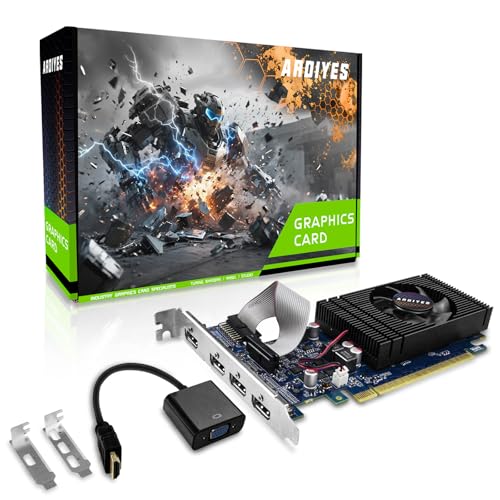
Best for: a four-monitor office setup that has to stay silent Skip it if: you want more than a 90-day warranty
The ARDIYES upgrade over the SOYO is specific and worth stating clearly: 4 GB of GDDR5 memory instead of DDR3, and four HDMI ports for a quad-monitor setup. ARDIYES says the card is engineered with a silent fan for near-silent operation and includes both low-profile and standard brackets in the box, along with a quick-start guide and screwdriver. For a shared office PC that drives dashboards on four screens, that combination is hard to match at this price position.
Two things hold it back from a higher spot. First, the warranty is 90 days, the shortest in the set by a wide margin. Second, ARDIYES does not publish the card's dimensions, so you are relying on the low-profile bracket claim rather than a measured length. The blue shroud is the giveaway that this is a boutique-brand board; that is not a fault, but it is the trade-off you accept for the four HDMI outputs no other pick here offers.
Pros:
- 4 GB GDDR5, faster than DDR3 alternatives
- Four HDMI ports for quad-monitor setups
- Low-profile and standard brackets in the box
- Silent-fan cooling claim
- Second-cheapest of the six
Cons:
- 90 day warranty, shortest of the six
- No dimensions published
- Boutique brand with limited support history
5. QTHREE GeForce GT 730 4GB — Best minimal setup
A low-profile Kepler card built for a compact ITX chassis, with four outputs and a listed 300 W power-supply requirement.

Best for: a compact ITX build that only drives desktop apps Skip it if: your motherboard has no PCIe x8 or x16 slot free
The QTHREE GT 730 is the most narrowly-scoped pick here, and that is why it is on the list. QTHREE says the card offers basic display capabilities for office work and light multimedia, with a 1000 MHz memory clock, 4 GB of DDR3, and Kepler architecture. The outputs cover 2x HDMI, DisplayPort, and VGA, which is the widest port variety of any low-profile card in this set. QTHREE also lists a PCI Express x8 lane requirement and a 300 W or greater power supply, both worth checking before you order.
The reason to buy this over the two GT 740 options is the DisplayPort. If your monitor is DisplayPort-only, the GT 730 saves you a cable adapter. The reason to hesitate is that QTHREE publishes no warranty and no dimensions, only that the design is low-profile. Against the rest of the six, this card takes the "minimal" label seriously: it is here to put a picture on a screen, quietly, in a small case.
Pros:
- DisplayPort output, unique among low-profile picks
- 2x HDMI plus VGA for four total outputs
- Low-profile design fits ITX chassis
- 4 GB of DDR3 listed
- Documented 300 W PSU requirement
Cons:
- No warranty published
- No dimensions published
- Kepler architecture, oldest generation here
6. MOUGOL AMD Radeon RX 580 8GB GDDR5 — Best for pros
The only 8 GB card in the set, aimed at content creation in a mid-tower rather than a genuinely small case.

Best for: a content creator who wants 8 GB of VRAM in a mid-tower Skip it if: your case is genuinely small, not just mid-sized
The RX 580 sits at the edge of what "compact" can mean. MOUGOL claims a 240 x 135 x 45 mm footprint, or 9.45 x 5.31 x 1.77 in, and says the card fits standard ATX mid-towers and micro-ATX cases. That is bigger than the RTX 3050 winner, and much bigger than every low-profile pick here. It earns its place on VRAM alone: 8 GB of GDDR5 is double the RTX 3050 winner and quadruple the low-profile picks. MOUGOL calls out DirectX 12, Vulkan, and OpenGL 4.6 support, and 2048 stream processors at a 1206 MHz core clock.
The trade-offs are two. First, the 1 year manufacturer warranty is a third of what ASUS publishes on its cards. Second, the RX 580 is an older AMD architecture; the 8 GB helps in creative apps that stream large textures, but it does not turn this into a current-generation gaming card. Buy this if VRAM is the specification that decides your workflow. Otherwise the RTX 3050 is the better ceiling.
Pros:
- 8 GB GDDR5, the largest VRAM in the set
- 2048 stream processors, 1206 MHz core clock
- Triple output: HDMI, DisplayPort, DVI
- DirectX 12, Vulkan, and OpenGL 4.6 support
- Dual-fan cooling with heat pipes
Cons:
- 9.45 in claimed length rules out small cases
- 1 year warranty, shorter than the ASUS pair
- Older AMD architecture, no current ray-tracing
Will these fit a slim or SFF case?
Fit is the specification most buyers get wrong in this category, so measure your case before you order. Three questions decide it.
- Bracket height. A slim desktop takes a low-profile bracket, roughly 2.7 in tall. A standard mini-tower takes a full-height bracket at roughly 4.7 in. The RTX 3050 winner is full-height only.
- Card length. Measure from the back of the case to whatever sits in the card's path. The RTX 3050 is 7.9 in. The GT 1030 is 6.8 in. The RX 580 pick claims 9.45 in. The three no-length listings you have to check by contacting the seller.
- Slot count. A dual-fan card, like the RTX 3050 and the RX 580, takes two slots even when the bracket is single-height. Confirm the neighbouring slot is free.
If your case takes a low-profile bracket, the RTX 3050 and RX 580 are out regardless of what else they offer. If your case is a standard mini-tower with a full-height bracket, the RTX 3050 is the better pick because it is the newer chip.
Modern GPU or old Kepler card: which is the smarter buy?
The four low-profile picks in this set, three of them GT 730 or GT 740 boards, are Kepler-era designs from around a decade ago. The RTX 3050 winner is a 2024 Ampere card. The RX 580 is somewhere in between, on an AMD architecture that is older than the RTX 3050 but newer than the GT 730.
Two rules keep the decision simple:
- If any part of the workload is gaming past 2020 titles, buy the RTX 3050. ASUS says it carries 2nd generation RT cores and 3rd generation tensor cores. None of the Kepler cards runs modern DLSS or ray tracing at all.
- If the workload is desktop apps, multi-monitor productivity, or 1080p video, the low-profile Kepler cards are enough. SOYO says the GT 740 delivers smooth 1080p playback. QTHREE says the GT 730 handles office work and light multimedia. Those claims match the chips.
The mistake is buying a Kepler card for gaming because the VRAM figure looks generous. 4 GB of DDR3 on a GT 730 is not 4 GB of GDDR6 on a modern chip. Match the card's generation to the software you actually run.
What the listings do not tell you
Four things Amazon does not put in the bullets, and every buyer should confirm before ordering:
- The exact card length in inches or millimetres. Three of the six picks here do not publish dimensions. If the seller cannot supply them by message, treat the listing as unfit for a compact build.
- The bracket type in the box. Some low-profile cards ship with only a low-profile bracket, some with both. ARDIYES lists both. The other low-profile picks do not.
- The power connector, if any. SOYO explicitly says the GT 740 draws power from the PCIe slot. The RTX 3050 and RX 580 pages do not spell this out; check the seller listing for a 6-pin requirement before you assume your PSU has the cable.
- Driver support horizon. NVIDIA and AMD both drop older architectures from mainline drivers over time. A Kepler card that works today may not receive new drivers in three years. The RTX 3050 will.
None of that is a reason to avoid these cards. It is a reason to read every specification field before you buy.
The verdict
If your case has room for a full-height card at least 7.9 in long, buy the ASUS Dual GeForce RTX 3050 6GB GDDR6 OC Edition. It is the only current-generation chip in this set, it carries a 3 year warranty, and at 0.9 lb it is the lightest dual-fan card here. That combination is the right default for a compact gaming build.
If your case takes a low-profile bracket instead, buy the ASUS GeForce GT 1030 2GB GDDR5. At 6.8 x 2.7 in it is a genuine slim-desktop card, ASUS backs it with the same 3 year warranty as the winner, and the passive-friendly cooling design suits a quiet HTPC. The cutoff between the two picks is bracket height: full-height goes to the RTX 3050, low-profile goes to the GT 1030. The two GT 740 picks and the GT 730 are alternatives if the GT 1030 is out of stock or you need specific outputs it lacks. The RX 580 is a specialist choice, worth it only when 8 GB of VRAM decides your workflow and you have a mid-tower to hold its 9.45 in claimed length.
FAQ
What is the best compact budget graphics card for a slim desktop PC?
The best compact budget graphics card for a slim desktop is the ASUS GeForce GT 1030 2GB GDDR5, at 6.8 x 2.7 in with a low-profile bracket. It runs on Pascal architecture with a 1506 MHz OC Mode boost clock claim, carries a 3 year warranty, and ASUS lists a passive-friendly heatsink design that suits quiet office and HTPC builds.
Is a compact budget graphics card worth buying in 2024?
A compact budget graphics card is worth buying when the alternative is integrated graphics that cannot drive your monitors or video codecs. The ASUS Dual RTX 3050 6GB OC brings current-generation ray tracing and DLSS to a 7.9 in card at 0.9 lb. For office work in a slim chassis, the GT 1030 does the same job for less.
How long is the ASUS Dual RTX 3050 6GB and will it fit a mini-ITX case?
The ASUS Dual RTX 3050 6GB is 1.5 x 7.9 x 4.7 in per the ASUS specifications, so it is a short dual-fan card but full-height. It will not fit a case that only accepts low-profile brackets, and its two-slot cooler needs a free neighbouring slot. Measure ITX case clearance carefully before ordering; some ITX cases accept full-height cards, most do not.
Should I choose the ASUS RTX 3050 or the MOUGOL RX 580 for compact gaming?
Choose the ASUS RTX 3050 for compact gaming if your case is under 8 in long. It is the newer chip, the warranty is 3 years instead of 1, and ASUS lists a 7.9 in length that fits more cases. Pick the RX 580 only when you need 8 GB of VRAM for creative apps and your mid-tower can hold MOUGOL's 9.45 in claimed length.
What is the biggest mistake people make buying a compact budget graphics card?
The biggest mistake people make is comparing VRAM figures without checking the card's generation or physical dimensions. A GT 730 with 4 GB of DDR3 is not equivalent to an RTX 3050 with 6 GB of GDDR6. Bracket height, card length, slot count, and driver support horizon all matter more than the raw VRAM number printed in the listing title.
Read the compact budget graphics card table one more time before you click through, and open your case first. Bracket height decides more of this purchase than any specification on the box, and the two ASUS picks here cover the two most common cases: a full-height mini-tower and a low-profile slim desktop. The RTX 3050 is the default because it is the only current-generation chip in this six, and because ASUS publishes both a length figure and a 3 year warranty that let you buy with confidence rather than guesswork.