Best Mini ITX PC Case: Cooler Master Q300L Leads

Six small-form-factor chassis, one deciding number: cooler clearance. That single figure separates a quiet home-office build from a machine that whines through every call.

By Samuel HarrisUpdated 16 min read
On this page
- Best mini ITX PC case for remote workers at a glance
- What actually decides a mini ITX PC case for remote workers?
- How I ranked these six on published numbers alone
- 1. Cooler Master Q300L V1 Micro-ATX PC Case — Best overall
- 2. RGEEK Mini ITX PC Case, Small Form Factor Computer Case — Most versatile
- 3. JOYJOM Aluminum Mini ITX Case with PCIe 3.0 Riser — Best premium
- 4. RGEEK Mini ITX PC Case, Small Form Factor Computer Case — Best warranty
- 5. T.F.SKYWINDINTL Mini ITX HTPC Case SFF Small Form Factor — Best upgrade
- 6. T.F.SKYWINDINTL Mini ITX Case SFF Small Form Factor 0.6mm — Best budget pick
- Cooler clearance, litre for litre: the real trade-off
- Does a small case mean a quiet desk?
- What the listings leave out
- The verdict
- FAQ
The best mini ITX PC case for remote workers is the Cooler Master Q300L V1, because its 159mm cooler clearance lets you run a big, slow-spinning air tower instead of a screaming 60mm fan. If your desk can't spare a 15 x 15.4 in footprint, the RGEEK Metalfish T40 drops to a 10.2 in cube and still takes a graphics card. Cooler height is the number that splits this field, and almost nobody checks it before they buy.
Best mini ITX PC case for remote workers at a glance
| Pick | Max CPU cooler | Max GPU length | Price |
|---|---|---|---|
Best overall Cooler Master Q300L V1 Micro-ATX PC Case |
159mm claim | 360mm claim | Check Price |
Most versatile RGEEK Metalfish T40 |
70mm claim | 206mm claim | Check Price |
| Not stated 4.3L volume |
170mm claim | Check Price | |
Best warranty RGEEK Metalfish T60 |
60mm claim | 300mm claim | Check Price |
Best upgrade T.F.SKYWINDINTL Mini ITX HTPC Case M09 |
36mm claim | Integrated only | Check Price |
Best budget pick T.F.SKYWINDINTL Mini ITX Case M05 |
36mm claim | Integrated only | Check Price |


What actually decides a mini ITX PC case for remote workers?
Most small-case comparisons open with volume in litres. Litres tell you whether the box fits your desk. They tell you nothing about whether you can stand to sit next to it for eight hours.
The number that decides a mini ITX PC case for remote workers is maximum CPU cooler height. Cooler height sets fan diameter, and fan diameter sets how fast the fan has to spin to move the same air. A 159mm tower runs a 120mm or 140mm fan at low RPM. A 36mm limit means a blower the size of a coaster, spinning hard, right next to your microphone.
Here's the spread across these six, all figures as the listings state them:
- Cooler Master Q300L V1: 159mm
- RGEEK Metalfish T40: 70mm
- RGEEK Metalfish T60: 60mm
- JOYJOM aluminium case: not published, 4.3L internal volume
- T.F.SKYWINDINTL M09: 36mm, dropping to 29mm with a 7mm drive fitted
- T.F.SKYWINDINTL M05: 36mm
That's a 123mm gap between top and bottom. No other published specification in this set varies by that much.
One thing to be straight about: none of these listings mentions video calls, noise levels in decibels, or anything measured for a home office. "Remote worker" is a use case you have to map onto the numbers yourself. I'm doing that mapping with cooler clearance, GPU length and footprint, because those are the figures actually published.
How I ranked these six on published numbers alone
I weighted four criteria, in this order.
Cooler clearance, weighted heaviest. For the reason above. A case that lets you fit a big heatsink is a case that lets you build something quiet, and quiet is the whole point of a machine that lives 60cm from your face during a standup.
Footprint against desk reality. A 15.4 in depth is a real commitment on a 24 in desk. A 10.2 in cube is not. I treated smaller as better only where the cooler clearance didn't collapse to compensate.
GPU support. Plenty of remote work needs no discrete card at all. Plenty needs one: video editing, CAD, 3D, anything with hardware encode. A case that supports both paths beats one locked to integrated graphics.
Published detail. A listing that states cooler height, GPU length, PSU format and warranty is easier to build in than one that states a volume figure and a wall thickness. Two picks here publish no cooler height at all. Two publish "non" under warranty.
Why those weights and not others? Because the mistake I see most often in this category isn't a case that's too big. It's a case that's technically capable of housing the parts and then makes them audible. Everything else you can measure with a tape before you order.
1. Cooler Master Q300L V1 Micro-ATX PC Case — Best overall
The 159mm cooler clearance is nearly two and a half times the next-best figure here, and that's what makes it the quiet default for a desk you sit at all day.
Best for: a permanent desk build that has to stay quiet on calls Skip it if: your desk depth is under 15 in
Cooler Master publishes the clearances the others mostly don't: 159mm for the CPU cooler, 360mm for the graphics card, 160mm for the power supply. That last figure matters more than it looks, because it means a standard ATX unit rather than a hard-to-find SFX one. Across this set, it's the only pick that takes a full-size PSU.
The listing describes a 240mm liquid cooler mount and room for up to five fans. It also claims a modular I/O panel you can reposition front, top or bottom on either side, which is genuinely useful when your desk forces the case to one specific orientation.
Dimensions are 15 x 15.4 x 9.06 in, comfortably the largest here. It's also the only pick in this comparison with a published two-year warranty and more than one seller listing it. The shipping weight reads 1.06 lb, which reflects the packaging figure rather than a steel chassis you'd carry around.
The trade-off is footprint. It takes up roughly twice the desk area of the T40 cube, and the transparent side panel is a styling choice that not every home office wants in the background of a call.
Pros:
- Highest published cooler clearance in this set at 159mm
- Takes 360mm graphics cards, longest here
- Only pick supporting a standard 160mm ATX power supply
- Published 2 year warranty, unmatched in this group
- Mounts for up to five fans and a 240mm radiator
Cons:
- Largest footprint of the six at 15 x 15.4 in
- Transparent panel looks out of place in a plain office
- Micro-ATX chassis, so mini ITX builds leave dead space
- No dust filters mentioned in the listing
2. RGEEK Mini ITX PC Case, Small Form Factor Computer Case — Most versatile
A 10.2 in cube that still takes a 206mm graphics card, with 70mm of cooler room, which is the best clearance-per-litre balance here.

Best for: a cube-shaped build with a short discrete GPU Skip it if: you don't want to buy a riser cable separately
The T40 is the compromise pick, and it earns it. RGEEK states 212 x 137 x 260mm internally, with support for SFX and SFX-L power supplies, CPU coolers up to 70mm and graphics cards up to 206 x 150 x 46mm. That 70mm figure is the second-highest in this comparison, and it's enough for a decent low-profile tower rather than a bare stock cooler.
Front connectivity is 1x USB 3.0, 1x USB 2.0 and audio jacks. For a desk machine you plug a headset into daily, having audio on the front panel of a case this small is not a given. The listing also specifies a mesh front with top and bottom dust filters included, which matters over years in a room with carpet.
Build is 1.0 to 1.2mm steel, matching the T60. Warranty is stated as 6 months.
The catch is the riser. A 20cm double-reverse PCIe riser cable is required for a discrete GPU and is not in the box, so a graphics build costs you an extra part and a bit of research to get the right one. Against the Q300L, you're also giving up 89mm of cooler clearance and 154mm of GPU length.
Pros:
- 10.2 x 10.2 in footprint, tidiest desk presence of the larger picks
- 70mm cooler clearance, second-highest here
- SFX and SFX-L power supply support
- Top and bottom dust filters included
- Front USB 3.0, USB 2.0 and audio jacks
Cons:
- Riser cable required for a GPU and not supplied
- 6 month warranty, a quarter of the Q300L's
- 206mm GPU limit rules out most longer cards
- Only one seller lists it
3. JOYJOM Aluminum Mini ITX Case with PCIe 3.0 Riser — Best premium
At 4.3L and 2.0mm aluminium, this is the one you actually pick up and move, and the riser cable is already in the box.
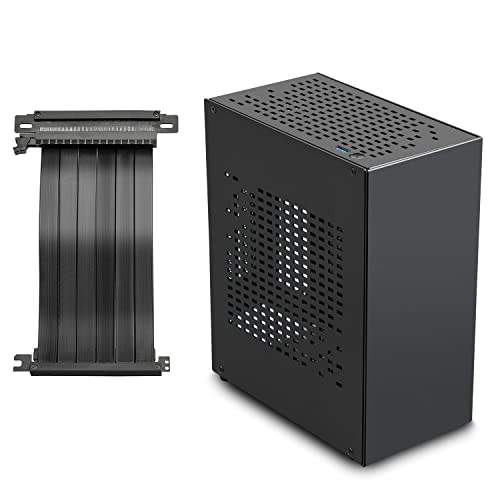
Best for: a 4.3L aluminium build you carry between two desks Skip it if: you need a standard SFX power supply
This is the most expensive pick here and the smallest by a wide margin: 8.78 x 7.24 x 4.09 in on the listing, described as 4.3L. JOYJOM specifies 2.0mm aluminium alloy for the body, thicker than the 1.0 to 1.2mm steel of the RGEEK pair and more than triple the 0.6mm sheet of the two T.F.SKYWINDINTL cases.
It's also the only pick in this set that includes the PCIe 3.0 riser cable, listed at 18.5cm, rather than making you source one. Supported parts are a standard 170 x 170mm ITX board, a FLEX 1U power supply at 15 x 4 x 8cm, a graphics card up to 170 x 100 x 40mm and a 2.5 in drive.
Two things to weigh. The FLEX 1U power supply requirement is the narrowest PSU format in this comparison, and those units are typically small-fan designs that get loud under load, which cuts against the quiet-office goal. And no maximum CPU cooler height is published anywhere in the listing, so you're sizing that by the 4.09 in external width and hoping.
Against the T40, you gain portability and lose GPU length, PSU choice and any published warranty.
Pros:
- Smallest here at 4.3L and 8.78 x 7.24 x 4.09 in
- 2.0mm aluminium body, thickest material in this set
- PCIe 3.0 riser cable included, 18.5cm
- 2.51 lb, genuinely portable between desks
Cons:
- No published CPU cooler height limit
- FLEX 1U power supply requirement, hardest format to source and often noisy
- No warranty stated
- Most expensive pick here despite the fewest published specifications
4. RGEEK Mini ITX PC Case, Small Form Factor Computer Case — Best warranty
Takes a 300mm graphics card in a slim 8.46 in profile, the only pick here that pairs near-full-length GPU support with a compact chassis.

Best for: a longer 300mm GPU in a slim horizontal chassis Skip it if: your cooler is taller than 60mm
The T60 is the T40's stretched sibling. RGEEK lists 315 x 135 x 215mm, with GPU support to 300mm, a 60mm cooler limit and dual 120mm top fan mounts. That 300mm figure is second only to the Q300L, and it comes in a chassis measuring 8.46 x 12.4 x 12.4 in.
Storage is the T60's real differentiator. The listing describes one 3.5 in or 2.5 in bay in the GPU compartment when you're running integrated or a short ITX card, plus a separate fixed 2.5 in mount. Among these six, that's the most flexible drive arrangement published, and it matters if you keep local project archives rather than working entirely from cloud storage.
Front I/O covers USB 3.0 and USB 2.0. Build is 1.0 to 1.2mm steel with adhesive top and bottom dust filters included. Warranty is 6 months, matching the T40 and beaten only by the Q300L.
The 60mm cooler ceiling is the problem, and it's 10mm tighter than the T40's for a chassis that's physically larger. You get GPU length and drive bays in exchange for accepting a smaller, faster CPU fan.
Pros:
- 300mm GPU support in a slim 8.46 in chassis
- Most flexible drive layout here: 3.5 in plus 2.5 in options
- Dual 120mm top fan mounts
- Dust filters top and bottom, included
Cons:
- 60mm cooler ceiling, tightest of the GPU-capable picks
- Riser cable required for a discrete card, not supplied
- 12.4 in depth is not much slimmer than the Q300L
- 6 month warranty only
5. T.F.SKYWINDINTL Mini ITX HTPC Case SFF Small Form Factor — Best upgrade
The only pick here designed to mount behind your monitor and run off an external power brick, which removes a fan from the room entirely.

Best for: mounting behind a monitor with an external power brick Skip it if: you want a discrete graphics card
At 7.48 x 8.35 x 2.36 in, the M09 is the flattest chassis in this comparison. T.F.SKYWINDINTL lists internal dimensions of 212 x 60 x 190mm, two 6cm WiFi antenna ports, and the ability to mount behind a monitor.
The interesting design decision is power. The listing describes a DC-ATX power module rated at 300W or less plus an external adapter, which the maker says eliminates the power supply cooling fan. For a home office, that's a real acoustic argument: one less fan inside the box, and the brick sits on the floor. It's also why I've placed this above the M05 despite both sharing a 36mm cooler limit.
Build is 0.6mm SPCC steel. The listing notes the cooler ceiling drops to 29mm once you fit a 7mm 2.5 in drive, and storage is a single 2.5 in bay.
This is an integrated-graphics machine, full stop. No GPU support, no riser, no room. Against the M05 you gain the monitor mount, the antenna ports and the fanless-PSU approach for a small step up in price position.
Pros:
- Flattest here at 2.36 in thick, mounts behind a monitor
- External adapter design removes the PSU fan
- Two 6cm WiFi antenna ports built in
- 0.6mm SPCC steel resists deformation better than plastic
Cons:
- No discrete graphics support at all
- 36mm cooler limit, dropping to 29mm with a drive fitted
- Single 2.5 in drive bay only
- No warranty stated
6. T.F.SKYWINDINTL Mini ITX Case SFF Small Form Factor 0.6mm — Best budget pick
The cheapest of the six and a straightforward shelf box for an integrated-graphics office build, provided your cooler is under 36mm.

Best for: an integrated-graphics office box on a shelf Skip it if: your CPU cooler is taller than 36mm
The M05 is the entry point. It measures 7.56 x 8.07 x 2.36 in, weighs 1.85 lb, takes a 170 x 170mm ITX board and runs from a laptop-style AC adapter rather than an internal power supply. Like the M09, it's a single 2.5 in drive and no discrete GPU.
T.F.SKYWINDINTL positions it as an HTPC that disappears onto a TV shelf or into a closet. That framing translates cleanly to a home office: it sits under a monitor arm or beside a router and stops being visible. Material is 0.6mm SECC, described as anti-rust and compression resistant.
The 36mm cooler ceiling is the hard limit, and it's the tightest figure published in this set alongside the M09. At that height you're on a stock or low-profile cooler with a small fan, so pair it with a low-power CPU rather than anything you plan to load for hours.
Against the M09, you lose the monitor mount and the WiFi antenna ports. What you keep is the lowest price position here, and a chassis that does exactly one job.
Pros:
- Cheapest of the six
- 1.85 lb and 2.36 in tall, disappears on a shelf
- Runs from a laptop-style AC adapter, no internal PSU fan
- 0.6mm SECC with anti-rust treatment
Cons:
- 36mm cooler ceiling, joint-tightest here
- No discrete graphics support
- Single 2.5 in drive, no 3.5 in option
- Warranty listed as none
Cooler clearance, litre for litre: the real trade-off
Small cases don't get quieter as they shrink. They get louder, because the fans get smaller and have to work harder for the same airflow. Watch how the two figures move together across this set.
- Cooler Master Q300L V1: 15.4 in deepest side, 159mm clearance
- RGEEK T60: 12.4 in, 60mm clearance
- RGEEK T40: 10.2 in, 70mm clearance
- JOYJOM: 8.78 in, no published clearance
- T.F.SKYWINDINTL M09: 8.35 in, 36mm clearance
- T.F.SKYWINDINTL M05: 8.07 in, 36mm clearance
The T40 is the interesting outlier. It's physically smaller than the T60 on every axis yet publishes 10mm more cooler room, because the cube layout stacks components differently. That's the exception that proves the rule: layout beats raw volume, and the only way to know is to read the published clearance rather than the litre count.
If your work is document-heavy and your CPU rarely exceeds a light load, a 36mm cooler is survivable. If you compile, render, or run long video calls with background processing, the 159mm and 70mm figures are where the best mini ITX PC case for remote workers decision actually lands.
Does a small case mean a quiet desk?
Not automatically, and two picks here show why the answer depends on the power supply rather than the chassis.
The Q300L takes a 160mm standard ATX unit. Those use 120mm or 140mm fans that idle almost silently. The JOYJOM requires a FLEX 1U supply at 15 x 4 x 8cm, and that format is defined by a very small, very fast fan. Same category, opposite acoustic outcome.
The M05 and M09 sidestep the question entirely by putting the power supply outside the case as an adapter. One fewer fan in the room. For a home office where the machine sits within arm's reach, that's a bigger practical win than most spec sheets suggest.
None of these listings publishes a noise figure, so treat every claim about airflow and heat dissipation as the maker's own wording. What you can verify before ordering is the power supply format the case requires, the maximum fan diameter it will accept, and whether dust filters are included. The RGEEK pair both include top and bottom filters. Clogged filters are a slow acoustic problem, and cases without them get dustier faster.
What the listings leave out
Six listings, and the gaps are consistent enough to be worth naming.
Riser cables. Both RGEEK picks require a 20cm double-reverse PCIe riser for a discrete GPU and neither includes it. Only the JOYJOM ships one. Budget for the part and check the direction and generation carefully.
Cooler clearance on the JOYJOM. Publishes material thickness, volume and riser length, but no CPU cooler height. That's the single most important number in this category and it's absent.
Warranty. One pick publishes 2 years. Two publish 6 months. Three publish nothing, with two listing "non" outright.
Fans. None of these listings states that fans are included. Assume you're buying them separately and size them to the mounts described: five positions on the Q300L, dual 120mm on the T60.
Anything about remote work. No listing here mentions call quality, sustained office loads, or noise at a desk. That connection is inference from published clearances, not a manufacturer claim, and I'd rather say so than pretend otherwise.
The verdict
The Cooler Master Q300L V1 is the winner because it's the only pick here that lets you build a genuinely quiet machine without hunting down exotic parts. A 159mm cooler ceiling means a full 120mm air tower. A 160mm PSU bay means a standard ATX supply with a slow, large fan. A 360mm GPU limit means almost any card you'd want. Add the only published two-year warranty in this set, and the case for it is straightforward.
Two conditions flip that recommendation. First, desk space: if you can't give up 15 x 15.4 in of surface, the RGEEK Metalfish T40 gets you down to a 10.2 in cube while keeping 70mm of cooler room and SFX power supply support, which is the second-best acoustic position here by a clear margin. Second, portability: if the machine moves between two locations, the JOYJOM's 4.3L aluminium body and 2.51 lb weight are the only figures in this comparison that make that practical, and the included riser cable saves you a purchase.
The T40's exact advantage over the Q300L is footprint per unit of capability. It surrenders 89mm of cooler clearance and 154mm of GPU length to reclaim roughly half the desk area. That's a fair trade for a small desk and a bad one for a big one.
FAQ
Is a mini ITX PC case for remote workers worth it over a laptop?
A mini ITX PC case for remote workers is worth it if you want repairable, upgradeable hardware at your desk. You get a full-size CPU cooler, real drive bays, and the option of a discrete GPU. The Q300L's 159mm cooler clearance alone allows quieter operation than most thin laptops manage under sustained load.
What size CPU cooler fits the smallest cases here?
The size CPU cooler that fits the smallest cases here is very limited: both T.F.SKYWINDINTL picks cap at 36mm, and the M09 drops to 29mm once a 7mm 2.5 in drive is installed. That means a low-profile or stock cooler with a small fan. Pair either with a low-power CPU rather than a high-wattage chip.
Cooler Master Q300L or RGEEK Metalfish T40 for a home desk?
Cooler Master Q300L or RGEEK T40 comes down to desk depth. The Q300L needs 15.4 in and rewards you with 159mm cooler clearance, 360mm GPU support and a standard ATX power supply. The T40 fits a 10.2 in cube, keeps 70mm of cooler room, and takes SFX supplies. Deep desk, Q300L. Tight desk, T40.
Which of these cases gives the most capability for the least money?
The most capability for the least money in this set is the RGEEK Metalfish T40. It sits below the two premium picks in price position while publishing more usable specifications than either: 70mm cooler clearance, 206mm GPU support, SFX and SFX-L compatibility, front USB 3.0 and audio, and dust filters included in the box.
Do I need a riser cable for a graphics card in these cases?
You need a riser cable for a graphics card in three of these six. Both RGEEK picks specify a 20cm double-reverse PCIe riser that isn't supplied. The JOYJOM includes an 18.5cm PCIe 3.0 riser. The Q300L needs none, and the two T.F.SKYWINDINTL cases don't support discrete cards at all.
Start with a tape measure, not a shopping cart. Measure the depth you can actually give up behind your monitor, then read the published cooler clearance for anything that fits, and take the largest figure available. That order of operations puts most home-office buyers on the Cooler Master Q300L V1, because 159mm of clearance is the difference between a machine you forget is running and one you hear on every call. If the tape says you have less than 15 in to spare, drop to the RGEEK Metalfish T40 and accept a slightly smaller fan. Either way, the number to check is height, not litres.