Best RGB Airflow PC Case for a Mesh-Front Build

Fan count is the wrong place to start when you shop RGB airflow cases. Panel design, internal volume and mounting flexibility decide how cool your build runs. Five cases compared on published specifications.

By Samuel HarrisUpdated 16 min read
On this page
- Best rgb airflow pc case at a glance
- How I narrowed the field to five
- 1. CORSAIR 4000D RS ARGB Frame Modular Mid-Tower ATX PC Case — Best overall
- 2. Lian Li V100-ATX Mid-Tower PC Case — Best lightweight
- 3. CORSAIR AIR 5400 RS ARGB Triple-Chamber Panoramic — Best premium
- 4. Fractal Design Pop XL Air RGB Black Tempered Glass Clear — Most versatile
- 5. MOROVOL PC Case Pre-Install 4 RGB Fans — Best budget pick
- Does fan count decide how cool a case runs?
- Which RGB airflow PC case fits your GPU?
- Front, top or side: where should the fans go?
- What more money buys in this set
- What the listings leave out
- The verdict
- FAQ
The best RGB airflow PC case is the CORSAIR 4000D RS ARGB, because its steel InfiniRail mounting system lets you move the three pre-installed RS ARGB fans instead of living with a fixed layout. If your graphics card is long, the Lian Li V100-ATX is the better buy, with support quoted to 420 mm and a body that weighs just 18.1 lb.
Most buyers shop this category by counting fans. Four beats three, so the four-fan case wins. That comparison collapses the moment you look at where those fans can go, how open the front panel actually is, and how much internal volume the air has to move through. Two of these cases ship four fans and are still outclassed on airflow structure.
Best rgb airflow pc case at a glance
| Pick | Pre-installed fans | Max GPU length | Price |
|---|---|---|---|
| 3x RS ARGB PWM | Not listed 19.1 in deep body |
Check Price | |
Best lightweight Lian Li V100-ATX Mid-Tower PC Case |
4x 120 mm ARGB | 420 mm claim | Check Price |
| RS ARGB array | Not listed 13.4 in wide body |
Check Price | |
Most versatile Fractal Design Pop XL Air RGB Black Tempered Glass Clear |
4x 120 mm Aspect RGB | Not listed 20.5 in deep body |
Check Price |
Best budget pick MOROVOL PC Case Pre-Install 4 RGB Fans |
4x 120 mm RGB | 300 mm claim | Check Price |


How I narrowed the field to five
I weighted four criteria, in this order, and the order matters more than the list.
- Mounting flexibility, weighted heaviest. A case that lets you relocate fans keeps working when you switch from air to a 360 mm radiator. A fixed tray does not.
- Published clearance figures. GPU length, cooler height and radiator support are the numbers that decide whether your parts physically fit.
- Front panel structure. Mesh geometry is what turns fan RPM into actual intake.
- Body size and weight. Internal volume affects how much air can move; weight affects whether you dread moving it.
Why that order? Because fan count and lighting are the easiest things to add later and the hardest specifications to fake. Any of these five can hold six RGB fans eventually. Only some of them let you decide where those fans sit. That is why the CORSAIR 4000D RS ARGB leads with three pre-installed fans instead of four, and why the MOROVOL sits last despite matching the Lian Li on fan count.
Cases that publish no clearance figures at all were cut. Every pick here gives you at least a full exterior dimension set, and three give a stated warranty of two years.
1. CORSAIR 4000D RS ARGB Frame Modular Mid-Tower ATX PC Case — Best overall
The only case here whose fan mounting is designed to be rearranged rather than reused as-is.
Best for: builders who want to change the fan layout later Skip it if: you need the shortest possible depth on a desk
Three of these five cases weigh over 22 lb. This one sits at 22.7 lb across a 19.1 x 19.2 x 9.41 in body, which puts it in the middle of the set on both counts. That is the sweet spot for a mid-tower. Corsair describes the InfiniRail system as a steel multi-point mounting arrangement for the front and roof, with the stated aim of flexible fan configuration. Three RS ARGB PWM fans come pre-installed in the front, and Corsair says they daisy-chain over 4-pin PWM and support a Zero RPM mode.
The front panel claim is worth reading carefully. Corsair calls it a 3D Y-pattern perforated steel panel, described as a low-obstruction intake path. Steel mesh with a three-dimensional pattern is the structural approach that separates a real airflow case from a case with holes cut in it.
Then there's the side. Corsair says the internal panel near the motherboard tray works as a cable cover, or comes out so you can mount fans there instead. That's a genuine choice between a clean build and extra intake, and no other pick here offers it.
The trade-off against the Lian Li is depth. At 19.1 in front to back, this case needs more desk than the V100-ATX, and it ships one fewer fan.
Pros:
- Steel InfiniRail mounting for front and roof fans
- Removable inner panel doubles as side fan mount
- 2-year manufacturer warranty, matching the longest here
- Fans support daisy-chained 4-pin PWM per Corsair
- 22.7 lb, lighter than two picks in this set
Cons:
- Three pre-installed fans, one fewer than three rivals
- No GPU or cooler clearance figure published
- Only two sellers list it
- Deeper body than the lightweight Lian Li pick
2. Lian Li V100-ATX Mid-Tower PC Case — Best lightweight
The lightest case here at 18.1 lb, and the only one publishing a 420 mm GPU figure.

Best for: long GPUs in a case you have to move often Skip it if: you want more than a one-year warranty
At 18.1 lb, this is nearly 13 lb lighter than the AIR 5400 and almost 7 lb under the Pop XL Air. The body measures 19.1 x 17.6 x 9.25 in, so it's the shallowest of the four full mid-towers, and it still lists four pre-installed 120 mm ARGB fans with daisy-chain wiring.
The clearance figures are the reason to buy it. Lian Li quotes GPU support to 420 mm, CPU coolers to 178 mm and a top radiator to 360 mm. Those are the three numbers a builder actually needs, and this is the only pick in the set that publishes all three. A 420 mm graphics card allowance covers essentially every consumer card sold, in a chassis 17.6 in deep.
Lian Li also lists a 26-LED ARGB strip with motherboard software sync, plus support for back-connect ATX and Micro-ATX boards. Both side panels use a tool-less mounting mechanism, per the listing.
The catch is the warranty. One year is the shortest cover here, tied with the MOROVOL and half what the two Corsairs and the Fractal Design offer. There's no InfiniRail-style rail system either, so the fan positions you get are broadly the fan positions you keep.
Pros:
- Lightest pick in the set at 18.1 lb
- 420 mm GPU and 178 mm cooler clearance published
- Four ARGB fans plus a 26-LED strip
- Tool-less panels on both sides per Lian Li
- Supports back-connect ATX for cleaner routing
Cons:
- 1-year warranty, half the coverage of three rivals
- No modular fan rail system
- Shallowest body limits front radiator depth options
- Only two sellers list it
3. CORSAIR AIR 5400 RS ARGB Triple-Chamber Panoramic — Best premium
Splits CPU, GPU and PSU into three isolated chambers so hot air is never recycled.

Best for: a hot CPU and a hot GPU that should not share air Skip it if: 13.4 in of width will not fit your desk
This case takes a different structural approach from every other pick. Corsair describes three isolated chambers: a front chamber holding a 360 mm radiator for the CPU, a central chamber for the GPU and motherboard, and a third for the power supply, storage and cables. Corsair states the third chamber has its own dedicated intake and exhaust points, and that the CPU chamber's heat does not reach the others.
That layout has a physical cost. The AIR 5400 measures 18.4 x 18.5 x 13.4 in and weighs 30.7 lb, making it the widest and the heaviest pick here. It's the most expensive of the five too. You are paying for internal volume and separation, not for a longer specification sheet.
Corsair also cites an airflow duct on the bottom fan array, described as accelerating air by forcing it into a narrow channel. That is a claim about velocity rather than raw volume, and it fits the central chamber's stated vertical airflow design.
Against the 4000D RS, the trade is flexibility for isolation. You get 8 lb of extra chassis and 4 in of extra width, and you give up the InfiniRail rearrangement. No GPU or cooler clearance figure is published either.
Pros:
- Three isolated chambers for CPU, GPU and PSU
- Dedicated 360 mm CPU radiator chamber per Corsair
- Separate intake and exhaust for the PSU chamber
- 2-year manufacturer warranty
- Airflow duct on the bottom fan array
Cons:
- Heaviest pick at 30.7 lb
- 13.4 in width, over 4 in wider than three rivals
- Most expensive case in this comparison
- No published GPU or cooler clearance numbers
4. Fractal Design Pop XL Air RGB Black Tempered Glass Clear — Most versatile
The only pick that takes E-ATX boards and up to four HDDs plus six SSDs.

Best for: E-ATX boards plus four hard drives and six SSDs Skip it if: you have a compact desk or a small shelf
This is the odd one out, and deliberately so. It's an XL-ATX chassis at 20.5 x 20.6 x 9.06 in, the tallest and deepest pick in the set, and the only one whose listing quotes E-ATX support up to 280 mm alongside ATX, mATX and Mini-ITX.
Storage is where it separates from the rest. Fractal Design lists up to four HDDs and six SSDs, dropping to three HDDs and five SSDs with an optical bay in use. Nobody else here publishes anything close. If you're building a workstation that games, or a media server with a window, this is the shape that suits it.
Four 120 mm Aspect RGB fans come pre-installed, with support quoted for two more to a total of six. Radiator support is listed as 360 mm front, 280 mm top and 140 mm rear. The tempered glass side panel has a clear tint and Fractal Design describes it as easily mounted.
It's also the oldest design here, released in 2022, against 2025 for three of the other picks. The warranty runs two years, matching both Corsairs. The real cost is footprint: 25 lb and a 20.6 in height mean this needs floor space, not desk space.
Pros:
- E-ATX support up to 280 mm, unique in this set
- Four HDD and six SSD bays published
- Four Aspect RGB fans with room for six total
- Radiator support quoted front, top and rear
- 2-year warranty
Cons:
- Largest footprint at 20.5 x 20.6 in
- Oldest design in the set, from 2022
- 25 lb, second heaviest here
- Only one seller lists it
- Premium price position without modular fan rails
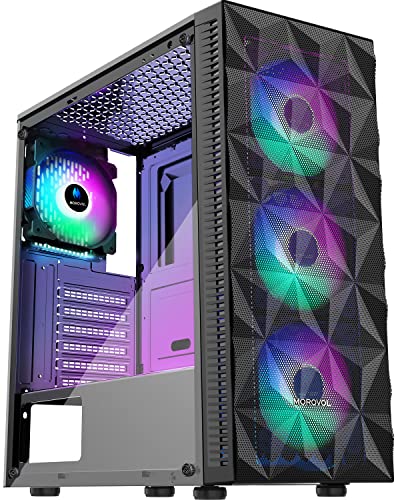
5. MOROVOL PC Case Pre-Install 4 RGB Fans — Best budget pick
Four RGB fans and a diamond mesh front in the cheapest and smallest chassis here.
Best for: a first build on a tight budget with a short GPU Skip it if: your graphics card is longer than 300 mm
This is the cheapest of the five and the only one under 17 in in any exterior dimension. At 16.7 x 14.6 x 7.28 in it's markedly smaller than everything else here, which is both the appeal and the constraint.
MOROVOL lists four pre-installed 120 mm RGB fans and describes them as fixed RGB lighting capable. Read that phrase closely. Fixed lighting is not the addressable ARGB the Lian Li and both Corsairs claim, so per-fan colour control from your motherboard software is not on the table. The listing also specifies a diamond-shaped mesh front panel with a stereo contour, which is the right idea for intake.
Clearances are published and they are the tightest here: GPU up to 300 mm, PSU up to 160 mm, CPU cooler height up to 155 mm. Board support covers ATX, Micro-ATX and Mini-ITX. The I/O panel lists one USB 3.0 port and two USB 2.0 ports.
That 300 mm GPU figure is 120 mm shorter than the Lian Li's claim, and it rules out a lot of current graphics cards. Warranty is listed at one year. This is a sound starting chassis for a modest build, not a home for a flagship card.
Pros:
- Cheapest pick in this comparison
- Four 120 mm RGB fans pre-installed
- Diamond mesh front panel for intake
- Smallest footprint at 16.7 x 14.6 in
- GPU, PSU and cooler clearances all published
Cons:
- Fixed RGB rather than addressable per-fan control
- 300 mm GPU limit, tightest in the set
- 155 mm cooler height ceiling
- 1-year warranty
- No published weight figure
Does fan count decide how cool a case runs?
No, and this is the single most common mistake in the category. Fan count decides how much lighting you get out of the box. Airflow is decided by three things the fan count never tells you.
- Panel restriction. A fan behind a solid panel with slots moves a fraction of its rated air. Corsair's Y-pattern perforated steel and MOROVOL's diamond mesh are both attempts to solve this.
- Internal volume. Air needs somewhere to go. The AIR 5400's 13.4 in width and the Pop XL Air's 20.6 in height buy room that a compact chassis cannot.
- Path structure. Corsair's isolated CPU chamber and its bottom airflow duct are both about directing air, not adding it.
Here's the practical test. If two cases ship the same four fans and one is 16.7 in deep while the other is 20.5 in deep, the larger one has a longer, straighter path from intake to exhaust. That matters more than the fourth fan.
The takeaway: in the best rgb airflow pc case, panel geometry and internal volume come first, and fan count is what you top up afterwards.
Which RGB airflow PC case fits your GPU?
This is the specification that ends builds, so check it before anything else. Only two picks here publish a GPU length figure at all.
The Lian Li V100-ATX quotes 420 mm, which comfortably clears any consumer card. The MOROVOL quotes 300 mm, which does not clear many current flagship cards. That is a 120 mm gap between two cases that both ship four RGB fans.
For the three picks without a published number, use the body depth as a rough sanity guide and confirm with the manufacturer before you buy. The 4000D RS is 19.1 in deep, the AIR 5400 is 18.4 in, and the Pop XL Air is 20.5 in.
Cooler height matters just as much for air cooling. Lian Li lists 178 mm and MOROVOL lists 155 mm, a 23 mm gap that separates a large dual-tower cooler from a mid-size one. Radiator support is published for three picks: 360 mm front on both the Pop XL Air and the AIR 5400's CPU chamber, and 360 mm top on the Lian Li. Measure the card you own, not the card you plan to buy.
Front, top or side: where should the fans go?
Intake at the front, exhaust at the top and rear, is the default that works in every case here. Where the picks differ is how much you can deviate from it.
The 4000D RS is the flexible one. Corsair's InfiniRail is described as a steel multi-point system covering front and roof positions, and the inner panel near the motherboard tray comes out so you can mount fans on the side instead of using it as a cable cover. That's three surfaces you can configure.
The AIR 5400 makes the decision for you, and that's the point. Corsair separates the CPU radiator into its own front chamber and drives vertical airflow through the central GPU chamber, with the PSU chamber given its own intake and exhaust. You don't rearrange it because the layout is the product.
The Pop XL Air sits between the two: four fans installed, two more positions available to reach six, and radiator mounts quoted at three locations. The Lian Li and MOROVOL are more fixed, though the Lian Li's 360 mm top radiator support gives you a real water-cooling route.
If you plan to switch cooling methods within two years, buy the case with rails.
What more money buys in this set
Spending more here does not buy more fans. It buys structure. Here's how the three tiers break down.
The cheaper end. The MOROVOL and the Lian Li V100-ATX both sit at the entry position, and they behave very differently. MOROVOL gives you four fans, a mesh front and tight clearances in the smallest body. The Lian Li gives you four addressable fans, a 26-LED strip, 420 mm of GPU room and 18.1 lb of chassis, which is remarkable value for the second-cheapest pick.
The middle. The 4000D RS is the third-cheapest, and the money goes into the InfiniRail rail system, the removable inner panel and the 3D Y-pattern steel front. This is the tier where fan positioning becomes yours to choose, and it comes with a two-year warranty.
The top. The Pop XL Air and the AIR 5400 are the two most expensive picks. Fractal Design's money buys volume and storage: E-ATX up to 280 mm, four HDDs, six SSDs. Corsair's buys thermal isolation: three chambers, a dedicated 360 mm CPU radiator bay, and an airflow duct on the bottom array. Both carry two-year warranties. Neither ships more fans than the entry pair.
The pattern is consistent. Money buys the case, not the fans.
What the listings leave out
Three of these five publish no GPU clearance number. That's the figure builders need most, and it's absent from the 4000D RS, the AIR 5400 and the Pop XL Air listings. Check with the manufacturer before ordering if your card is long.
Airflow itself is never quantified. No listing here states CFM, static pressure or a decibel figure for the pre-installed fans. Corsair mentions a Zero RPM mode on the RS ARGB fans, which implies low-noise behaviour at low load, but that's a mode name and not a measurement.
The MOROVOL listing gives no weight figure at all, which makes it the only pick you can't compare on chassis mass. And "fixed RGB lighting capable" is doing quiet work in that same listing: it signals non-addressable lighting, which is a real functional difference from the ARGB the other four claim.
Fan headers are another gap. Daisy-chaining is mentioned by both Corsair and Lian Li, but no pick states how many motherboard headers or hubs the setup consumes. Assume you will need a controller or a splitter for a six-fan build.
The verdict
If you want one case that stays useful across two or three upgrade cycles, the CORSAIR 4000D RS ARGB is the best rgb airflow pc case here. The InfiniRail steel mounting system and the removable inner side panel mean the fan layout you start with is not the fan layout you're stuck with, and the 3D Y-pattern perforated front is a genuine airflow structure rather than a decorative grille. Two-year warranty, 22.7 lb, and a 19.1 x 19.2 x 9.41 in body that fits a normal desk.
If you own a long graphics card or you move your machine regularly, the Lian Li V100-ATX is the better buy. Its exact advantage is published clearance: 420 mm GPU, 178 mm cooler, 360 mm top radiator, in a chassis weighing 18.1 lb. No other pick states all three, and none is lighter.
The cutoff between them is 300 mm of graphics card. Below that, either case works and the 4000D RS's rail system wins on longevity. Above it, buy the Lian Li and accept the one-year warranty. Above 420 mm, or if you need E-ATX and six SSD bays, step up to the Fractal Design Pop XL Air instead.
FAQ
Is a best rgb airflow pc case worth paying extra for?
A best rgb airflow pc case is worth extra spend only when the money buys structure. In this set, the premium picks add thermal isolation and storage bays, not fans. The entry pair already ships four fans each. If you want a case that adapts to future cooling, pay for the mounting system in the middle tier instead.
How many RGB fans do I actually need in an airflow case?
How many RGB fans you need depends on your parts, not the case. Three well-placed intakes behind an open mesh panel beat four behind a restrictive one. Four of these five picks ship with four or fewer fans, and the Fractal Design Pop XL Air supports six total. Start with what's installed and add only if temperatures require it.
Will a 360 mm radiator fit in these RGB airflow PC cases?
A 360 mm radiator fits in three of these picks according to their listings. Fractal Design quotes 360 mm in the front of the Pop XL Air, Lian Li quotes 360 mm on the top of the V100-ATX, and Corsair states the AIR 5400 holds a 360 mm radiator in its dedicated CPU chamber. Confirm thickness and fan stack height separately.
CORSAIR 4000D RS ARGB or Lian Li V100-ATX?
Choose the CORSAIR 4000D RS ARGB for its InfiniRail steel fan rails, removable inner panel and two-year warranty. Choose the Lian Li V100-ATX for published clearances of 420 mm GPU and 178 mm cooler, plus the lightest body here at 18.1 lb. The Corsair wins on flexibility, the Lian Li on fitting large hardware.
What is the biggest mistake buyers make with RGB airflow cases?
The biggest mistake is buying on fan count and lighting, then discovering the graphics card does not fit. Clearance figures vary hugely: 300 mm on the MOROVOL against 420 mm on the Lian Li. Measure your card, cooler and radiator first. Lighting can be added to any chassis. Extra internal length cannot.
Start by measuring the graphics card and CPU cooler you already own, then compare those two numbers against the clearances published above. That single step eliminates most of the buying regret in this category. The CORSAIR 4000D RS ARGB earns the default recommendation not because it ships the most fans, since it ships the fewest here, but because it is the only pick that expects you to change your mind about cooling later and gives you the steel rails to do it. Buy the chassis that survives your next upgrade.