Best Thunderbolt External SSD by Speed and Rating

Seven external SSDs ranked for creators who move 4K footage and RAW libraries. Real interface differences, honest speed ceilings, and which drive actually earns the Thunderbolt-class label.

By Samuel HarrisUpdated 17 min read
On this page
- Which interface does your work actually need?
- Best thunderbolt external SSD for content creators at a glance
- How I cut seven drives down to a ranking
- 1. SANDISK 1TB Creator Phone SSD — Best overall
- 2. Corsair EX400U Survivor 2TB USB4 External SSD — Best warranty
- 3. Sandisk 2TB Extreme Portable SSD — Best upgrade
- 4. OSCOO 1TB External Hard Drive — Best budget pick
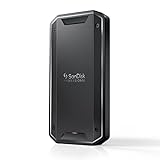
- 5. SANDISK Professional 4TB PRO-G40 SSD — Best minimal setup
- 6. Samsung T7 Portable SSD 1TB Titan Gray — Best for pros
- 7. OWC Express 1M2 80G 8TB USB4 80Gb/s Portable NVMe SSD — Best premium
- Does the Thunderbolt label match the port you own?
- What more capacity really buys a creator
- When a different drive wins
- The verdict
- FAQ
The best thunderbolt external SSD for content creators is the SANDISK 1TB Creator Phone SSD, a 1.9 oz drive rated up to 1,000 MB/s that clips to a MagSafe phone and takes a five-year warranty. If you shoot on a laptop with a USB4 port and want the fastest raw throughput here, the Corsair EX400U Survivor 2TB claims up to 4,000 MB/s instead. Both are 2025 drives. One wins on portability, one on speed.
Which interface does your work actually need?
Here is the thing most guides skip. The interface on the box decides your real transfer time, not the "MB/s" number in the headline. These seven drives split into three groups, and the group matters more than the brand.
The interface is the socket standard your cable and port speak. USB 3.2 Gen 2 tops out around 10Gbps. USB4 and Thunderbolt reach up to 40Gbps. That gap is real. A USB4 drive can move a folder four times faster than a Gen 2 drive on the right port.
- Gen 2 group (about 10Gbps): the SANDISK Creator Phone SSD, the Sandisk 2TB Extreme, the Samsung T7, and the OSCOO.
- Thunderbolt/USB4 group (up to 40Gbps): the Corsair EX400U Survivor and the SANDISK Professional PRO-G40.
- USB4 80Gbps outlier: the OWC Express 1M2 80G, which claims over 6,000 MB/s peak real-world speed.
So why does the Gen 2 SanDisk win overall for the best thunderbolt external SSD for content creators shortlist? Because most creators are recording to a phone or a mirrorless body over USB-C, where 1,000 MB/s is already faster than the camera writes. The fastest interface only pays off when your host and your footage can feed it.
Best thunderbolt external SSD for content creators at a glance
| Pick | Interface & speed | Capacity | Price |
|---|---|---|---|
Best overall SANDISK 1TB Creator Phone SSD |
USB 3.2 Gen 2 1,000 MB/s claim |
1TB | Check Price |
Best warranty Corsair EX400U Survivor 2TB |
USB4 40Gbps 4,000 MB/s claim |
2TB | Check Price |
Best upgrade Sandisk 2TB Extreme Portable |
USB 3.2 Gen 2 1,050 MB/s claim |
2TB | Check Price |
Best budget pick OSCOO 1TB External SSD |
USB 3.2 Gen 2 2,100 MB/s claim |
1TB | Check Price |
Best minimal setup SANDISK Professional 4TB PRO-G40 |
Thunderbolt 3 40Gbps 3,000 MB/s claim |
4TB | Check Price |
Best for pros Samsung T7 1TB Titan Gray |
USB 3.2 Gen 2 1,050 MB/s claim |
1TB | Check Price |
Best premium OWC Express 1M2 80G 8TB |
USB4 80Gbps 6,000 MB/s claim |
8TB | Check Price |






How I cut seven drives down to a ranking
I started with a disqualification test, not a wish list. Three cuts shaped this ranking before I compared anything else.
- No published capacity option, cut. Every drive here states its size, from 1TB up to 8TB. A listing that hides capacity behind vague marketing does not make the set.
- No stated durability or warranty, downranked. A creator drops gear. I favoured drives with an IP rating and a long warranty, and I noted where a listing skipped one.
- Speed claims read as manufacturer claims, never as measured results. Every "MB/s" here is what the brand states. I compared the numbers, but I did not treat them as tested truth.
After the cuts, I lined up the published specifications side by side: interface, rated speed, capacity, weight, warranty length, and any water or dust rating. Then I mapped each survivor to a buyer.
- The two USB4/Thunderbolt drives went to speed-first editors.
- The Gen 2 drives went to phone and camera shooters.
- The 8TB OWC went to anyone filling a drive faster than they can offload it.
The result is a ranking by fit, not by raw number. A drive that claims 6,000 MB/s is not the best pick for a creator whose phone tops out well below that.
1. SANDISK 1TB Creator Phone SSD — Best overall
The Creator Phone SSD wins because it matches the way most creators actually shoot: straight to an external over USB-C, at a speed the camera can keep up with.
Best for: phone-first shooters recording ProRes to an external Skip it if: you need more than 2TB in one drive
This is a 2025 drive built around a real workflow. At 1.9 oz and 0.43 x 3.25 x 2.7 in, it clips to a MagSafe phone and rides along while you record. SanDisk says it hits up to 1,000 MB/s read and 950 MB/s write over USB 3.2 Gen 2, which is faster than an iPhone writes ProRes. That headroom is the point.
Compatibility is the other reason it leads. SanDisk lists Windows 10+, macOS 14+, iOS/iPadOS 17+, and Android 14+, so it moves between your phone, tablet, and edit machine without fuss. The IP65 claim covers water and dust for field use. A five-year limited warranty backs it, longer than the Samsung T7's three.
The trade-off is capacity and interface. This drive tops out at 2TB and speaks Gen 2, not Thunderbolt, so a laptop editor moving huge libraries will hit its 1,000 MB/s ceiling sooner than they would on the Corsair or the PRO-G40. For phone and camera creators, that ceiling rarely bites.
Pros:
- Up to 1,000 MB/s read claim over Gen 2
- MagSafe-compatible for USB-C phone shooting
- Five-year limited warranty, longest tier here
- IP65 water and dust resistance claim
- Light 1.9 oz body, pocketable at 0.43 in thick
Cons:
- Gen 2 interface, not Thunderbolt speed
- Caps at 2TB, no larger option
- Only one seller lists it
- Write speed trails the USB4 drives
2. Corsair EX400U Survivor 2TB USB4 External SSD — Best warranty
The Corsair pairs the fastest sensible interface here with a sealed shell and a five-year warranty, which makes it the drive to grab when speed and survival both matter.

Best for: creators who want USB4 speed and a rugged shell Skip it if: your laptop has no USB4 or Thunderbolt 4 port
This is where the interface gap starts to pay off. Corsair says the EX400U Survivor reaches up to 4,000 MB/s read and 3,600 MB/s write over USB4 at 40Gbps, four times the rated ceiling of the Gen 2 drives above. On a USB4 or Thunderbolt 4 host, that turns a slow folder copy into a coffee-length wait.
The build backs the speed. It weighs 2.82 oz in a 0.67 x 3.23 x 1.57 in body, and Corsair rates the housing IP55 against dust and water. One USB-C cable carries power and data, so field setup is a single plug. A five-year manufacturer warranty matches the best coverage in this set.
The catch is the port. Corsair notes maximum performance needs a USB4 or Thunderbolt 4 host. Plug it into an older Gen 2 laptop and you lose most of that 4,000 MB/s advantage, which is the exact reason it sits behind the phone-friendly SanDisk for general creators. Match it to the right port and it flies.
Pros:
- Up to 4,000 MB/s read claim over USB4
- IP55 sealed rugged housing claim
- Five-year manufacturer warranty
- Single USB-C cable for power and data
- 2TB in a compact 2.82 oz body
Cons:
- Needs USB4 or Thunderbolt 4 for full speed
- Premium price position in this set
- Only one seller lists it
- No iOS support beyond iPadOS 13+ per listing
3. Sandisk 2TB Extreme Portable SSD — Best upgrade
The Extreme Portable is the easy step from 1TB to 2TB without jumping to a premium price, and it stays the lightest drive in the whole set.
Best for: editors stepping up to 2TB without a big spend Skip it if: you want the fastest interface available
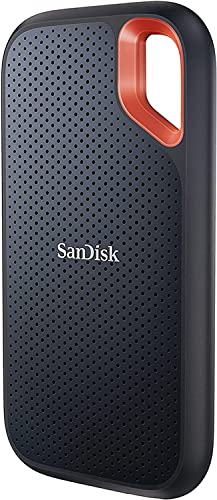
If the 1TB SanDisk feels tight, this is the natural upgrade. It carries 2TB and weighs just 1.76 oz, the lightest of all seven drives despite the extra capacity. At 0.38 x 3.97 x 2.07 in it slips into a jacket pocket, and the carabiner loop clips it to a bag or belt.
SanDisk rates it up to 1,050 MB/s read and 1,000 MB/s write, a hair above the newer Creator Phone SSD on paper. It adds up to 3-meter drop protection and an IP65 water and dust claim, plus 256-bit AES hardware encryption and password protection for private footage. A five-year limited warranty rounds it out.
This is a 2020 model, and it shows in the interface. Like the other Gen 2 drives, it tops out around 10Gbps, so it cannot touch the Corsair or OWC on raw throughput. Against the rest of the set, its trade is age for value: a proven design at a mid price, giving up cutting speed for a bigger, lighter drive.
Pros:
- 2TB capacity at a mid price position
- Lightest drive here at 1.76 oz
- Up to 1,050 MB/s read claim
- 256-bit AES hardware encryption
- Up to 3-meter drop protection claim
Cons:
- Gen 2 interface, not Thunderbolt class
- 2020 design, oldest here alongside the T7
- Speed trails the USB4 drives sharply
- Longer footprint at 3.97 in
4. OSCOO 1TB External Hard Drive — Best budget pick
The OSCOO is the cheapest of the seven and still posts the highest Gen 2 speed claim in the group, which makes it the low-risk entry drive.

Best for: new creators wanting a pocket drive for the price Skip it if: you need a published crush or drop rating
For a first external drive, this one asks the least. It is the cheapest pick here and the smallest by footprint at 0.5 x 2.88 x 0.87 in, weighing 1.7 oz. OSCOO claims up to 2,100 MB/s, the highest number among the Gen 2 drives on the list, though that figure is a manufacturer claim and real speed depends on your host.
OSCOO pitches it at creators directly, citing 4K video, RAW photos, and direct 4K 120fps HDR recording from compatible phones and cameras. The aluminium shell is described as water- and drop-proof, and it works across Windows, Mac, iPad Pro, Chromebooks, Android, Linux, PS4, PS5, and Xbox.
Two things hold it back. The listing gives no specific IP number or drop-height rating, so the "water- and drop-proof" claim is vaguer than SanDisk's IP65. And the warranty runs three years, shorter than the five-year cover on most rivals. It trades documented ruggedness and long warranty for the lowest entry price here.
Pros:
- Cheapest of the seven picks
- Up to 2,100 MB/s claim, highest Gen 2 here
- Smallest footprint at 2.88 in long
- Broad device and console compatibility
- Aluminium shell, only 1.7 oz
Cons:
- No specific IP or drop-height rating listed
- Three-year warranty, shortest in the set
- Speed claim is unverified marketing
- Only one seller lists it
5. SANDISK Professional 4TB PRO-G40 SSD — Best minimal setup
The PRO-G40 is the drive to buy when you want one cable, real Thunderbolt speed, and 4TB in a body tough enough to leave in the field.
Best for: one-cable field kits that never touch water safely Skip it if: 8TB in a single drive is the goal
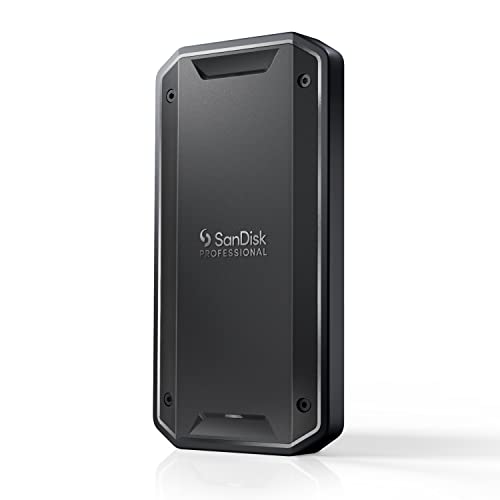
This is a proper Thunderbolt drive. SanDisk Professional rates the PRO-G40 up to 3,000 MB/s read and 2,500 MB/s write over Thunderbolt 3 at 40Gbps, and says it can move 50GB in a minute or less. It also drops to USB-C at 10Gbps, so it stays useful on machines without Thunderbolt.
Toughness is the headline. The listing claims IP68 dust and water resistance, 4,000 lb crush resistance, and 3m drop resistance, the strongest durability spec of any drive here. An aluminium core pulls heat away to hold speed during long transfers. It carries 4TB and a five-year limited warranty in a 4.32 oz body.
The compromise is size and price. At 0.47 x 4.36 x 2.28 in it is the longest of the drives short of the OWC, and it sits at a premium price position. Against the OWC it gives up half the capacity and a slower interface, but it wins on documented ruggedness and dual-mode fallback.
Pros:
- Thunderbolt 3 at up to 3,000 MB/s claim
- IP68 rating, toughest durability here
- 4,000 lb crush and 3m drop claims
- Dual-mode Thunderbolt and USB-C fallback
- 4TB with five-year warranty
Cons:
- Premium price position
- 4TB ceiling, half the OWC's capacity
- Longer body at 4.36 in
- Colour not listed on the spec sheet
6. Samsung T7 Portable SSD 1TB Titan Gray — Best for pros
The Samsung T7 is the thinnest, most proven pocket drive here, a reliable Gen 2 workhorse for creators who value slimness over the newest interface.
Best for: creators who value a thin, proven pocket drive Skip it if: you want a five-year warranty
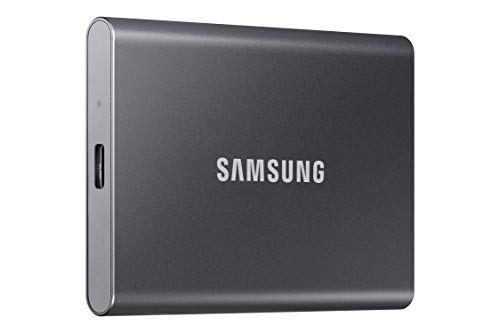
The T7 is the slimmest drive on the list at 0.3 in thick, in a 0.3 x 3.3 x 2.2 in body weighing 2.08 oz. Samsung rates it up to 1,050 MB/s read and 1,000 MB/s write over USB 3.2 Gen 2 using PCIe NVMe. It records 4K 60fps directly from a camera or phone and supports ProRes 4K at 60fps on compatible iPhones.
Its strength is that it is a known quantity. This 2020 design has been a default creator drive for years, and Samsung lists broad PC and mobile compatibility. For a shooter who just wants a thin, dependable 1TB drive that slides into a shirt pocket, it delivers exactly that.
Two gaps hold it in sixth. The warranty is three years, matching the OSCOO and trailing the five-year cover on the SanDisk and Corsair drives. And the listing gives no IP rating, so it is the least field-hardened drive in a set where most rivals publish water and dust numbers. It trades ruggedness and warranty length for a sleeker body.
Pros:
- Thinnest drive here at 0.3 in
- Up to 1,050 MB/s read claim
- Direct 4K 60fps and ProRes recording
- Proven NVMe design with broad support
- Light 2.08 oz pocket body
Cons:
- Three-year warranty, trails the leaders
- No IP rating listed for dust or water
- Gen 2 interface, not Thunderbolt
- 2020 model, oldest alongside the Extreme
7. OWC Express 1M2 80G 8TB USB4 80Gb/s Portable NVMe SSD — Best premium
The OWC is the capacity-and-speed monster of the group, an 8TB USB4 drive claiming over 6,000 MB/s for creators who fill drives faster than they can offload.

Best for: editors who fill 4TB and want room to grow Skip it if: you carry your drive in a shirt pocket
This is the top of the set on paper. OWC states over 6,000 MB/s peak real-world speed via USB4 at 80Gbps, the fastest interface and the highest claim here, and the largest capacity at 8TB. For an editor swimming in 4K and 8K footage, that combination cuts offload time and cuts the number of drives you juggle.
It is also the most flexible. OWC sells DIY and ready-to-run versions, and the enclosure takes 2280 or 2242 NVMe M.2 SSDs, so you can upgrade capacity later. A patented heat-dissipating design keeps the drive cool and silent under load, and it works with Macs, PCs, iPad Pros, Chromebooks, and Surface devices. A five-year limited warranty covers it.
Portability is the price. At 0.62 lb and 0.94 x 5.24 x 2.83 in, it is the biggest and heaviest drive here by a wide margin, and it sits at the top of the price ladder. It trades pocketability for capacity, which is the opposite bet from the SanDisk that leads this list.
Pros:
- Over 6,000 MB/s peak claim, fastest here
- 8TB capacity, largest in the set
- USB4 at 80Gbps interface
- User-upgradeable NVMe M.2 slot
- Five-year limited warranty
Cons:
- Heaviest drive here at 0.62 lb
- Largest footprint at 5.24 in long
- Highest price position in the set
- Only one seller lists it
Does the Thunderbolt label match the port you own?
The keyword here is "Thunderbolt," but only two of these drives actually speak a Thunderbolt-class 40Gbps interface, and the third fast drive uses USB4. So the honest answer is: check your port before you trust the label.
Thunderbolt is Intel's high-speed interface, carried over a USB-C shaped connector. USB4 shares much of the same wiring and can hit the same 40Gbps. A plain USB 3.2 Gen 2 port looks identical but runs at a quarter of the speed.
- The SANDISK PRO-G40 is the only true Thunderbolt 3 drive here.
- The Corsair EX400U is USB4, which needs a USB4 or Thunderbolt 4 host for full speed.
- The OWC Express 1M2 is USB4 at 80Gbps.
- The four remaining drives are USB 3.2 Gen 2.
Here is the practical test. Look at the port on your laptop for a small lightning bolt or a "4" icon. No symbol usually means Gen 2, and a Gen 2 machine cannot unlock a USB4 drive's speed. Buying the fastest drive for a slow port wastes money. That is why the best thunderbolt external SSD for content creators depends as much on your machine as on the drive.
What more capacity really buys a creator
Capacity here runs from 1TB to 8TB, and the jump is not linear in usefulness. More space buys you fewer offload sessions and fewer drives in the bag, not more speed.
Think in footage terms. A day of 4K ProRes can eat hundreds of gigabytes. At 1TB, you are offloading nightly. At 4TB, a full shoot can live on one drive. At 8TB, an entire project archive fits without swapping.
- 1TB (Creator Phone SSD, OSCOO, Samsung T7): daily shooters who offload often.
- 2TB (Corsair, Extreme Portable): a working project drive with breathing room.
- 4TB (PRO-G40): a full-shoot field drive.
- 8TB (OWC): a project-archive drive you rarely fill in one job.
The trap is buying more capacity than your workflow uses and paying the premium price for space that sits empty. A phone shooter rarely needs 8TB. An 8K multicam editor rarely wants 1TB. Match the size to how often you can offload, and the price sorts itself.
When a different drive wins
The overall pick fits most creators, but three clear conditions flip the recommendation. Each is checkable before you buy.
- If your laptop has a USB4 or Thunderbolt 4 port and you move huge files daily, the Corsair EX400U Survivor wins. Its up to 4,000 MB/s claim is four times the Gen 2 ceiling, and the five-year warranty and IP55 shell back it.
- If you shoot in rough conditions and need one drive to survive everything, the SANDISK PRO-G40 wins. IP68, 4,000 lb crush resistance, and 3m drop resistance beat every other durability spec here, and Thunderbolt 3 keeps it fast.
- If you fill 4TB and dread offload time, the OWC Express 1M2 wins. 8TB and an over 6,000 MB/s claim mean fewer drives and shorter waits, at the cost of a 0.62 lb body.
One more flip. If price is the only constraint, the OSCOO is the cheapest here and still claims 2,100 MB/s. It gives up a documented IP rating and two years of warranty for that low entry price. Know the trade before you take it.
The verdict
If you shoot to a phone or a camera and want a drive that never bottlenecks the recording, the SANDISK 1TB Creator Phone SSD is the pick. At 1.9 oz with a 1,000 MB/s claim, a MagSafe mount, and a five-year warranty, it fits the way most creators actually work in 2025. It is the best thunderbolt external SSD for content creators for the widest audience, even though its interface is Gen 2 rather than Thunderbolt proper.
If you edit on a laptop with a USB4 or Thunderbolt 4 port, the Corsair EX400U Survivor is the better buy. Its exact advantage is raw interface speed: up to 4,000 MB/s read against the SanDisk's 1,000 MB/s, four times the ceiling, plus the same five-year warranty and an IP55 rugged shell in 2TB. That gap only appears on the right port, which is the cutoff between the two.
The threshold is your port and your footage. Below USB4, the SanDisk's ceiling almost never bites, so the lighter, phone-friendly drive wins. Above it, with big daily transfers, the Corsair's speed pays for itself every offload. Pick by the socket on your machine, not the number on the box.
FAQ
Is a Thunderbolt external SSD worth it for content creators?
A Thunderbolt external SSD is worth it when your host has a USB4 or Thunderbolt 4 port and you move large files often. The Corsair EX400U claims up to 4,000 MB/s and the PRO-G40 up to 3,000 MB/s, roughly four times a Gen 2 drive. On an older port, a Gen 2 drive like the SanDisk Creator Phone SSD gives you most of the practical benefit for less.
Which drive offers the best value here?
The best value depends on your interface. The OSCOO is the cheapest of the seven and claims 2,100 MB/s over Gen 2, making it the low-cost entry. But it lists no IP rating and only a three-year warranty. The SanDisk Creator Phone SSD sits at a low price too and adds IP65 and a five-year warranty, so it offers more documented protection for a small step up.
Does the interface matter more than the speed number?
The interface matters more than the speed number because the port sets the real ceiling. A drive claiming 4,000 MB/s over USB4 falls to Gen 2 speeds on a Gen 2 laptop, since the socket caps the transfer. Check your port for a lightning-bolt or "4" icon first. Only a USB4 or Thunderbolt host unlocks the high numbers on the Corsair, PRO-G40, or OWC.
Should I buy the SanDisk Creator Phone SSD or the Samsung T7?
Choosing the SanDisk Creator Phone SSD or the Samsung T7 comes down to warranty and ruggedness. Both are Gen 2 1TB drives near 1,050 MB/s. The SanDisk adds an IP65 rating and a five-year warranty; the T7 lists no IP rating and a three-year warranty, but is thinner at 0.3 in. Pick the SanDisk for field protection, the T7 for the slimmest pocket profile.
What capacity should a content creator buy?
The capacity a content creator should buy depends on how often you offload. Daily 4K shooters do fine at 1TB with the Creator Phone SSD or Samsung T7. A working project drive suits 2TB, like the Extreme Portable. Full-shoot field work fits 4TB on the PRO-G40, and the OWC's 8TB holds a whole project archive. Buying beyond your workflow just pays for empty space.
Start by checking the port on your editing machine, because that single detail decides whether a fast drive is money well spent or money wasted. For most creators shooting to a phone or camera, the SANDISK 1TB Creator Phone SSD is the safe default: it matches the recording speed you actually use, clips to your rig, survives dust and water, and carries a five-year warranty. Match the interface to your host and the capacity to your offload habit, then buy once and shoot without watching a progress bar.