Best Thunderbolt External SSD for Layered Design Files
Five external SSDs, ranked for design work: which ones actually carry Thunderbolt, which cap out over USB-C, and where 8TB stops being overkill.

By Samuel HarrisUpdated 14 min read
On this page
- Best thunderbolt external SSD for graphic designers at a glance
- How the five picks were screened for design work
- Which of these drives actually has a Thunderbolt port?
- 1. SANDISK Professional 4TB PRO-G40 SSD — Best overall
- 2. OWC 8TB Envoy Ultra Thunderbolt 5 Portable SSD Enclosure — Best premium
- 3. OWC Express 1M2 80G 8TB USB4 80Gb/s Portable NVMe SSD — Best for heavy use
- 4. Sandisk 2TB Extreme Portable SSD — Best for beginners
- 5. Samsung T7 Portable SSD 1TB Titan Gray — Best budget pick
- How much capacity does a graphic designer really need?
- Does the fastest thunderbolt external SSD for graphic designers matter for stills?
- What the listings do not tell you about heat and cables
- The verdict
- FAQ
The best thunderbolt external SSD for graphic designers is the SanDisk Professional 4TB PRO-G40, the only pick here that pairs a Thunderbolt 3 port with a 4TB capacity in a 4.32 oz body. If your machine runs Thunderbolt 5 and your archive already spills past 4TB, the OWC 8TB Envoy Ultra is the better buy. This guide is not for you if you mostly work on 12-inch social graphics saved in the cloud. That workload never touches the ceiling these drives exist to raise, and a spare USB-C stick will do. Designers pushing 3GB layered PSDs and packaged InDesign folders across two machines are the ones who need this.
Best thunderbolt external SSD for graphic designers at a glance
| Pick | Capacity | Interface | Price |
|---|---|---|---|
Best overall SANDISK Professional 4TB PRO-G40 SSD |
4TB | Thunderbolt 3 (40Gbps) USB-C (10Gbps) |
Check Price |
Best premium OWC 8TB Envoy Ultra Thunderbolt 5 Portable SSD |
8TB | Thunderbolt 5 | Check Price |
Best for heavy use OWC Express 1M2 80G 8TB USB4 SSD |
8TB | USB4 (80Gb/s) | Check Price |
Best for beginners Sandisk 2TB Extreme Portable SSD |
2TB | USB-C (1050MB/s claim) | Check Price |
Best budget pick Samsung T7 Portable SSD 1TB |
1TB | USB 3.2 Gen 2 | Check Price |




How the five picks were screened for design work
I started from buyer profiles, not from a spec sheet. Design storage splits into four jobs, and each one wants a different drive.
- The scratch drive. You open working files directly off it and save every ten minutes. Speed and heat behaviour matter most.
- The archive. Finished campaigns, packaged fonts, raw scans. Capacity wins.
- The travel drive. It lives in a bag with a laptop and a lens cap. Ruggedness and weight decide it.
- The handoff drive. One project, one client, out the door. Cheap and small.
Two of the five picks published a Thunderbolt or USB4-class interface figure. Two published only USB-C read-speed claims. One is a Thunderbolt 5 enclosure. I kept all five because designers ask for the best thunderbolt external SSD for graphic designers and then discover their laptop has no Thunderbolt port at all.
What I cut: anything with no published warranty, and anything under 1TB. A 500GB drive fills in a fortnight once you start keeping layered masters instead of flattened exports.
Which of these drives actually has a Thunderbolt port?
This is the honest part of the answer, and it's where the search results mislead. Amazon returns plenty of fast portable SSDs when you ask for Thunderbolt, and most of them are USB drives.
Of the five here:
- The SanDisk PRO-G40 lists Thunderbolt 3 at 40Gbps, plus a USB-C fallback at 10Gbps.
- The OWC Envoy Ultra is a Thunderbolt 5 enclosure.
- The OWC Express 1M2 80G lists USB4 at 80Gb/s, which is the neighbouring standard, not Thunderbolt branding.
- The SanDisk Extreme and the Samsung T7 are USB drives. SanDisk claims up to 1050MB/s read; the T7 lists USB 3.2 Gen 2 with a 1,050MB/s claim.
So if "Thunderbolt" is a hard requirement because your dock or display chains through it, your shortlist is two drives long. Everything else here is a good drive that happens not to satisfy that word. Check your laptop's port first: a Thunderbolt drive on a USB-C-only machine still works, it just runs at the slower of the two.
1. SANDISK Professional 4TB PRO-G40 SSD — Best overall
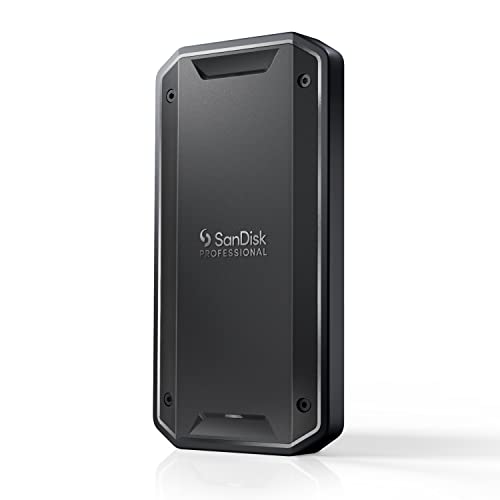
The only pick that combines a real Thunderbolt 3 port, 4TB of room and a 4.32 oz body you can forget in a laptop sleeve.
Best for: designers on a Thunderbolt 3 Mac who work off a laptop in changing locations Skip it if: your machine only has USB-C and you want the full quoted speed
The differentiator inside this set is dual-mode wiring. SanDisk lists Thunderbolt 3 at 40Gbps and USB-C at 10Gbps on the same connector, so the drive works on a studio Mac and a client's Windows laptop without an adapter hunt. Nothing else here does both.
Dimensions are 0.47 x 4.36 x 2.28 in at 4.32 oz. That's slim enough to sit under a laptop on a hot desk. SanDisk claims up to 3000MB/s read and 2500MB/s write over Thunderbolt 3, and says that translates to 50GB in a minute or less. Treat those as the manufacturer's figures.
Durability is where the case gets stronger for a working designer. The listing claims IP68 dust and water resistance, 4000lb crush resistance and 3m drop resistance onto carpeted concrete. Only one other pick publishes an IP rating, and it's the lower IP65. The aluminium core is described as pulling heat away from the drive, which matters when you're saving a 4GB composite repeatedly.
The trade-off against the two OWC picks is ceiling. You get half the capacity of either 8TB drive and a lower quoted peak speed, in exchange for a body that is roughly a third of the Envoy Ultra's weight.
Pros:
- Only pick with both Thunderbolt 3 and USB-C modes
- 4.32 oz and 0.47 in thick
- IP68 claim is the highest here
- 5-year limited manufacturer warranty
- 4000lb crush and 3m drop claims
Cons:
- Half the capacity of both 8TB picks
- Quoted peak speed sits well below the OWC drives
- Drops to 10Gbps on USB-C machines
- No colour listed, so you can't plan a colour-coded set
2. OWC 8TB Envoy Ultra Thunderbolt 5 Portable SSD Enclosure — Best premium
The fastest published figure in this group, paired with 8TB, for designers whose archive stopped fitting years ago.

Best for: designers with a Thunderbolt 5 machine and multi-terabyte project archives Skip it if: you're on older hardware and won't see the headline number
This is the most expensive pick here, and the reason is the interface. OWC lists Thunderbolt 5 and claims over 6000MB/s, describing that as up to twice as fast as Thunderbolt 4 and USB4. It's the only Thunderbolt 5 drive in the set.
OWC also claims an "Ultra Maximizer" that pulls the most available speed from Thunderbolt 3, Thunderbolt 4 and USB4 machines, so an older Mac isn't wasted hardware. It just won't hit the headline figure. The company says it matches internal storage performance and works with Macs, PCs, iPad Pros, Chromebooks and Surface devices.
At 0.72 lb it's the heaviest pick here, noticeably more than the 4.32 oz PRO-G40. That weight is the price of an 8TB enclosure with a Thunderbolt 5 controller. The listing describes it as rugged, shock resistant and weatherproof against dust, drops and downpours, though no IP figure is published, which is a step back from SanDisk's stated IP68.
Only one seller lists it, and OWC covers it with a 5 Year OWC Limited Warranty. The trade-off is plain: you pay the most in this set for a speed advantage most stills work will never touch, and you carry the extra weight every day to get it.
Pros:
- Only Thunderbolt 5 pick in this group
- 8TB, tied for the largest here
- Over 6000MB/s claimed
- 5 Year OWC Limited Warranty
Cons:
- Most expensive pick here
- Heaviest at 0.72 lb
- No IP rating published, unlike two cheaper picks
- No dimensions listed, so bag fit is guesswork
- Only one seller lists it
3. OWC Express 1M2 80G 8TB USB4 80Gb/s Portable NVMe SSD — Best for heavy use
8TB behind an 80Gb/s USB4 interface, in an enclosure you can re-drive later instead of replacing.

Best for: designers who want 8TB now and a swappable drive later Skip it if: you need something pocketable
Upgradeability is the argument. OWC says you can buy this as a ready-to-run drive or a DIY enclosure, and that it takes 2280 or 2242 NVMe M.2 SSDs, so a bigger or faster stick can go in three years from now. No other pick here offers that.
The interface is USB4 at 80Gb/s rather than Thunderbolt branding, with a claimed peak of over 6000MB/s real-world speed. OWC describes a patented heat-dissipating design that protects the drive while keeping it cool for consistent top speed, which is the claim that matters most on this list. Sustained writes are where portable SSDs quietly slow down, and a designer batch-exporting 400 press-ready PDFs is doing a sustained write.
Size is the honest cost. At 0.94 x 5.24 x 2.83 in it's the biggest pick here by every dimension, roughly twice the thickness of the PRO-G40. It weighs 0.62 lb. This is a drive that lives on a desk beside a monitor stand, not one that rides in a jacket pocket.
Against the Envoy Ultra it gives up the Thunderbolt 5 badge and the captive-cable convenience, and it's the second-most-expensive pick, but it hands back the ability to swap the drive inside.
Pros:
- 8TB with a swappable 2280 or 2242 M.2 drive
- USB4 at 80Gb/s, over 6000MB/s claimed
- Heat-dissipating shell aimed at sustained writes
- OWC 5 Year Limited Warranty
Cons:
- Largest body here at 5.24 in long
- No Thunderbolt branding, which some docks and workflows expect
- Second-highest price position in this set
- No IP rating published
- Only one seller lists it
4. Sandisk 2TB Extreme Portable SSD — Best for beginners
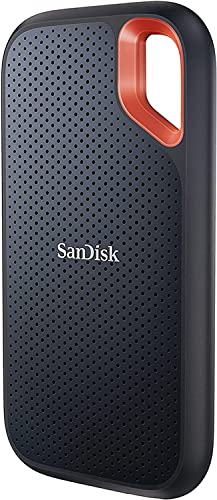
A 1.76 oz drive with a carabiner loop and hardware encryption, and the lightest thing on this list by a wide margin.
Best for: a first external drive for a designer moving off a full internal SSD Skip it if: you're moving huge composites daily
Weight is the story. At 1.76 oz this is less than half the PRO-G40 and a fraction of either OWC drive, and it measures 0.38 x 3.97 x 2.07 in. SanDisk adds a carabiner loop for clipping it to a belt loop or backpack, which is a small thing that changes how often you actually bring it.
SanDisk claims NVMe performance up to 1050MB/s read and 1000MB/s write. That is roughly a third of the PRO-G40's Thunderbolt 3 claim, and it is not a Thunderbolt drive. For opening a 200MB layered file and saving it back, the difference is a few seconds. For migrating a 900GB archive, it's an afternoon.
The security feature is worth a designer's attention. The listing includes password protection with 256-bit AES hardware encryption, and SanDisk's Memory Zone app for managing files. Client work under NDA belongs on an encrypted volume.
Ruggedness is claimed at up to 3-meter drop protection and IP65 water and dust resistance, a step below the PRO-G40's IP68. SanDisk backs it with a 5-year limited manufacturer warranty, and the listing marks it as the older model. It's the second-cheapest pick here, and the trade you're making is interface speed for pocketability.
Pros:
- Lightest pick here at 1.76 oz
- 256-bit AES hardware encryption included
- Carabiner loop for bag or belt
- IP65 and 3-meter drop claims
- 5-year limited manufacturer warranty
Cons:
- No Thunderbolt port at all
- Claimed speed is roughly a third of the PRO-G40's
- Listed as the older model
- 2TB fills fast if you keep layered masters
5. Samsung T7 Portable SSD 1TB Titan Gray — Best budget pick
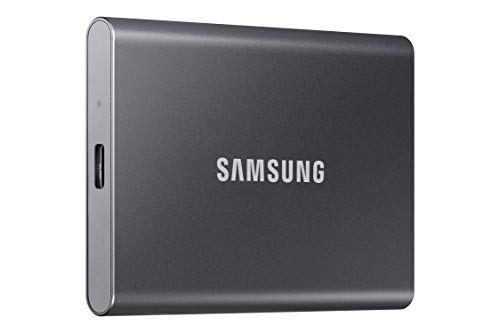
The cheapest of the five and the smallest at 0.3 in thick, built for handing one project to one person.
Best for: handing finished files to a client or printer Skip it if: you archive raw scans or long-lived layered files
This is the cheapest pick here and the smallest body: 0.3 x 3.3 x 2.2 in at 2.08 oz. It's thinner than everything else in the set, including the SanDisk Extreme. Titan Gray is the listed colour, useful if you label drives by finish.
Samsung lists USB 3.2 Gen 2 with claimed read and write speeds up to 1,050/1,000 MB/s, and says PCIe NVMe technology sits behind that. The company describes it as made for makers, points at video editing and photo filing, and claims 4K 60fps recording straight from a camera. Compatibility is listed across PCs and mobile phones.
Capacity is the limit that defines it. 1TB is the smallest here, one-eighth of either OWC drive. A designer with three years of packaged InDesign jobs will fill it and then own a drive that needs its own backup. Where it earns its place is transfer: load a campaign, walk it to the printer, wipe it, repeat.
Two other things to weigh. The warranty is 3 year limited, the shortest in this set by two years, and the listing publishes no IP rating or drop figure, so it's the least protected pick against a desk-edge fall.
Pros:
- Cheapest pick in this set
- Thinnest body at 0.3 in
- 2.08 oz, easy to pocket
- Named colour helps with labelling drives
Cons:
- Smallest capacity at 1TB
- 3 year limited warranty, shortest here
- No IP or drop rating published
- No Thunderbolt port
How much capacity does a graphic designer really need?
Capacity is what designers underestimate, because design files grow after delivery, not before it. A brand refresh you finish at 40GB becomes 180GB once you keep every linked asset, every font licence and every version the client rejected.
Rough shape of the decision, using the capacities on this list:
- 1TB (Samsung T7). One live project plus handoffs. Not an archive.
- 2TB (SanDisk Extreme). A year of client work if you flatten and prune.
- 4TB (SanDisk PRO-G40). Several years of layered masters with room to work off the same drive.
- 8TB (both OWC picks). Raw scans, photography libraries, and every version of everything.
The trap is buying the drive that fits today's folder. Buy the one that fits it twice over, because the alternative is a shelf of half-full drives and no idea which one holds the logo suite.
Does the fastest thunderbolt external SSD for graphic designers matter for stills?
Less than the marketing suggests, and this is the misconception worth naming. Interface speed decides how long a bulk transfer takes. It barely touches how a 2GB PSD feels once it's open, because at that point your RAM and your CPU are doing the work.
Where the interface genuinely earns its money:
- Migrating an archive between machines
- Batch-exporting hundreds of press PDFs
- Working directly off the drive rather than copying to internal storage first
- Backing up a full project folder at end of day
Where it barely registers: opening one file, tweaking type, saving it back.
So the best thunderbolt external SSD for graphic designers is not automatically the one with the biggest number. A 4.32 oz drive you carry every day beats a 0.72 lb one you leave at home, and a 4TB drive that never fills beats an 8TB one you bought for a speed figure your laptop can't reach. Sustained write behaviour matters more than peak read, which is why OWC's heat-dissipation claims deserve more attention than its 6000MB/s figure.
What the listings do not tell you about heat and cables
Three gaps run through all five listings, and they're worth knowing before you order.
Cable length and type. Not one listing here publishes a cable length. Thunderbolt cables are short by design, and a 40Gbps-rated cable is not the same as the USB-C lead in your drawer. If the drive ships with a captive or bundled cable, that's the one to use.
Thermal throttling under load. Both OWC picks and the PRO-G40 make heat claims: an aluminium core, a patented heat-dissipating design. None publishes a sustained-write figure. That gap matters most if you export overnight.
Formatting out of the box. No listing states the filesystem. A designer running a Mac and a Windows machine needs to decide on exFAX or a cross-platform format before loading 4TB onto it, because reformatting later means moving everything twice.
The practical move is to test with a real project folder in the first week, while the return window is open. Copy 100GB, watch the transfer rate at the end rather than the start, and see whether it holds.
The verdict
If you're on a Thunderbolt 3 or 4 Mac and you move between a desk and a client's office, the SanDisk Professional 4TB PRO-G40 is the pick. It's the only drive here that carries both a Thunderbolt 3 port and a USB-C fallback, it holds 4TB, and it does it at 4.32 oz in a 0.47-inch-thick shell with an IP68 claim behind it. That combination of real Thunderbolt wiring, working capacity and a body you'll actually carry is why it wins.
If your machine runs Thunderbolt 5 and your archive is already past 4TB, the OWC 8TB Envoy Ultra is the better buy. It claims over 6000MB/s, doubles the capacity, and carries a 5 Year OWC Limited Warranty. You pay the most in this set and carry 0.72 lb for it.
The cutoff is 4TB. Below it, the PRO-G40 handles a designer's working set and travels better than anything else here. Above it, you're in 8TB territory and choosing between the Envoy Ultra's interface and the Express 1M2's swappable M.2 slot. Pick the Express 1M2 if you'd rather upgrade the drive inside than replace the whole enclosure in three years.
FAQ
Is a thunderbolt external SSD worth it for graphic design work?
A thunderbolt external SSD is worth it if you regularly move whole project folders or work directly off the drive. The PRO-G40 claims 50GB in a minute or less over Thunderbolt 3. If you mostly open one file at a time and save it back, a USB drive like the 2TB SanDisk Extreme does the same job for less.
What capacity should I choose for layered design files?
The capacity you choose should fit your archive twice over, not just today's folder. 1TB, as on the Samsung T7, suits single-project handoffs. 4TB, as on the PRO-G40, covers years of layered masters with working room. The two 8TB OWC picks are for raw scans and full photography libraries.
SanDisk PRO-G40 or OWC Envoy Ultra: which should I buy?
Between the PRO-G40 and the Envoy Ultra, port and weight decide it. The PRO-G40 gives you Thunderbolt 3 plus USB-C at 4.32 oz and 4TB, with an IP68 claim. The Envoy Ultra gives you Thunderbolt 5, a claimed 6000MB/s and 8TB at 0.72 lb. Match it to your laptop's port.
Will these drives work with a Windows laptop and an iPad?
These drives work across platforms according to their listings, with caveats. OWC states both its picks support Macs, PCs, iPad Pros, Chromebooks and Surface devices. The PRO-G40 falls back to USB-C at 10Gbps on non-Thunderbolt machines. Samsung lists broad PC and mobile compatibility for the T7. Check the filesystem before loading files.
What's the biggest mistake when buying external storage for design?
The biggest mistake is buying for peak read speed and ignoring sustained writes and capacity. Long batch exports heat a drive, and heat slows it down, which is why OWC publishes heat-dissipation claims on both picks. The second mistake is undersizing, then owning three half-full drives with no index of what's on them.
Start by checking one thing on your laptop: whether the port beside the charger carries the Thunderbolt lightning symbol. If it does, the PRO-G40 gives you the full 40Gbps path and a drive light enough to live in your bag permanently. If it doesn't, spend the difference on capacity instead and take the 2TB SanDisk Extreme or an 8TB OWC. The reason the PRO-G40 is the right default is that it's the only pick that refuses to make you choose: full Thunderbolt speed on the machines that have it, working USB-C speed on the ones that don't, and a five-year warranty either way.