Best 17 Inch Laptop for a Working Developer
A 17-inch screen is the cheapest productivity upgrade a developer can buy. Six machines compared on RAM, storage, weight and warranty, with the gaming spec separated from the marketing.

By Samuel HarrisUpdated 18 min read
On this page
- Best 17 inch gaming laptop for programmers at a glance
- How I screened these six down
- Does a 17 inch gaming laptop actually help programmers?
- 1. HP 17-inch Touchscreen Business Laptop — Best overall
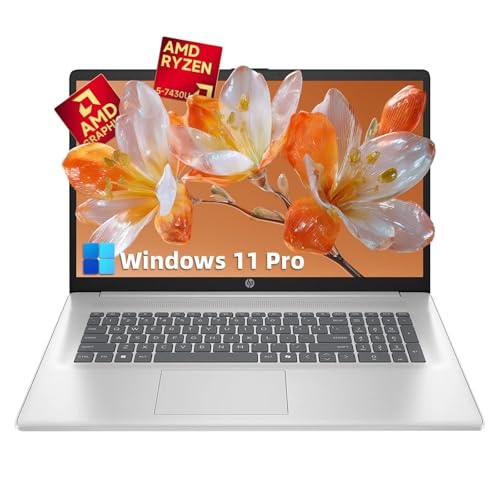
- 2. HP 17 Inch Laptop, AMD Ryzen 5 7430U 6-Core — Best for heavy use
- 3. ASUS TUF Gaming A17 — Most versatile
- 4. LG gram Pro 17-inch Lightweight Laptop Computer — Best premium
- 5. IJKKJI 17 Inch Laptop with Ryzen 5 — Best for families
- 6. NBVCXSD 17 Inch Laptop — Best budget pick
- RAM or storage: which one should you spend on?
- What each price tier buys you here
- When a different pick wins
- What these listings don't tell you
- The verdict
- FAQ
The best 17 inch gaming laptop for programmers is the HP 17-inch Touchscreen Business Laptop, which pairs 16GB of DDR4 RAM with a 17.3-inch touch panel in a 4.62 lb body. If you routinely run containers, a database and an IDE at once, the 32GB HP 17 Inch Laptop is the better buy at the same rough price position.
Here's the honest map of this field. The entry tier buys you screen size and little else: 8GB of RAM, 256GB of storage, no published processor generation. The middle tier is where developer machines live, with 16GB or 32GB and a terabyte of NVMe. The top tier splits two ways, one buying a real gaming GPU and one buying a 3.26 lb chassis.
Best 17 inch gaming laptop for programmers at a glance
| Pick | RAM + storage | Weight | Price |
|---|---|---|---|
Best overall HP 17-inch Touchscreen Business Laptop |
16GB + 512GB NVMe | 4.62 lb | Check Price |
Best for heavy use HP 17 Inch Laptop, AMD Ryzen 5 7430U 6-Core |
32GB + 1TB SSD | 9 lb | Check Price |
Most versatile ASUS TUF Gaming A17 |
16GB DDR5 + 1TB PCIe 4.0 | 4.2 lb | Check Price |
Best premium LG gram Pro 17-inch Lightweight Laptop |
32GB + 2TB SSD | 3.26 lb | Check Price |
Best for families IJKKJI 17 Inch Laptop with Ryzen 5 |
8GB + 256GB SSD | 2.5 lb | Check Price |
Best budget pick NBVCXSD 17 Inch Laptop |
8GB + 256GB SSD | 2.5 lb | Check Price |


How I screened these six down
I lined up the published specifications for every 17-inch machine in this set side by side and sorted on the three figures a developer can actually verify before buying: memory, storage and weight. Everything else in the listings is either a marketing bullet or absent.
Three things decided the ranking.
- Memory, first. Two picks publish 32GB, two publish 16GB, two publish 8GB. That single figure separates a machine you can run a container stack on from one you can't.
- Storage type and size. Four picks state NVMe or PCIe storage. Repository checkouts, node_modules trees and Docker images eat disk faster than anything else a programmer does, and 256GB fills quickly.
- Weight against screen size. These range from 2.5 lb to 9 lb for the same 17.3-inch panel. That's not a rounding error, it's the difference between a portable machine and a desktop replacement.
Two picks were kept in despite thin data because they anchor the bottom of the price range and a reader shopping there deserves to know what the compromise looks like. Neither NBVCXSD nor IJKKJI publishes a processor generation year, a display refresh rate or a GPU. Both list a Ryzen 5 3500U in their feature text and 8GB of RAM. That's the whole picture.
I did not reward feature bullets. ASUS says its MUX switch routes frames straight to the display; LG says its RTX 5050 handles rendering and AI work. Both are plausible manufacturer claims. Neither is a measurement I can stand behind.
Does a 17 inch gaming laptop actually help programmers?
Mostly, yes, but not for the reason the category name suggests. The gaming part is incidental to development work. The 17.3-inch panel is the actual upgrade.
Screen area is where a programmer gets paid back. Two source files side by side, a terminal below, a browser on the right. On a 13-inch display you're alt-tabbing all day. On a 17.3-inch FHD panel at 1920x1080 you can hold three panes without squinting.
The gaming hardware matters in narrower cases. A discrete GPU earns its keep if you compile shaders, train models locally, or run CUDA workloads. Two picks here have one: the ASUS TUF Gaming A17 with a GeForce RTX 4050 at what ASUS lists as 140W Max TGP, and the LG gram Pro with a GeForce RTX 5050. The other four have no published discrete graphics at all, which is worth flagging clearly given the search term.
That's the honest position on the "gaming" qualifier. Four of these six aren't gaming machines. They're big-screen productivity laptops, and for a developer writing web services or scripts, that's the better trade. You get more RAM per unit of spend and a quieter chassis.
Refresh rate is the other gaming spec with a programming use. ASUS publishes 144Hz with Adaptive-Sync. Scrolling long files on a high-refresh panel is genuinely easier on the eyes. No other pick here publishes a refresh figure.
1. HP 17-inch Touchscreen Business Laptop — Best overall
A 16GB, 17.3-inch touch machine at 4.62 lb, and the one buyers pick most often in this set.
Best for: a developer who wants a big screen, a full keypad and a touch panel without the bulk
Skip it if: you need a discrete GPU for compiling shaders or training models
This is the balanced pick, and it's also the machine that sells fastest of the six by a wide margin. It publishes 16GB of DDR4 RAM and a 512GB NVMe SSD in its specification block, though the listing title and feature text both claim 1TB. Treat the 512GB figure as the one to plan around and check the configuration you're ordering.
At 4.62 lb and 0.78 x 15.8 x 10.8 in, it's the middle of this field for portability. Half the weight of the 32GB HP, twice the weight of the entry pair. HP says the AMD Ryzen 5 7430U handles everyday productivity, and the listing states Wi-Fi 6 and Bluetooth 5.4, which matters if you push builds to a remote runner over a busy network.
The touchscreen is the differentiator here. No other pick in this set publishes one. For scrolling documentation, dragging Figma frames or poking at a mobile layout, it's a real convenience. The full-size keyboard with numeric keypad is the other quiet win: useful for anyone entering test data or working in spreadsheets alongside code.
The trade-off against the ASUS is graphics. This has no published discrete GPU, so shader compilation and local model work belong elsewhere. Against the 32GB HP, you're giving up half the memory.
Pros:
- 16GB DDR4 RAM, double the entry pair
- Only pick here with a touchscreen
- 4.62 lb, half the weight of the 32GB HP
- Wi-Fi 6 and Bluetooth 5.4 listed
- Full numeric keypad on a 17.3-inch chassis
Cons:
- No discrete GPU published, despite the gaming search term
- Specification says 512GB while the title claims 1TB
- Display listed as HD+, not full 1920x1080
- Only one seller lists it
2. HP 17 Inch Laptop, AMD Ryzen 5 7430U 6-Core — Best for heavy use
32GB of RAM and 1TB of NVMe, in a 9 lb body that isn't going anywhere.

Best for: running several containers, an IDE and a browser full of docs at once
Skip it if: the machine has to leave your desk regularly
Memory is the reason to buy this one. 32GB of DDR4 at 3200MHz, per HP's own bullet, is twice what the overall winner offers and four times the entry pair. If your daily loop involves Docker Compose bringing up a database, a cache and two services while your editor indexes a large repository, this is the pick in this set that doesn't stall.
Storage matches: 1TB of PCIe NVMe. HP also states a 17.3-inch Full HD IPS anti-glare display at 1920x1080, which is a step up from the winner's HD+ panel and genuinely better for long editing sessions.
Then there's the weight. 9 lb, listed, against 4.62 lb for the near-identical 16GB model. Same 15.8 x 0.78 in footprint, roughly twice the mass. That figure may include packaging, but it's what the listing publishes and I'd plan on this being a desk machine. The lift-hinge keyboard and HP Fast Charge support HP mentions reinforce that: comfort features for stationary use.
It's also the second-slowest seller of the four HP and generic options here. The trade-off against the ASUS is graphics again, with no discrete GPU published, and against the LG you lose 1TB of storage.
Pros:
- 32GB DDR4 3200MHz, the joint highest here
- 1TB PCIe NVMe SSD
- Full HD IPS anti-glare panel at 1920x1080
- Windows 11 Pro, the only Pro licence in this set
- Numeric keypad and lift-hinge keyboard
Cons:
- 9 lb listed weight, the heaviest of the six by far
- No discrete GPU for GPU-accelerated work
- Warranty field reads simply "1" with no unit
- Only one seller lists it
3. ASUS TUF Gaming A17 — Most versatile
The only pick here with both a 144Hz panel and a 140W GPU, at 4.2 lb.

Best for: someone who codes by day and games at 144Hz by night
Skip it if: your work is all text editors and terminals
If the "gaming" half of the search matters to you, this is the machine that takes it seriously. ASUS publishes a GeForce RTX 4050 Laptop GPU at 140W Max TGP, an AMD Ryzen 7 7735HS processor, and a 17.3-inch FHD 144Hz display with Adaptive-Sync. That combination doesn't appear anywhere else here.
The developer-relevant specs are strong too. 16GB of DDR5-4800MHz, faster memory than the DDR4 in both HP picks, and 1TB of PCIe 4.0 storage. ASUS notes an additional SSD slot, which means you can add a second drive for VM images without cloning the boot disk. That's a practical detail the other five listings don't mention.
Cooling gets named attention: ASUS describes a pair of 84-blade Arc Flow Fans built for a high-power CPU under full load. A long compile is exactly that kind of load, so the engineering is aimed at the right place. The MUX switch with Advanced Optimus, per ASUS, routes frames directly to the display and switches GPU modes for battery.
At 4.2 lb it's marginally lighter than the winning HP. The catch is the model year: 2023, the oldest release date published in this set, and it's the second-most expensive pick.
Pros:
- RTX 4050 at 140W Max TGP, the highest-power GPU claim here
- 144Hz FHD display with Adaptive-Sync
- DDR5-4800MHz, faster than both HPs
- 1TB PCIe 4.0 plus a spare SSD slot
- 4.2 lb, lighter than the overall winner
Cons:
- 2023 release, the oldest here
- 16GB RAM, half the 32GB picks
- No numeric keypad mentioned in the listing
- Second-highest price position in the set
4. LG gram Pro 17-inch Lightweight Laptop Computer — Best premium
3.26 lb with a 17-inch screen, 32GB of RAM and 2TB of storage. Nothing else here comes close on portability.

Best for: a consultant who carries a 17-inch screen between client sites
Skip it if: you want the most RAM per unit of spend
This one exists to solve a specific problem: you want the screen real estate of a 17-inch panel and you also have to put it in a bag every morning. 3.26 lb and 0.63 x 14.9 x 10.4 in. The winning HP is 4.62 lb and thicker, the 32GB HP is 9 lb.
The specification sheet is the strongest here on paper. 32GB of RAM, 2TB of SSD storage, an Intel Core Ultra 9 285H processor, and a GeForce RTX 5050 laptop GPU. It's the only 2025 release in this set, and the only pick with more than one seller listing it. That 2TB figure is double the next largest, which matters if you keep several large repositories and VM images locally.
LG's claims are worth reading carefully. The company describes gram AI as a hybrid on-device and cloud arrangement, and positions the RTX 5050 for rendering and AI performance. Those are marketing bullets, not benchmarks, and the thin 0.63 in chassis is a fair question mark over sustained GPU load during a long build.
It's the most expensive pick here and the slowest seller of the six. The 32GB HP gives you the same memory for a lot less, if you can accept a desk-bound machine.
Pros:
- 3.26 lb, the lightest 17-inch pick here
- 2TB SSD, double the next largest
- 32GB RAM plus a GeForce RTX 5050
- Only 2025 release in this set
- 0.63 in thick, the slimmest of the six
Cons:
- Most expensive pick here
- 0.63 in chassis raises sustained-load cooling questions
- Slowest seller of the six
- No RAM or storage figure in its own specification block, only in the title
5. IJKKJI 17 Inch Laptop with Ryzen 5 — Best for families
8GB and 256GB at 2.5 lb, with the entry tier's best-documented listing.

Best for: a shared household machine that a beginner also codes on
Skip it if: you compile anything larger than a class project
This is the second-cheapest pick and the better documented of the two entry machines. It publishes a model number, MTL1735, a Space Gray finish, and a 17.3-inch size figure. Its listing states a Ryzen 5 3500U at up to 3.7GHz, 8GB of RAM and a 256GB SSD, plus a 17.3-inch FHD IPS panel at 1920x1080 with wide viewing angles.
For a household machine that gets used for schoolwork, streaming and someone's first Python course, that's a reasonable specification. The FHD IPS panel is the same resolution as the far pricier HP heavy-use pick. The listing also mentions a backlit keyboard, an RJ45 ethernet port for wired connections, HDMI, USB 3.0 and full-function Type-C. Ethernet on a 17-inch budget machine is genuinely handy if your home Wi-Fi is unreliable.
At 2.5 lb it ties for lightest here, which for a 0.8 x 15.7 x 10 in chassis is a figure worth verifying at delivery.
Be clear on the limits. 8GB is not enough for containerised development, and 256GB fills fast once you've installed an IDE, a runtime or two and a few repositories. No discrete GPU is published. As a learning machine it's fine. As a working developer's daily driver, it isn't.
Pros:
- Second-cheapest of the six
- FHD IPS panel at 1920x1080
- Backlit keyboard and RJ45 ethernet listed
- 2.5 lb, tied lightest here
- Published model number, unlike the budget alternative
Cons:
- 8GB RAM, a quarter of the top picks
- 256GB storage, the smallest here alongside NBVCXSD
- No discrete GPU published
- No processor generation year stated
6. NBVCXSD 17 Inch Laptop — Best budget pick
The cheapest 17-inch screen in this set, with the thinnest specification sheet.

Best for: a first big-screen machine for learning to code on a tight budget
Skip it if: you need a published processor generation and model number
This is the cheapest of the six and it sets the floor for what a 17-inch panel costs. The listing states a 17.3-inch screen at 1920x1080, a Ryzen 5 3500U CPU, 8GB of RAM and up to 256GB of storage. Weight is given as 2.5 lb, dimensions 0.8 x 15.7 x 10 in.
Its one clear advantage over the IJKKJI is the port list. NBVCXSD mentions dual USB 3.0, RJ45, HDMI, an SD card slot and a 3.5mm jack. That SD slot is the only one named in this whole set, and if you move files off cameras or single-board computers it saves you a dongle. The listing also claims a 5400mAh battery.
What's missing matters more. No model number in the specification block. No colour. No processor generation. No GPU. The listing copy is machine-translated and reads like it, which tells you something about the support you can expect from a brand with no track record in this category.
For learning to code, writing scripts and reading documentation on a big screen, it works. Ask it to index a large monorepo or run a container stack and 8GB will stop you. The IJKKJI costs slightly more and documents itself better.
Pros:
- Cheapest of the six
- 1920x1080 resolution on a 17.3-inch panel
- Only pick listing an SD card slot
- RJ45, HDMI, dual USB 3.0 and Type-C
- 2.5 lb, tied lightest here
Cons:
- No model number, colour or processor generation published
- 8GB RAM and 256GB storage, the joint lowest here
- No discrete GPU, despite the gaming search term
- Thinnest specification sheet of the six
RAM or storage: which one should you spend on?
RAM first. Every time. This is the single question that decides which of these six you should buy, and most shoppers get it backwards.
Storage is a problem you can fix later. Most 17-inch chassis take a second drive, and ASUS explicitly mentions an additional SSD slot on the TUF A17. An external NVMe enclosure over USB 3.0 or Type-C costs little and holds archives fine.
Memory is usually soldered or awkward to reach, and running out of it is the failure that makes a machine feel broken. Here's what happens when a developer hits the ceiling: the operating system starts swapping to disk, your editor's language server stalls mid-keystroke, and a build that took two minutes takes nine.
Rough guide for this set:
- 8GB, the two entry picks: an editor, a browser and a local runtime. One at a time.
- 16GB, the HP touchscreen and the ASUS: a full IDE, a browser with twenty tabs, one or two containers.
- 32GB, the 32GB HP and the LG gram Pro: a container stack, a database, an IDE indexing a large repository, all at once.
Storage tiers here run 256GB, 512GB, 1TB and 2TB. If you check out large repositories with deep histories, 256GB is tight before you've written a line.
What each price tier buys you here
The three price tiers in this set buy three genuinely different things, and knowing which one you need saves you from overspending on the wrong axis.
The entry tier buys screen size. Both cheapest picks give you a 17.3-inch 1920x1080 panel, a backlit keyboard, RJ45 ethernet and 2.5 lb. What they don't give you is memory, storage, a documented processor generation or a GPU. You're paying for pixels and ports.
The middle tier is where developer machines sit. Both HP picks move you to 16GB or 32GB, NVMe storage measured in gigabytes not hundreds of megabytes, Wi-Fi 6, Bluetooth 5.4 and a full numeric keypad. One adds a touchscreen, the other adds Windows 11 Pro and a Full HD IPS anti-glare display. Neither adds a discrete GPU.
The top tier splits, and this is the part worth understanding. The extra spend buys you one of two things, not both. The ASUS buys graphics performance: an RTX 4050 at 140W, a 144Hz panel, DDR5, active cooling built around a high-power CPU. The LG buys portability: 3.26 lb, 0.63 in thick, 32GB, 2TB, a 2025 processor.
If you want the top tier's graphics and the top tier's weight in one machine, this set doesn't have it.
When a different pick wins
The winner is right for most developers shopping for a big screen. Three specific conditions flip it.
- You run a container stack daily. Go to the 32GB HP. 16GB is workable for a single service; a compose file with four containers plus an indexing IDE isn't. The 9 lb weight is the price of admission.
- You compile GPU code or train models locally. Go to the ASUS TUF Gaming A17. The RTX 4050 at 140W Max TGP is the only high-power GPU claim in this set, and DDR5-4800 plus PCIe 4.0 storage support that workload properly.
- The laptop travels every day. Go to the LG gram Pro. 3.26 lb versus 4.62 lb sounds small until it's in a bag on a train five days a week, and you keep 32GB and 2TB in the bargain.
One more threshold. If your budget stops below the middle tier, buy the IJKKJI rather than the NBVCXSD. The difference in price position is small, and the IJKKJI publishes a model number, a colour and a coherent specification block. Documentation is worth something when you need a driver.
What these listings don't tell you
There's a gap between what these six listings publish and what a programmer actually needs to know, and it's worth naming.
Battery life. Not one pick publishes a runtime figure. NBVCXSD mentions a 5400mAh cell and HP mentions Fast Charge support. Neither is hours.
Keyboard travel and feel. You'll spend eight hours a day on it. HP mentions a lift-hinge keyboard and both entry picks mention backlighting. Nothing states key travel.
Thermals under sustained load. ASUS is the only brand that addresses this directly, describing 84-blade Arc Flow Fans built for a high-power CPU at full load. A long compile is a sustained load, and on the four picks that say nothing, you're guessing.
Display brightness and colour. Three picks state 1920x1080. One states HD+. None states nits or colour coverage.
Memory upgradeability. Nothing here confirms whether RAM is soldered. That's the difference between an 8GB machine you can fix and one you can't.
Warranty specifics. Five picks list one year. ASUS publishes the most detail: a one-year international warranty, eligibility for a year of free domestic accidental damage protection on registration, and two-way free shipping for standard hardware repair. That's the most substantial coverage documented in this set.
The verdict
The best 17 inch gaming laptop for programmers in this set is the HP 17-inch Touchscreen Business Laptop. It lands 16GB of DDR4 RAM, NVMe storage, Wi-Fi 6, Bluetooth 5.4, a full numeric keypad and a 17.3-inch touch panel into a 4.62 lb body at a middle price position. It's also the machine buyers here choose most often by a wide margin. For the developer who wants more screen without a desktop replacement, it's the sensible default.
Two conditions flip that call. If your workday means multiple containers and a large repository index running together, the 32GB HP 17 Inch Laptop is the right buy: double the memory, a 1TB NVMe drive, a Full HD IPS anti-glare panel and a Windows 11 Pro licence, at the cost of a 9 lb listed weight that keeps it on a desk.
If you actually game or compile GPU workloads, the ASUS TUF Gaming A17 is the only pick here built for it. RTX 4050 at 140W Max TGP, a 144Hz Adaptive-Sync display, DDR5-4800MHz memory, 1TB of PCIe 4.0 storage plus a spare SSD slot, and the most detailed warranty documentation in the set. Its 2023 release date is the trade.
The LG gram Pro remains the answer to one question only: a 17-inch screen at 3.26 lb.
FAQ
Is a 17 inch gaming laptop worth it for programmers?
A 17 inch gaming laptop is worth it for programmers mainly because of screen area, not graphics. A 17.3-inch 1920x1080 panel holds two code panes, a terminal and a browser at once. The gaming hardware only earns its keep for shader compilation, local model training or CUDA work. If your stack is web services and scripts, spend the same money on 32GB of RAM instead.
What's the best 17 inch gaming laptop for programmers on a budget?
The best 17 inch gaming laptop for programmers on a budget in this set is the IJKKJI, which pairs a 17.3-inch FHD IPS panel with 8GB of RAM and a 256GB SSD at 2.5 lb. It costs slightly more than the NBVCXSD but publishes a model number and a fuller specification sheet. Accept the limit: 8GB won't run a container stack.
How much RAM do I need to code comfortably?
How much RAM you need depends on your stack. 8GB handles an editor, a browser and one runtime. 16GB, as in the HP touchscreen and the ASUS, covers a full IDE plus a couple of containers. 32GB, as in the 32GB HP and the LG gram Pro, is what a compose file with four services and a large repository index actually wants.
HP touchscreen or ASUS TUF Gaming A17 for development?
HP touchscreen or ASUS depends on whether you need a GPU. The HP gives you 16GB, a touch panel, a numeric keypad and 4.62 lb at a lower price position. The ASUS gives you an RTX 4050 at 140W, a 144Hz display, DDR5-4800 memory, PCIe 4.0 storage and a spare SSD slot. No GPU workload, buy the HP.
What's the biggest mistake buying a 17 inch laptop?
The biggest mistake buying a 17 inch laptop is ignoring weight. These six span 2.5 lb to 9 lb for the same 17.3-inch panel. Buyers focus on the screen figure, order the machine, then discover it never leaves the desk. Check the published weight before anything else. Then check RAM, because memory is the spec you usually can't upgrade later.
Start with the 16GB HP if you want a big screen that still travels, and check the memory and storage figures on the exact configuration listed before you order, because the HP touchscreen's own specification block and title disagree on storage size. The wider point about this category: the "gaming" label buys graphics you may never use, while the screen is the part that changes how you work every day. Four of these six have no discrete GPU and are better developer machines for it. Match the memory to your container count, then pick the weight you can live with.