Best Budget Chromebook for Engineers: HP G6 Leads

A ranked shortlist of six Chromebooks judged on weight, ports, storage and warranty, with a clear winner for engineering-adjacent work and honest limits on what ChromeOS can and cannot run.

By Samuel HarrisUpdated 15 min read
On this page
- Best budget Chromebook for engineers at a glance
- What a Chromebook can and cannot do for engineering work
- 1. HP Chromebook 11 G6 EE — Best overall
- 2. HP 17.3" HD+ Chromebook — Best premium
- 3. Samsung Galaxy Chromebook Go — Best upgrade
- 4. Dell 3100 11.6" Touchscreen Chromebook — Most versatile
- 5. Ripakiya HP Chromebook — Best for families
- 6. Lenovo C340 15.6" 2-in-1 — Best warranty
- How I screened these six listings
- Which specs actually decide it?
- Ports, weight and warranty compared
- Which pick fits which engineer?
- The verdict
- FAQ
The best budget Chromebook for engineers is the HP Chromebook 11 G6 EE, a 2.7 lb 11.6-inch machine with a 90-day limited warranty and the cheapest position in this six-laptop set. If you'd rather read datasheets on a 17.3-inch anti-glare panel and can accept a 4.53 lb chassis, the HP 17.3-inch HD+ Chromebook is the smarter buy. Every pick here runs ChromeOS or ChromeOS Flex, so treat this as a browser-first shortlist.
Best budget Chromebook for engineers at a glance
| Pick | Weight | Storage / RAM | Price |
|---|---|---|---|
Best overall HP Chromebook 11 G6 EE |
2.7 lb | 16 GB / 4 GB | Check Price |
Best premium HP 17.3" HD+ Chromebook |
4.53 lb | 256 GB SSD / 8 GB | Check Price |
Best upgrade Samsung Galaxy Chromebook Go |
3.2 lb | 32 GB / 4 GB | Check Price |
Most versatile Dell 3100 Touchscreen Chromebook |
2.9 lb | 32 GB / 4 GB | Check Price |
Best for families Ripakiya HP Chromebook |
1 lb listed | 64 GB / 4 GB | Check Price |
Best warranty Lenovo C340 15.6" 2-in-1 |
4.19 lb | 64 GB / 4 GB | Check Price |


What a Chromebook can and cannot do for engineering work
Set expectations before you spend a dollar. A Chromebook is a browser on a keyboard. That covers a real slice of engineering-adjacent work: SSH into a remote workstation, Overleaf for LaTeX, Google Colab notebooks, Onshape or Fusion in-browser viewers, GitHub in the tab, MATLAB Online, Jupyter through a hosted kernel, and every meeting client that ships as a web app.
What it does not do is run native Windows or Linux CAD suites. SolidWorks, full-fat MATLAB, ANSYS, Altium, KiCad on the device itself: not here. Some Chromebooks run Android and Linux app containers, but two picks in this set explicitly restrict that. The HP 17.3-inch says "no game downloads allowed" and ships ChromeOS Flex, and the Ripakiya HP is described as a student device.
So the honest framing is this: the best budget Chromebook for engineers is a lightweight second machine, or a thin client for a beefier remote box, or a note-taking and reading laptop that survives a lab bench. It is not a workstation.
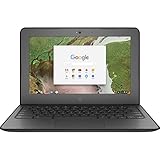
1. HP Chromebook 11 G6 EE — Best overall
A 2.7 lb 11.6-inch renewed Chromebook that hits the lowest price position in this set and still ships with a stated 90-day limited warranty.
Best for: engineering students running browser-based CAD viewers and SSH sessions Skip it if: you need local storage beyond 16 GB
Three numbers do the work here. Weight is 2.7 lb, the second-lightest published figure in the set behind a listing figure that reads oddly. Thickness is 0.7 in, the slimmest here. The chassis footprint is 8.18 x 8.1 in, which is genuinely bag-and-jacket-pocket friendly for a laptop. That combination is what makes this the best budget Chromebook for engineers who carry a machine between lectures, labs and the library.
The catch is real: 16 GB of flash storage and 4 GB of RAM. That is a browser-and-cloud spec, not a local-files spec. Point it at Google Drive, keep two dozen tabs open at most, and it will do the job. The 2019 release date and Celeron 1.10 GHz processor make clear this is a renewed unit, and the sales rank of 346 in its category is the strongest of this six-laptop set: the one buyers choose most often here.
Pros:
- Lightest weight at 2.7 lb
- The cheapest of the six
- Slimmest chassis at 0.7 in
- 90-day limited warranty stated
- Strongest sales position in this set
Cons:
- Only 16 GB of flash storage
- 4 GB RAM caps heavy tab work
- 11.6-inch screen is tight for datasheets
- Renewed condition, 2019 release
2. HP 17.3" HD+ Chromebook — Best premium
A 17.3-inch anti-glare Chromebook with 8 GB of RAM and a 256 GB SSD, and the most expensive pick here.

Best for: reading long PDFs and datasheets on a big anti-glare screen Skip it if: you carry the laptop between labs all day
If the winner is defined by weight, this one is defined by screen area. The 17.3-inch HD+ panel is the largest display in the set, and HP describes it as anti-glare, which matters for anyone who reads specifications and datasheets for hours. HP says the battery lasts up to 7 hours 45 minutes and that Fast Charge reaches roughly 50 percent in 45 minutes.
The specs that separate this pick are 8 GB of RAM, twice what every other pick lists, and a 256 GB SSD, which is an order of magnitude more local storage than the winner. That gives real headroom for offline docs and locally cached repos. The trade is 4.53 lb of laptop plus a 15.8 x 10.2 in footprint, so this is a desk machine that occasionally travels, not the other way round.
Two footnotes matter. The listing says ChromeOS Flex, not standard ChromeOS, so the Google Play Store is out. And the warranty is 30 days from the seller, the shortest here.
Pros:
- Largest screen at 17.3 in
- Most RAM in the set at 8 GB
- Largest storage at 256 GB SSD
- Anti-glare panel per the listing
- HP Fast Charge claim of about 50% in 45 minutes
Cons:
- Heaviest published laptop weight at 4.53 lb
- Shortest warranty at 30 days
- ChromeOS Flex blocks Play Store apps
- The most expensive pick here
3. Samsung Galaxy Chromebook Go — Best upgrade
A 14-inch renewed Chromebook with unlocked 4G LTE, a 180-degree hinge, and Wi-Fi 6.

Best for: field engineers who need 4G LTE off Wi-Fi Skip it if: you rely on a Verizon or Sprint SIM
This is the only laptop in the set with cellular data. The listing says it is unlocked for GSM carriers including AT&T, T-Mobile and MetroPCS, and calls out that it will not work with CDMA carriers such as Verizon, Sprint or Boost. Read that line twice before you buy: it decides whether this laptop is useful to you at all. If your existing phone is on a compatible network, a data-only SIM turns this Chromebook into a machine that pulls sensor data or opens a Jira ticket from a job site where the Wi-Fi doesn't reach.
The rest of the sheet is solid without being remarkable. 14-inch 1366 x 768 display, 4 GB LPDDR4x RAM, 32 GB eMMC storage expandable via microSD up to 1 TB per the listing, and Wi-Fi 6 with Bluetooth 5.1. Weight is 3.2 lb, which sits between the winner and the two 15-inch picks. The 180-degree hinge lays the screen flat, which is helpful when two people share a screen at a bench.
Pros:
- Only pick here with 4G LTE
- Wi-Fi 6 (Gig+) per the listing
- 180-degree hinge lays flat
- Storage expandable to 1 TB microSD per listing
- Two USB-C ports plus USB 3.0
Cons:
- GSM only, not CDMA
- Renewed unit, 90-day warranty
- 1366 x 768 resolution on a 14-inch panel
- 4 GB RAM at a mid-tier price position
4. Dell 3100 11.6" Touchscreen Chromebook — Most versatile
An 11.6-inch touchscreen Chromebook with two USB-C ports and two USB 3.1 ports, refurbished.

Best for: note-taking with a touchscreen and stylus-friendly hinge Skip it if: you want a current-model warranty
The Dell 3100 is the second-cheapest pick and the only 11-inch touchscreen in the set. That combination is what earns its place. Touch on ChromeOS is not a gimmick for engineering work: it turns the machine into a passable notepad in a meeting, and it makes browser-based whiteboards, mind maps and PDF annotation genuinely usable. At 2.9 lb it's within grams of the winner.
Port selection is where the Dell separates itself. The listing calls out two USB 3.1 ports and two USB-C ports, more USB-C than the winner and enough to run a monitor from one side while charging from the other. Storage is 32 GB of eMMC and RAM is 4 GB, matching the Samsung. Warranty is 90 days.
The listing's release-year field reads 2026, which almost certainly reflects the refurbisher's re-listing rather than the panel's original launch. Treat this as a refreshed older unit, not a new design. Sales rank of 969 is the second-strongest here, so this listing moves.
Pros:
- Only 11-inch touchscreen in the set
- Two USB-C plus two USB 3.1 ports
- Second-cheapest in this set
- Second-strongest sales position here
- 2.9 lb keeps it portable
Cons:
- 1366 x 768 resolution
- 4 GB RAM and 32 GB storage
- Refurbished, 90-day warranty
- Listed release-year data reads oddly
5. Ripakiya HP Chromebook — Best for families
An Intel Celeron N4500 Chromebook with 4 GB LPDDR4x RAM, Wi-Fi 6 and Bluetooth 5.3.

Best for: a shared home Chromebook with Wi-Fi 6 and modern USB-C Skip it if: you want a proven sales history
Read this listing carefully. The published weight field says 1 lb, and the same listing later describes the laptop as weighing 3.35 lb in a feature bullet. Trust the second figure: no 12.9 x 8.94 in Chromebook weighs a pound. Treat this as a student-class Chromebook in the same weight class as the Samsung.
What earns its place in the shortlist is connectivity. Wi-Fi 6 (2x2) and Bluetooth 5.3 are the newest wireless specs in the set. The listing describes one USB-C at 10 Gbps with USB Power Delivery and DisplayPort 1.4, two USB-A at 5 Gbps and an HDMI 1.4 output. For a family that plugs into a monitor, a printer and a games controller on the same afternoon, that port sheet does more work than the winner's minimal layout.
The listing says the Celeron N4500 reaches 2.8 GHz burst with 4 MB L3 cache. Storage is 64 GB of eMMC, four times the winner. Sales rank of 48,757 is the second-lowest here.
Pros:
- Newest wireless: Wi-Fi 6 (2x2), BT 5.3
- USB-C with DisplayPort 1.4 per the listing
- 64 GB eMMC storage
- HDMI 1.4 output included
- 1-year warranty stated
Cons:
- Conflicting weight figures in the listing
- Weak published sales history in this set
- 720p webcam
- 4 GB RAM at a mid-tier position
6. Lenovo C340 15.6" 2-in-1 — Best warranty
A 15.6-inch FHD touchscreen 2-in-1 Chromebook with an Intel i3 CPU and a stated 1-year seller's warranty.

Best for: buyers who want a 1-year seller warranty and a 15.6-inch FHD panel Skip it if: you want to keep the laptop under 3 lb
The Lenovo C340 is the only pick here with a 1-year seller's warranty and the only one whose listing calls out an Intel i3 CPU with up to 3.4 GHz. It is also the only 15.6-inch FHD IPS display in the set, which is a meaningful upgrade over the 1366 x 768 panels on the Dell, the Samsung and the winner. Lenovo describes the C340 as a 2-in-1 convertible with a claimed 10 hours of video playback.
The trade you make is bulk. At 4.19 lb and 14.3 x 9.76 in, this is the second-heaviest laptop here, and it sits at the second-highest price position. Sales rank is 224,224, the slowest seller of the six by a wide margin. That does not mean the laptop is bad; it means the specific listing has not moved. Treat that number as a note, not a verdict.
Storage is 64 GB of flash and RAM is 4 GB. So the i3 has less memory to work with than the HP 17.3-inch, which is the odd shape of this listing.
Pros:
- Longest warranty at 1 year
- Only FHD IPS panel in the set
- Only i3 CPU listed here
- 2-in-1 convertible with touchscreen
- 10-hour battery claim per Lenovo
Cons:
- Slowest seller of the six
- 4.19 lb chassis
- 4 GB RAM limits the i3 CPU
- Premium price position
How I screened these six listings
The criteria came before the picks, and each pick had to clear all three or it was cut.
- ChromeOS or ChromeOS Flex, current listing. Every laptop here runs one of those two. That's the category, so it's the floor.
- A published warranty of at least 30 days. Two picks list 30 to 90 days, three list 90 days, one lists a full year. A missing warranty field is a real red flag on a renewed unit, and it was a disqualifier.
- Enough specification detail to compare like for like. Weight, dimensions, RAM, storage and a named CPU. If a listing was missing two of those five, it was out.
That leaves the weightings. I ranked weight and portability highest, because a Chromebook you don't carry is a Chromebook that loses to a phone. Then storage and RAM, because engineering-adjacent workloads punish 16 GB machines. Then port count, because docking to a monitor at a desk is how most people actually use these. Warranty was the tiebreaker, not a headline factor, because a Chromebook is a modest purchase and most warranty escalations happen inside the first 90 days anyway. Price position broke remaining ties in favour of the cheaper listing.
Which specs actually decide it?
Most Chromebook roundups compare CPU speed. For engineering-adjacent use on ChromeOS, that isn't what decides it, because the browser is what runs your workload and a Celeron handles two dozen tabs perfectly well. Three other numbers matter more.
- Weight. A 2.7 lb laptop travels between rooms without thought. A 4.53 lb laptop stays on the desk. That single figure decides where the machine actually lives.
- RAM. 4 GB is the floor for ChromeOS in 2024 and it strains at 25 tabs. 8 GB, the HP 17.3-inch spec, is the difference between "close a tab to open a tab" and "leave it all open".
- Storage. 16 GB of flash on the winner is a cloud-only spec. 64 GB and above lets you keep local copies of PDFs, repos and Linux container images.
The cutoff is roughly 3.5 lb: below it, you carry the laptop; above it, you dock it. Apply the cutoff first, then let RAM and storage pick between the survivors.
Ports, weight and warranty compared
The port sheet is where cheap Chromebooks separate themselves, and it's under-reported.
- HP 11 G6 EE: the listing focuses on the core spec and the port count isn't detailed. Assume minimal.
- HP 17.3-inch: larger chassis, port detail not published in this listing.
- Samsung Galaxy Chromebook Go: two USB-C, one USB 3.0, a combo audio jack, a microSD reader.
- Dell 3100: two USB-C, two USB 3.1, a combo audio jack.
- Ripakiya HP: one USB-C with DisplayPort 1.4, two USB-A at 5 Gbps, one HDMI 1.4.
- Lenovo C340: USB-C plus Bluetooth per the listing, other port detail not published.
Warranty tells its own story. The Lenovo lists 1 year. The Ripakiya HP lists a 1 (which the listing does not clarify, so treat that as unverified). The HP 11, the Samsung and the Dell each list 90 days. The HP 17.3-inch lists 30 days. That is the shortest window in the set, and on a premium-tier renewed laptop it is a genuine drawback.
On weight: 2.7 lb, 2.9 lb, 3.2 lb, 4.19 lb, 4.53 lb, and one listing that contradicts itself. Sort by weight and the decisions almost make themselves.
Which pick fits which engineer?
Match the machine to the job, not the other way round.
- Undergraduate on the move, browser-first workflow: HP Chromebook 11 G6 EE. Lightest, cheapest, best sales position here.
- Reader of long specifications and datasheets: HP 17.3-inch. The only 8 GB pick with a 256 GB SSD and an anti-glare 17.3-inch panel.
- Field engineer or site tech who leaves Wi-Fi behind: Samsung Galaxy Chromebook Go, on a GSM carrier.
- Note-taker who wants a stylus-friendly touchscreen at 11 inches: Dell 3100. Two USB-C ports for docking.
- Family sharing one Chromebook among school, work and streaming: Ripakiya HP. Wi-Fi 6, Bluetooth 5.3 and modern USB-C.
- Buyer who wants the longest published warranty and an FHD panel: Lenovo C340.
None of these will replace a Windows or Linux CAD workstation. Every one of them can front-end a remote workstation over SSH or RDP.
The verdict
The best budget Chromebook for engineers is the HP Chromebook 11 G6 EE. Two numbers carry that call: 2.7 lb, the lightest weight in the set, and the cheapest published price position among the six. A Chromebook earns its keep by being the machine you actually pick up, and this one is the easiest to pick up. The 90-day limited warranty and the strongest sales position of the six back it up.
If you spend most of your day reading long PDFs and datasheets, buy the HP 17.3-inch HD+ instead. It's the only pick with 8 GB of RAM and a 256 GB SSD, and its anti-glare 17.3-inch panel is genuinely different from the 1366 x 768 screens on the cheaper picks. You give up 1.83 lb of portability and you accept a 30-day warranty, but if the laptop lives on a desk that trade is worth making.
Field work is the third case. A Samsung Galaxy Chromebook Go with a GSM SIM is the only pick that gets online without Wi-Fi.
FAQ
Can a Chromebook really run engineering software?
Can a Chromebook really run engineering software? Not the native heavyweights. SolidWorks, full MATLAB, ANSYS and Altium do not install on ChromeOS. The browser-hosted versions do: Onshape, Fusion in a viewer, MATLAB Online, Overleaf, GitHub, Colab and Jupyter through a hosted kernel. If your workflow already lives in a browser tab or on a remote workstation over SSH or RDP, a Chromebook works. If it doesn't, it won't.
Is the HP Chromebook 11 G6 EE worth it?
Is the HP Chromebook 11 G6 EE worth it? For a browser-first engineering student, yes. It's the cheapest of the six here, the lightest at 2.7 lb, the slimmest at 0.7 inches, and it carries a 90-day limited warranty. The 16 GB of flash storage and 4 GB of RAM cap it as a cloud-and-tabs machine. Point it at Google Drive, keep tabs sensible, and it earns its keep.
HP 11 G6 EE vs HP 17.3-inch: which should I buy?
HP 11 G6 EE vs HP 17.3-inch comes down to where the laptop lives. The 11 G6 EE is 2.7 lb and travels between labs, lectures and libraries without complaint, but ships with 16 GB of storage. The 17.3-inch is 4.53 lb, so it stays on a desk, but it brings 8 GB of RAM, a 256 GB SSD and a large anti-glare panel that reads datasheets comfortably. Portability or headroom: pick one.
How much RAM do I need on a Chromebook for engineering-adjacent work?
How much RAM do I need on a Chromebook is the single most under-asked question. 4 GB, which five of the six picks here list, is the ChromeOS floor and it strains past 20 open tabs. 8 GB, which only the HP 17.3-inch offers, gives real headroom for long research sessions with dozens of tabs, a hosted notebook and a video call running together. If your workflow lives in tabs, prioritise 8 GB.
What's the biggest mistake buyers make in this category?
The biggest mistake buyers make in this category is buying on screen size when they should buy on weight. A 17.3-inch Chromebook looks generous in a listing photo and then never leaves the desk, because 4.53 lb in a backpack teaches you a lesson. Decide first whether the laptop travels daily. If it does, stay under 3.5 lb. If it doesn't, size and RAM matter far more than the CPU badge on the sticker.
Pick the machine that matches how you actually work, not the one whose listing photo you liked. If you'll carry it every day, start with the HP Chromebook 11 G6 EE and add a decent USB-C hub for docking at a desk. If the laptop lives at a desk and you read long specifications, the HP 17.3-inch is a smarter buy despite the shorter warranty. If you're doing site work, the Samsung Galaxy Chromebook Go is the only pick that gets online without Wi-Fi. Once you've decided on weight, RAM and connectivity in that order, the rest of the choice falls into place, and none of these Chromebooks pretends to replace a workstation.