Best Budget Compact Graphics Cards by Spec

A side-by-side read of six low-profile and small-form-factor GPUs, with the deciding specs called out and a clear winner for the person who actually wants to game.

By Samuel HarrisUpdated 15 min read
On this page
- Best budget compact graphics card at a glance
- What the price bands actually buy here
- How I screened the shortlist
- The spec that really decides this
- 1. ASUS Dual GeForce RTX 3050 6GB OC — Best overall
- 2. msi GeForce GT 1030 4GB DDR4 LP OC — Runner-up
- 3. ARDIYES GT 740 4GB GDDR5 Low Profile — Best budget pick
- 4. ASUS GeForce GT 1030 2GB GDDR5 — Best for beginners
- 5. QTHREE GeForce GT 730 4GB — Best for heavy use
- 6. maxsun AMD Radeon RX 550 4GB ITX — Best compact
- Does compact mean low-profile?
- What the listings do not tell you
- Which pick fits your PC?
- The verdict
- FAQ
The best budget compact graphics card in this set is the ASUS Dual GeForce RTX 3050 6GB OC, thanks to a 1500 MHz boost clock in OC Mode and a 3-year warranty inside a 7.9 in dual-fan body. If your case only takes a low-profile single-slot card, the msi GeForce GT 1030 4GB DDR4 wins instead, at 5.91 in long and 0.6 lb, with a modern DisplayPort 1.4a and HDMI 2.0b pair on the bracket.
Best budget compact graphics card at a glance
| Pick | VRAM | Length | Price |
|---|---|---|---|
Best overall ASUS Dual GeForce RTX 3050 6GB OC |
6GB GDDR6 | 7.9 in | Check Price |
Runner-up msi GeForce GT 1030 4GB DDR4 LP OC |
4GB DDR4 | 5.91 in | Check Price |
Best budget pick ARDIYES GT 740 4GB GDDR5 Low Profile |
4GB GDDR5 | Low profile | Check Price |
Best for beginners ASUS GeForce GT 1030 2GB GDDR5 |
2GB GDDR5 | 6.8 in | Check Price |
Best for heavy use QTHREE GeForce GT 730 4GB |
4GB DDR3 | Low profile | Check Price |
Best compact maxsun AMD Radeon RX 550 4GB ITX |
4GB GDDR5 | 7.28 in | Check Price |




What the price bands actually buy here
The six cards split cleanly into three tiers, and knowing which tier does what saves you from paying premium for entry-level silicon.
At the cheapest end sit the ARDIYES GT 740 and the QTHREE GT 730. Both carry 4GB of memory, but the GT 740 uses GDDR5 while the GT 730 uses DDR3. Both are Kepler-era chips aimed at office desktops and multi-monitor setups. Neither is a gaming part.
The middle band holds the ASUS GT 1030 2GB and the maxsun RX 550 4GB. These are the compromise picks: enough for older or lightweight games, easy to slot into small cases, but limited by narrow memory buses (64-bit on the GT 1030, 128-bit on the RX 550). The maxsun is the only AMD card here.
The most expensive pick here, the ASUS RTX 3050 6GB, is also the only card in the set on NVIDIA's Ampere generation. It gets 2nd-generation RT Cores and 3rd-generation Tensor Cores, which is what buys you DLSS and hardware ray tracing. The msi GT 1030 4GB DDR4 sits alongside it in the premium band on listing price, but the silicon is a much older generation, so you are paying for the compact 5.91 in low-profile bracket rather than for gaming performance. That distinction matters more than the price tag.
How I screened the shortlist
I lined up every listing in the compact and low-profile graphics card niche and compared the published specifications side by side. Three disqualifiers cut most of what I saw.
- No stated memory type or interface width. A card described as "4GB graphics" without saying whether that is DDR3, DDR4 or GDDR5 is a card you cannot compare against anything else. The QTHREE GT 730 barely survived this cut because its feature bullets confirm 4GB DDR3 on a 64-bit bus.
- Length or slot height not published. Compact is a size claim. A listing that will not commit to dimensions is not making the claim.
- No warranty terms at all. Every survivor except the ARDIYES publishes a warranty length. The ARDIYES lists 90 days, which is short but it is a number.
What survived: two GT 1030 variants (msi's DDR4 and ASUS's GDDR5), two older Kepler-generation office cards (GT 730 and GT 740), the maxsun RX 550, and a single genuinely modern GPU in the ASUS RTX 3050 6GB. Five of the six are single-fan or passive; only the ASUS RTX 3050 uses a dual-fan cooler.
The spec that really decides this
Most best budget compact graphics card guides compare boost clock. That is not what decides it. Memory bandwidth is.
Boost clock tells you how fast the shader cores tick. Bandwidth tells you how fast the card can feed those cores from VRAM, and on a low-end GPU the cores spend most of their time waiting for data. A 1506 MHz boost on a 64-bit bus (the ASUS GT 1030) is not faster in games than a 1183 MHz boost on a 128-bit bus (the maxsun RX 550), because the RX 550 has twice the memory bus width.
The pattern across this set:
- 64-bit bus: msi GT 1030 4GB DDR4, ASUS GT 1030 2GB GDDR5, QTHREE GT 730 4GB DDR3.
- 128-bit bus: maxsun RX 550 4GB GDDR5.
- Wider still: the ASUS RTX 3050 6GB, on GDDR6, is on a newer generation entirely.
If you only remember one thing, remember that the DDR4 memory on the msi GT 1030 is slower than the GDDR5 on the ASUS GT 1030, even though msi's card carries twice the VRAM. More is not faster when the type is slower. The bus width and memory generation together decide how the card actually behaves in a game or a workload.
1. ASUS Dual GeForce RTX 3050 6GB OC — Best overall
The only card in this set on a current NVIDIA generation, and the only one built for gaming.
Best for: the small-form-factor builder who still wants to game at 1080p. Skip it if: your case only accepts a single-slot low-profile card.
This is the only pick here running NVIDIA's Ampere architecture. ASUS quotes a 1500 MHz boost in OC Mode and 1470 MHz in Default Mode, and the card lands at 7.9 in long, 4.7 in tall, 1.5 in thick, weighing 0.9 lb. That footprint is compact by modern gaming-card standards, though it is not a low-profile board: it will not fit slim desktops or 1U cases.
The 6GB of GDDR6 is a step change from everything else in this roundup, and the 2nd-generation RT Cores plus 3rd-generation Tensor Cores are what enable DLSS upscaling in supported titles. ASUS backs it with a 3-year warranty, matching the msi and ASUS GT 1030s on paper. It is the most expensive pick here, and only one seller lists it, which limits your pricing leverage.
The trade-off is size. If your budget compact build is truly small, one of the low-profile picks will fit and this will not.
Pros:
- Only Ampere-generation card in the set
- 6GB GDDR6 on a wider memory bus
- Dual-fan axial cooling for sustained loads
- 3-year warranty from a major brand
- DLSS and hardware ray tracing supported
Cons:
- Not a low-profile card at 4.7 in tall
- Most expensive pick here
- Only one seller currently lists it
2. msi GeForce GT 1030 4GB DDR4 LP OC — Runner-up
The most genuinely compact card that still carries a modern display output pair.
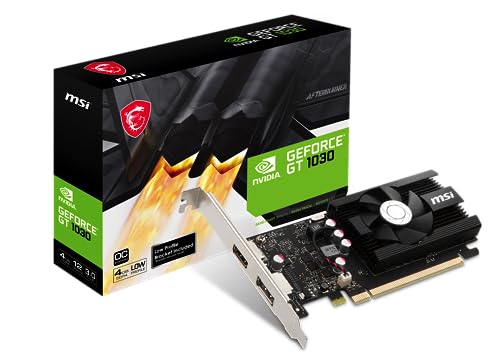
Best for: a slim office or HTPC build that needs modern DisplayPort 1.4a output. Skip it if: you want to play current-gen 3D games.
At 5.91 in long, 2.72 in tall and 0.75 in thick, weighing 0.6 lb, this is the smallest card in the set that still lists full specifications. msi quotes a 1430 MHz boost clock, 4GB of DDR4 memory on a 64-bit interface, and DisplayPort 1.4a plus HDMI 2.0b on the bracket. Those are the two outputs a modern 4K TV or monitor actually wants, which no other low-profile card in this roundup can quite match.
The DDR4 memory is the honest catch. It is slower per bit than GDDR5, so on paper this card sits behind the ASUS GT 1030 2GB in raw bandwidth despite carrying twice the VRAM. msi's own listing does not hide this. Two sellers stock it, and the warranty is 3 years.
Against the ASUS RTX 3050, this card gives up gaming performance in exchange for genuine low-profile height and lower power draw.
Pros:
- 5.91 in length fits slim and SFF cases
- DisplayPort 1.4a plus HDMI 2.0b outputs
- 3-year warranty
- 0.6 lb, the lightest card here
- Two sellers listed
Cons:
- DDR4 memory slower than GDDR5 alternatives
- 64-bit memory bus limits bandwidth
- Not aimed at 3D gaming
3. ARDIYES GT 740 4GB GDDR5 Low Profile — Best budget pick
The cheapest of the six and the only one advertising four HDMI outputs for a quad-monitor desk.
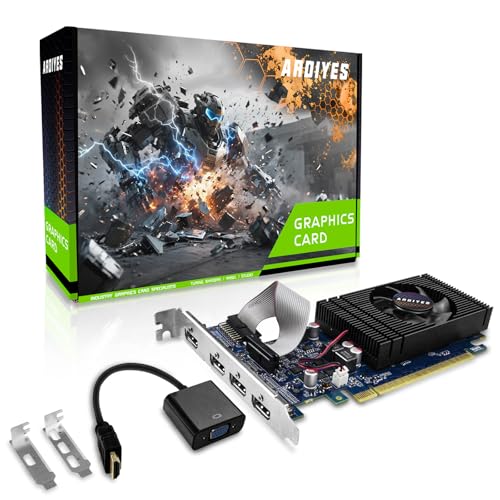
Best for: a four-monitor office or trading setup on the cheapest card in this set. Skip it if: you need more than a 90-day warranty.
The ARDIYES is the cheapest of the six, and it is the only pick advertising four HDMI ports on a single low-profile bracket. ARDIYES describes it as 4GB of GDDR5 on a low-profile PCB with a silent fan, both low-profile and standard brackets in the box, plus a quick start guide and a screwdriver.
There are two honest catches. First, the warranty is 90 days, the shortest in this set by a wide margin: everyone else lists 3 years. Second, the listing does not publish weight, dimensions, boost clock or memory bus width, so you are trusting ARDIYES on the specifications that decide performance. The GT 740 chipset itself is an older Kepler-generation part built for office work, not gaming.
Against the QTHREE GT 730, this one has GDDR5 rather than DDR3, which is the more useful memory type. Against the msi GT 1030, it is much cheaper and adds two extra display outputs, at the cost of the warranty gap.
Pros:
- Cheapest pick here
- Four HDMI outputs for quad monitors
- GDDR5 memory rather than DDR3
- Both low-profile and standard brackets in the box
- Screwdriver and quick start guide included
Cons:
- 90-day warranty, the shortest in this set
- No published weight, length or boost clock
- Kepler-generation chipset, not built for gaming
- Only one seller lists it
4. ASUS GeForce GT 1030 2GB GDDR5 — Best for beginners
A passively cooled, silent, major-brand low-profile card, ideal for a first build.

Best for: a first-time builder wanting a passive, silent card from a major brand. Skip it if: you are building anything more demanding than a media PC.
ASUS quotes a 1506 MHz boost in OC Mode on Pascal architecture, with 2GB of GDDR5 on a low-profile board that measures 6.8 in long and 2.7 in tall. The card is passively cooled, which means it has no fan and makes zero noise. ASUS calls out aerospace-grade Super Alloy Power II components and Auto-Extreme manufacturing, and includes a 1-year premium XSplit Gamecaster license alongside GPU Tweak II software. The warranty is 3 years.
For a first PC build, the appeal is simple: it is small, it is silent, it comes from a major brand with a proper warranty, and Pascal drivers remain well-supported. Two sellers list it.
The 2GB VRAM is the constraint. Where the msi and ARDIYES pack 4GB, this one has half that, so it is more limited for modern browsers, video editors and any game beyond casual titles. Boost clock is faster on paper than the msi's DDR4 card, but VRAM is the binding limit in 2025.
Pros:
- Passive cooling, zero fan noise
- 6.8 in low-profile board fits slim cases
- Faster GDDR5 memory
- 3-year ASUS warranty
- GPU Tweak II software and XSplit license included
Cons:
- Only 2GB VRAM, half of most rivals
- Passive card needs case airflow
- Pascal generation is now dated
5. QTHREE GeForce GT 730 4GB — Best for heavy use
Four display outputs on a genuinely low-profile bracket, aimed at productivity rather than games.

Best for: a productivity workstation running four monitors from a low-profile slot. Skip it if: you want any published warranty at all.
QTHREE lists a GT 730 chipset with 4GB of DDR3 memory on a 64-bit bus and a 1000 MHz memory clock, plus four outputs on the bracket: two HDMI, one DisplayPort and one VGA. That VGA port is worth calling out: it is the only card here that can drive a legacy monitor without an adapter. QTHREE says the card runs on a PCI Express x8 slot and asks for a 300W or greater power supply.
For someone running four spreadsheets across four screens, this is a well-targeted pick. It is the second-cheapest of the six, and only one seller stocks it.
The trade-offs are real. DDR3 is the slowest memory type in this set. There is no published warranty. The card lacks weight and length figures on the listing, so buyers of ITX cases should measure carefully before committing. Against the ARDIYES GT 740, this one has legacy VGA and a slightly newer listing but weaker memory type.
Pros:
- Four display outputs including legacy VGA
- 4GB VRAM at the second-cheapest price
- Low-profile bracket for slim cases
- x8 slot compatibility broadens fitment
Cons:
- No published warranty
- DDR3 is the slowest memory type here
- No listed weight or dimensions
- Only one seller lists it
6. maxsun AMD Radeon RX 550 4GB ITX — Best compact
The only AMD card here, and the widest memory bus outside the RTX 3050.

Best for: an ITX chassis where the 0.04 in profile is the only thing that fits. Skip it if: you want NVIDIA features like DLSS or CUDA.
maxsun publishes a 1183 MHz boost clock, 4GB of GDDR5 on a 128-bit bus with 6000 MHz memory speed, and 512 stream processors. The listed dimensions are 7.28 in long by 1.37 in tall by 0.04 in thick, and it weighs 6.98 oz. That 128-bit bus is meaningfully wider than the 64-bit interface on all three GT 1030 and GT 730 cards, which is the strongest technical argument for this pick. The board carries DVI-D dual link, HDMI and DisplayPort, and maxsun cites a 9cm fan for airflow.
Warranty is 3 years. Only one seller stocks it. The listing markets the card at 3D CAD/CAM, video and photo editing, and 1080p gaming.
The catch is the software stack. This is the only AMD card in the roundup, so features tied to NVIDIA like DLSS, CUDA and NVENC are not available. If you are streaming or running AI tools that expect NVIDIA, this one falls out immediately.
Pros:
- 128-bit memory bus, wider than any GT 1030 or GT 730
- 4GB GDDR5 at 6000 MHz
- Three display outputs including DVI-D dual link
- 3-year warranty
- Compact ITX form factor
Cons:
- No NVIDIA features like DLSS or CUDA
- Only one seller lists it
- 1183 MHz boost is the lowest in the set
Does compact mean low-profile?
This is the trap. Compact and low-profile are not the same thing, and mixing them up is how buyers end up with a card that will not fit.
- Low-profile means the card is short enough (roughly 2.7 in tall) to fit a slim desktop or 1U server case, and usually ships with a shorter bracket in the box. Four cards in this roundup qualify: the msi GT 1030, ARDIYES GT 740, ASUS GT 1030 and QTHREE GT 730. The maxsun RX 550 lists a 1.37 in bracket height that also fits this description.
- Compact just means smaller than a full-size gaming card. The ASUS RTX 3050 6GB is compact at 7.9 in long, but at 4.7 in tall it is a standard dual-slot card and it will not fit a low-profile case.
Before you buy, measure two things in your case: the maximum card length, and the bracket height allowed. If your chassis says low-profile only, cross the ASUS RTX 3050 off the list. If it says up to 200 mm and dual-slot, any of the six will fit.
What the listings do not tell you
Three things I could not verify from the product data, worth checking on the manufacturer page before you buy:
- PCIe generation and lane count. Only the QTHREE listing mentions the slot type (x8) and only ARDIYES mentions PCIe 3.0. The rest leave you guessing. Older boards with PCIe 2.0 slots will still run these cards, just slower.
- Power requirements. Only the QTHREE listing states a recommended power supply (300W). The RX 550 and RTX 3050 draw more; check your PSU headroom.
- Driver support timelines. The GT 730, GT 740 and GT 1030 are Kepler and Pascal generation. NVIDIA continues to publish driver updates for them, but not at the same cadence as Ampere. If you plan to keep the machine five years, the RTX 3050 has the longest runway.
Which pick fits your PC?
Match the pick to what you actually plug it into:
- Full ATX mid-tower with a decent PSU, gaming target: the ASUS RTX 3050 6GB.
- Slim desktop or 1U case, HTPC or office duties: the msi GT 1030 4GB DDR4.
- Four-monitor trading or dispatch desk on a low budget: the ARDIYES GT 740 for HDMI or the QTHREE GT 730 for legacy VGA.
- First-time build in a small case, silent operation prized: the ASUS GT 1030 2GB, because passive cooling means no fan to fail.
- Small ITX chassis with AMD-friendly software: the maxsun RX 550.
If the modifier that brought you here was budget, the ARDIYES GT 740 is the cheapest of the six but the 90-day warranty stings. The QTHREE GT 730 is second-cheapest and adds a legacy VGA output, though it publishes no warranty at all. Neither is a gaming card. If gaming is what "budget compact graphics card" means to you, stretch to the ASUS RTX 3050 6GB and accept that it is not low-profile.
The verdict
The ASUS Dual GeForce RTX 3050 6GB OC is the best budget compact graphics card in this set, because it is the only one built on a current gaming architecture. A 1500 MHz OC boost clock, 6GB of GDDR6, and Ampere's 2nd-generation RT Cores put it in a different league from every GT 1030, GT 730 and GT 740 here. The 3-year warranty and the dual-fan cooler back that hardware up. It is the most expensive pick here, and it needs a case that accepts a 7.9 in dual-slot card.
Two conditions flip the recommendation. First, if your case is strictly low-profile, the RTX 3050 will not fit, so the msi GeForce GT 1030 4GB DDR4 LP OC wins on its 5.91 in length and modern DisplayPort 1.4a plus HDMI 2.0b outputs. Second, if the whole point of a budget compact graphics card is driving four office monitors for as little cash as possible, the ARDIYES GT 740 4GB GDDR5 takes it on price and its four-HDMI bracket, provided the 90-day warranty is a trade you can accept.
FAQ
Is a budget compact graphics card enough for modern gaming?
A budget compact graphics card is enough for modern gaming only if you pick the right one. In this set, only the ASUS RTX 3050 6GB carries a current-generation NVIDIA chip with DLSS support, so it is the sole option for 1080p gaming in recent titles. Everything else is aimed at office work, HTPC use or older games.
Is the ASUS RTX 3050 6GB worth the price premium?
The ASUS RTX 3050 6GB is worth the premium if you actually play games. You are paying for a generational leap: Ampere silicon with 2nd-generation RT Cores, 3rd-generation Tensor Cores, 6GB of GDDR6, and DLSS. None of the older Pascal or Kepler cards here can match that. If you only browse and stream video, it is overkill.
How does the msi GT 1030 DDR4 compare to the ASUS GT 1030 GDDR5?
The msi GT 1030 DDR4 and the ASUS GT 1030 GDDR5 use the same chipset but different memory. msi carries 4GB of DDR4, ASUS carries 2GB of GDDR5. The ASUS is faster per bit but has half the VRAM. Choose msi for slim cases needing DisplayPort 1.4a and HDMI 2.0b, choose ASUS for passive cooling and silent operation.
Will these cards fit a low-profile or ITX case?
Fit depends on the specific card. The msi GT 1030, ASUS GT 1030, ARDIYES GT 740 and QTHREE GT 730 all ship as low-profile boards with the shorter bracket. The maxsun RX 550 lists ITX dimensions. The ASUS RTX 3050 is 4.7 in tall and will not fit a low-profile slot. Measure your case length and bracket height first.
What is the biggest mistake buyers make in this category?
The biggest mistake buyers make is treating VRAM capacity as the deciding specification. In practice, memory bus width and memory type matter as much. A 4GB DDR3 card on a 64-bit bus feeds its shaders more slowly than a 4GB GDDR5 card on a 128-bit bus. Compare bandwidth, not just gigabytes, when the price gap is small.
Start with the shape of your case, then the workload. If you have room for the ASUS RTX 3050 6GB and games are in your plans at all, that is the pick that will still feel current in three years, because it is the only card here that is current now. Everything else in this roundup is a productivity, HTPC or legacy-monitor pick, and they earn their spots by being cheaper, smaller or quieter than the RTX 3050 rather than faster. Buy for the workload you actually have this month, and match the bracket height to the case before you check out.