Best Budget Filament Dryer: Comgrow Takes It

Five filament dryers compared on published temperature ceilings, spool capacity and chamber layout, with a clear note on which ones can actually reach engineering-material territory.

By Samuel HarrisUpdated 15 min read
On this page
- Best budget filament dryer for engineers at a glance
- How I matched five dryers to five kinds of user
- Why does the temperature ceiling decide this purchase?
- 1. Comgrow 3D Printer Filament Dryer Box — Best overall
- 2. Polymaker Polydryer Filament Dryer & Storage Box — Most versatile
- 3. SUNLU Official Filament Dryer S2 — Best compact
- 4. Official Creality Space Pi X4 Filament Dryer — Best for families
- 5. SUNLU E2 3D Printer Filament Dryer — Best premium
- Can a budget dryer really handle nylon and PC?
- One spool, two spools or four?
- What more money buys across this set
- The verdict
- FAQ
The best budget filament dryer for engineers is the Comgrow 3D Printer Filament Dryer Box, because it holds two 1 kg spools in a 9 x 9.2 x 6.4 in shell and costs the least of the five here. If your material list runs to nylon or polycarbonate, the SUNLU E2 and its claimed 110°C chamber is the pick instead. The gap between those two is a 60°C swing in ceiling temperature, and that single number decides more of this category than capacity or screen size ever will.
Most guides here compare spool counts. The ceiling is what splits the field: 50°C dries PLA and PETG, and nothing above them.
Best budget filament dryer for engineers at a glance
| Pick | Max temp (claim) | Spool capacity | Price |
|---|---|---|---|
Best overall Comgrow 3D Printer Filament Dryer Box |
50°C claim | 2 spools | Check Price |
Most versatile Polymaker Polydryer Filament Dryer & Storage Box |
Not published | 1 spool (1 kg) | Check Price |
Best compact SUNLU Official Filament Dryer S2 |
70°C claim | 1 spool, 210 x 85 mm | Check Price |
Best for families Official Creality Space Pi X4 Filament Dryer |
85°C claim | 4 spools | Check Price |
Best premium SUNLU E2 3D Printer Filament Dryer |
110°C claim | 1 chamber, dual-zone | Check Price |


How I matched five dryers to five kinds of user
I did not rank these on a single score. Filament drying splits cleanly by who is doing it, so I sorted the five listings into five buyer profiles first, then checked which product's published numbers fit each one.
- The PLA-and-PETG hobbyist with two open spools. Wants volume for the least outlay. Needs a ceiling around 50°C and room for 2 kg. That is the Comgrow, and it's the cheapest of the five.
- The tidy printer who hates re-drying. Cares more about sealed storage than raw heat. Polymaker's Polydryer pairs a dock with a storage box, which no other pick here does.
- The single-printer desk. One spool at a time, small footprint, and a published warranty as reassurance. The SUNLU S2 lists 1 year and measures 10.9 x 4 x 9.8 in.
- The shared workshop or family shop. Two materials running at once. Creality's Space Pi X4 lists four spool slots and two independently controlled chambers.
- The engineering-material user. PA, PC, glass- and carbon-filled nylon. Only the SUNLU E2 claims a chamber that goes near where those materials need to sit.
What got cut in the process: anything whose listing published neither a temperature figure nor a capacity figure, because those two numbers are the whole decision. The Polydryer survived that filter on capacity alone, which is why it sits second rather than first.
A note on the word "engineers" in the search itself. Amazon's results for a best budget filament dryer for engineers do not filter for engineering-grade materials, and only one product in this set publishes a claim that reaches into that territory. Treat the qualifier as something you verify against your own material list rather than something the search guarantees.
Why does the temperature ceiling decide this purchase?
Every dryer here blows warm air past a spool. The difference is how warm.
PLA and PETG give up moisture in the 45 to 55°C range. Nylon, polycarbonate and their filled variants sit far higher, which is why the same box that revives a wet PLA spool overnight does very little for a bag of PA6-CF. A dryer that cannot reach the material's drying temperature is not a slow dryer. It's the wrong tool.
That is the trap in the specification most buyers compare first. Spool count is easy to read off a listing and easy to feel good about. Four slots at 85°C serve a different user than two slots at 50°C, and neither number tells you anything on its own.
Here is how the claimed ceilings in this set stack up:
- Comgrow: 40 to 50°C adjustable, 50°C stated maximum
- SUNLU S2: 70°C stated maximum
- Creality Space Pi X4: 85°C from dual 200W PTC heaters
- SUNLU E2: 110°C, with a 500W PTC heater and 325W rated power
- Polymaker Polydryer: no temperature figure published
Those are manufacturer claims, printed on the listings, not measurements I made. Read them as the brand's design target. If your material's data sheet asks for a temperature above the number on the box, no amount of runtime closes that gap. Anyone shopping for a best budget filament dryer for engineers should start from their filament shelf, not the product grid.
1. Comgrow 3D Printer Filament Dryer Box — Best overall
The cheapest pick here is also the only one that dries two full spools, which is exactly the trade most PLA and PETG printers should take.
Best for: PLA and PETG printers who want two spools dried at once for the least outlay Skip it if: you print nylon, PC or carbon-filled blends
Two spools, cheapest price position, transparent shell. That combination doesn't repeat anywhere else in this set. The published inner dimensions are 9.29 x 6.49 x 9.13 in, and Comgrow says that fits two 1 kg rolls of 1.75mm or 2.85mm PLA, ABS or silk filament. The outer shell measures 9 x 9.2 x 6.4 in and the unit weighs 3.31 lb, so it sits on a shelf without a plan.
The controls are deliberately narrow. Comgrow lists an adjustable range of 40 to 50°C, with 50°C as the hard maximum, and timer settings from 6 to 12 hours. The listing also mentions real-time temperature and humidity readout. Set it for an overnight run and you're using it the way it was designed.
That 50°C ceiling is the whole story, though. It's the lowest in this comparison by 20°C, and it puts nylon, PC and filled blends out of reach permanently. The transparent body helps you confirm a spool is seated, but it insulates worse than the sealed black boxes here. And only two sellers list it, which narrows your options if one goes quiet.
Pros:
- Cheapest of the five picks
- Two 1 kg spools in one chamber
- Published inner dimensions of 9.29 x 6.49 x 9.13 in
- Timer spans 6 to 12 hours
- Transparent shell shows spool position
Cons:
- 50°C ceiling rules out nylon, PC and filled blends
- Lowest maximum temperature in this set
- No warranty listed
- Only two sellers stock it
2. Polymaker Polydryer Filament Dryer & Storage Box — Most versatile
The only pick that treats drying and sealed storage as one continuous loop rather than two separate jobs.

Best for: anyone who wants drying and sealed storage in one loop Skip it if: you need to dry more than one spool at a time
Polymaker sells this as a dock plus a storage box, and that structure is the point. The listing describes moving a spool from heated drying into sealed storage and then feeding it directly to the printer without breaking the seal. It also mentions desiccant support and built-in humidity monitoring. Every other pick here dries a spool and then hands the moisture problem back to you.
The published dimensions are 11.4 x 9.25 x 4.72 in and the weight is 2.87 lb, making it the lightest of the four picks that publish a weight. It's rated for 1 kg spools and the listing names PA Nylon, PLA, PVB, PETG, ABS, ASA and TPU across 1.75mm, 2.85mm and 3mm diameters. It also sells faster than any other pick in this comparison.
The gap is a big one: the listing publishes no maximum temperature. For a category where the ceiling is the deciding number, that absence matters. Compatibility with PA Nylon appears in the feature copy, but without a stated temperature you cannot check it against a material data sheet. Capacity is also the narrowest here at a single 1 kg spool.
Pros:
- Only pick pairing a dryer dock with sealed storage
- Feeds filament while the box stays sealed
- Lightest here at 2.87 lb
- Covers 1.75mm, 2.85mm and 3mm diameters
- Sells faster than the rest of this set
Cons:
- No maximum temperature published anywhere on the listing
- One 1 kg spool at a time
- No warranty listed
- Two-part design means more to store when idle
3. SUNLU Official Filament Dryer S2 — Best compact
The only pick in this set with a published warranty, wrapped around a 70°C claim and a slim 4-inch-deep body.
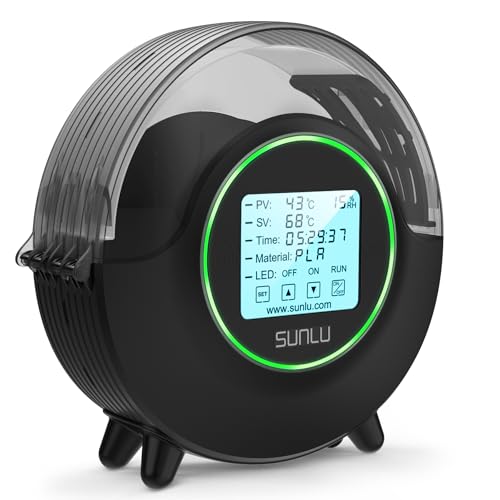
Best for: a single-printer desk with a published warranty as the tiebreaker Skip it if: you rotate between two filament types weekly
At 10.9 x 4 x 9.8 in, the S2 is the narrowest unit here. That 4-inch depth matters on a crowded bench, and at 3.3 lb it moves easily. It is the second-cheapest of the five, and the only one whose listing publishes a warranty at all: 1 year.
SUNLU claims 360° circular heating and a 70°C maximum, aimed at stringing, clogging and poor first-layer adhesion from wet filament. The control surface is a 4.6-inch LCD touch screen showing temperature, time, humidity, filament type and countdown, which is the most detailed readout of any pick in this comparison. Holder capacity is listed at 210 x 85 mm, and the compatibility line names 1.75, 2.85 and 3.00mm PLA, PETG, ABS, TPU, Nylon, PA and PC.
Treat that Nylon and PC mention carefully. 70°C is 40°C below what the E2 claims, so the compatibility list reads as "it will fit" rather than "it will fully dry". Capacity is one spool, so weekly material swaps mean waiting. And the case is opaque, so you check the screen rather than the spool.
Pros:
- Only pick with a published warranty, at 1 year
- Narrowest body here at 4 in deep
- 4.6-inch touch screen with humidity readout
- 70°C claimed ceiling beats the cheapest pick by 20°C
- Three sellers list it, the most in this set
Cons:
- Single-spool capacity
- 70°C is short of PA and PC drying territory
- Opaque case hides spool position
- Listed size figure of 3.42 x 2.87 in is ambiguous next to the full dimensions
4. Official Creality Space Pi X4 Filament Dryer — Best for families
Four spool slots and two separately controlled chambers, so two materials dry at two temperatures at the same time.
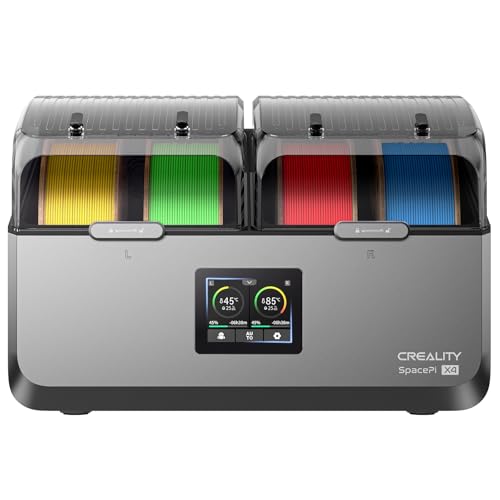
Best for: a household or shop running two materials at once Skip it if: you want a published chamber footprint before buying
Capacity is the headline: four spools, listed as dry-and-print-at-once. What makes it useful rather than just big is the dual-chamber design. Creality says each chamber has its own 200W PTC heater with independent temperature control, so PLA at one setting and PETG at another can run side by side. Nobody else in this set offers that split.
Combined heater output is listed at 200W + 200W with a claimed 85°C maximum, second only to the E2, and the listing names PLA, PETG, ABS, TPU, ASA, PC, PA and PAHT. Single- or dual-chamber modes are offered as a power-saving choice, so you're not heating four bays to dry one spool. Model is DB-05, and it's the lightest unit in the group at 2.2 lb.
Two real gaps. The listing publishes no dimensions, so you cannot check bench clearance for a four-spool box before it arrives. And there's a warning in the feature copy about third-party plastic trays needing to be heat resistant, with a nudge toward Creality's own RFID filament. That's a constraint worth reading twice if your spools come from mixed brands. It also sits in the more expensive half of this set.
Pros:
- Four spool slots, the largest capacity here
- Two independently heated chambers
- 85°C claimed ceiling, second highest in this set
- Single- or dual-chamber modes to cut power draw
- Lightest unit here at 2.2 lb
Cons:
- No dimensions published, so bench fit is a guess
- Listing warns against non-heat-resistant third-party spool trays
- No warranty listed
- Sits in the more expensive half of the group
5. SUNLU E2 3D Printer Filament Dryer — Best premium
The only pick claiming 110°C, and the only one that anneals finished parts as well as drying filament.

Best for: PA, PC and glass-filled nylon work, plus annealing Skip it if: you print PLA and nothing else
This is the pick that changes what the category can do. SUNLU lists a 110°C maximum from a 500W PTC heater at 325W rated power, and claims 70°C in about 30 minutes. The E2 is described as a dry-and-anneal 2-in-1: the same chamber that dries PA, PC and GF/CF nylon variants also relaxes internal stress in printed parts and cools them slowly. Nothing else here does the second job.
The construction reflects the higher target. SUNLU lists a one-piece silicone plug, dual-chamber heating and an ultra-airtight body. Dimensions are 10 x 7 x 14 in, and the weight is 17 lb, more than five times the Comgrow. That mass is insulation and heater, and it's why the temperature claim is plausible in a way a lightweight transparent box could never be.
It's also the most expensive pick here, and it's the slowest seller of the five. If your shelf is PLA and PETG, you're paying for a 60°C band of capability you'll never use, in a unit that takes real bench space. The 14-inch height rules out low shelves. Only two sellers list it.
Pros:
- 110°C claimed maximum, highest in this set
- Only pick that anneals printed parts
- 500W PTC heater, claimed 70°C in 30 minutes
- Sealed silicone plug and dual-chamber heating
- Aimed squarely at PA, PC and filled nylon
Cons:
- Most expensive pick in this comparison
- 17 lb and 14 in tall, the bulkiest here by far
- Wasted capability for PLA-only printing
- Slowest seller of the five, and only two sellers list it
Can a budget dryer really handle nylon and PC?
Partly, and the honest answer depends on which end of "budget" you mean.
Three of these listings name Nylon or PC in their compatibility text. Only one publishes a temperature that reaches where those materials actually want to sit. Compatibility copy tells you a spool fits and won't melt the tray. It does not tell you the chamber gets hot enough to pull moisture out of a hygroscopic engineering polymer.
So the practical split in this set looks like this:
- 50°C (Comgrow): PLA, PETG, ABS territory. Nylon and PC are out.
- 70°C (SUNLU S2): comfortable with ABS and TPU, marginal for PA and PC.
- 85°C (Creality X4): the listing calls this ideal for engineering filaments, and it's the closest an entry-to-mid box gets.
- 110°C (SUNLU E2): the only claim in this group written specifically around PA, PC and GF/CF variants.
If you print one filled nylon spool a year, the S2 or X4 plus a longer runtime is a defensible compromise. If filled nylon is your default material, the cheapest pick in this comparison is not a compromise, it's a mismatch. That is the uncomfortable part of shopping for a best budget filament dryer for engineers: the qualifier and the price band pull against each other.
One spool, two spools or four?
Capacity is where people overspend, because slot count reads like value.
Count how many spools you have open at once, right now. Most single-printer setups run one, occasionally two during a colour change. Four bays are for a household with two printers, or a shop where PLA and PETG both need to stay dry through the week. Otherwise you're heating empty space.
The set breaks down cleanly. Polymaker's Polydryer and the SUNLU S2 take one spool each. Comgrow takes two 1 kg rolls in a single 9.29 x 6.49 x 9.13 in chamber. Creality's X4 takes four across two chambers. The E2 is a single tall chamber built for temperature rather than volume.
One nuance worth catching: two spools in one chamber is not the same as two spools at two temperatures. Comgrow's pair shares one 40 to 50°C setting. Creality's two chambers each get their own 200W heater and their own control, which is why the X4 earns its slot count in a way a wide single-chamber box would not.
What more money buys across this set
The step up from entry to premium here buys temperature and sealing, not features.
The cheapest pick gives you a transparent 2 kg box, a 6 to 12 hour timer and a 50°C ceiling. Move to the other entry-price pick and you gain 20°C, a 4.6-inch touch screen, a 1-year warranty and a 4-inch-deep footprint, in exchange for half the capacity. That's the sharpest trade in the group.
The mid position buys a structural idea rather than a number. Polymaker's dock and sealed box keep filament dry between prints, which for many people is the actual failure mode: they dry a spool, then leave it on a shelf for three weeks.
The two premium picks split the difference two ways. Creality spends the money on four slots, two independent chambers and 85°C. SUNLU's E2 spends it all on heat and mass: 110°C, a 500W PTC heater, 17 lb of insulated body, and an annealing mode nothing else here offers. Neither is better in the abstract. One buys breadth, one buys depth.
The verdict
Entry tier. The Comgrow box is where most people should land. Two 1 kg spools in a 9 x 9.2 x 6.4 in shell at the lowest price position in this set, with a 6 to 12 hour timer and a 40 to 50°C range that covers PLA and PETG properly. Its ceiling is the compromise, and if your shelf is PLA and PETG, it's not really a compromise at all. The SUNLU S2 is the alternate at this tier: 20°C more headroom, a 1-year warranty, a 4.6-inch touch screen, and half the capacity.
Mid tier. Polymaker's Polydryer earns its place by solving storage rather than heat. Dry a spool, seal it, feed the printer through the box. The missing temperature figure is a genuine gap, so pick it for the workflow, not the ceiling.
Premium tier. Two different answers. Creality's Space Pi X4 buys capacity and flexibility: four spools, two independently heated chambers, 85°C. SUNLU's E2 buys depth: 110°C, a 500W PTC heater, and annealing, in a 17 lb body. If PA, PC and filled nylon are your normal materials, the E2's ceiling is the only one in this comparison that meets them, and that's worth the bulk and the price position.
FAQ
Is a cheap filament dryer worth buying at all?
A cheap filament dryer is worth buying if wet filament is causing your problem. Stringing, popping and weak layer adhesion in PLA and PETG usually clear up with a 50°C overnight run, which the Comgrow handles for the lowest outlay here. What a cheap box cannot do is dry nylon or polycarbonate, because those need temperatures above its 50°C ceiling.
How do I choose the best budget filament dryer for engineers?
Choosing the best budget filament dryer starts with your material list, not the price. Write down every filament you print, check each data sheet's drying temperature, then find the cheapest published ceiling that clears the highest number on your list. Capacity and screen size come second. A box that cannot reach your material's temperature is the wrong purchase at any price.
What temperature does a filament dryer need to reach?
The temperature a filament dryer needs depends entirely on the polymer. PLA and PETG release moisture around 45 to 55°C, which the Comgrow's 40 to 50°C range covers. ABS and TPU sit higher, closer to the SUNLU S2's claimed 70°C. PA, PC and their filled variants are why the SUNLU E2 advertises 110°C.
Comgrow or SUNLU E2: which should I get?
Comgrow or SUNLU E2 comes down to one question. If you print PLA, PETG and ABS, take the Comgrow: two 1 kg spools, the lowest price position in this set, and a 50°C ceiling that's sufficient for those materials. If you print PA, PC or glass-filled nylon, take the E2. Its claimed 110°C chamber and annealing mode have no substitute here.
What mistake do first-time dryer buyers make?
The mistake first-time dryer buyers make is drying a spool and then storing it in open air. Moisture returns within days, and the whole cycle repeats. That's why Polymaker's dock-plus-sealed-box design matters more than its unpublished temperature figure. Whatever you buy, pair it with sealed bags and fresh desiccant, or you'll be re-drying the same spool monthly.
Start from your filament shelf. If everything on it is PLA, PETG or ABS, the Comgrow box handles the job at the lowest cost in this group, and the 2 kg capacity means you're not queuing spools. If there's a bag of PA6-CF or a polycarbonate roll sitting there, the 50°C ceiling makes that decision for you and the SUNLU E2 becomes the sensible buy despite the bulk. The reason the Comgrow leads is simple: for the majority of printers, the extra 60°C of headroom is capability they'll never switch on.