Best Filament Dryer by Capacity and Heat Range

Six filament dryers compared on capacity, heat range and desk footprint, so a remote worker printing between calls knows exactly which one belongs on the shelf.

By Samuel HarrisUpdated 16 min read
On this page
- Best filament dryer for remote workers at a glance
- Does a filament dryer belong on a home-office desk?
- How I cut the field down to six
- What actually decides this purchase
- 1. Comgrow 3D Printer Filament Dryer Box — Best overall
- 2. 2026 New Official CREALITY Space Pi Filament Dryer Plus — Best upgrade
- 3. SUNLU Official Filament Dryer S2 — Most versatile
- 4. SUNLU S4 3D Printer Filament Dryer — Best warranty
- 5. Chitu Systems E1 Filament Dryer 4 Spools — Best minimal setup
- 6. Official Creality Filament Dryer — Best premium
- How much heat does your filament really need?
- What the listings do not tell you
- The verdict
- FAQ
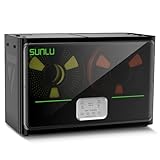
The best filament dryer for remote workers is the Comgrow 3D Printer Filament Dryer Box, because it holds two 1kg spools in a 9 x 9.2 x 6.4 in body that fits a home-office shelf and tops out at a quiet 50°C. If you print nylon or polycarbonate, the Official Creality Filament Dryer reaches 85°C across dual chambers and is the better buy. Here is the 30-second shortlist: Comgrow for PLA and PETG at a desk, the Creality Space Pi Plus if you dry two spool types at once, the SUNLU S4 if you want four spools with a stated warranty.
Best filament dryer for remote workers at a glance
| Pick | Capacity | Max heat | Price |
|---|---|---|---|
Best overall Comgrow 3D Printer Filament Dryer Box |
2 spools | 50°C claim | Check Price |
Best upgrade CREALITY Space Pi Filament Dryer Plus |
2 spools | 160W PTC claim | Check Price |
Most versatile SUNLU Official Filament Dryer S2 |
1 spool | 70°C claim | Check Price |
Best warranty SUNLU S4 3D Printer Filament Dryer |
4 spools | 70°C claim | Check Price |
Best minimal setup Chitu Systems E1 Filament Dryer |
4 spools | 120W PTC claim | Check Price |
Best premium Official Creality Filament Dryer |
4 spools | 85°C claim | Check Price |




Does a filament dryer belong on a home-office desk?
Short answer: yes, if you print at home between other work. Wet filament is the quiet reason a print fails overnight while you sleep. It strings, it pops, it clogs the nozzle. A dryer keeps a spool ready so you are not babysitting a failed job.
The catch is that "remote workers" is not a spec any dryer publishes. None of these six is built for an office rather than a workshop. So judge the fit yourself, on three things a listing does tell you:
- Footprint. Will it sit on a shelf without eating your desk? The Comgrow is 9 x 9.2 x 6.4 in. The Creality Space Pi Plus is 13.3 x 8.6 x 11.8 in.
- Noise. Every unit here runs a circulation fan. A lower max temperature and a smaller heater usually mean a quieter run, which matters if you are on calls.
- Weight. If you move it off the desk between prints, 3.31 lb is easy and 8.82 lb is not.
A filament dryer earns its place when it disappears into the room. That is the whole test for a home office. The rest of this guide is about which one disappears best for your filament.
How I cut the field down to six
I started with the listings and cut on disqualification, not on preference. Three reasons removed the most candidates.
First, no published capacity. A dryer that never states how many spools it holds is guesswork for a home shelf, and I dropped those. Every pick here names a count: 2 spools for the Comgrow, 4 for the SUNLU S4.
Second, no meaningful temperature control. Wet PETG and wet nylon need different heat. Units that offered a single fixed setting were cut in favour of ones that publish a range or a per-filament preset. The SUNLU S4 lists 35-70°C. The Creality X4 lists a max of 85°C.
Third, an unworkable footprint for a desk. This is the "remote worker" screen, and it is a soft one, because no listing is built for an office. I kept the six that a shopper could plausibly park on a shelf and judge for themselves, and I noted the widest bodies so you can measure before you buy.
What survived splits cleanly: three 2-spool boxes and three 4-spool boxes. I compared the published specifications side by side, lined up the size and weight figures, and let capacity and heat range do the ranking. Feature bullets I treat as the maker's claims, not measured fact.
What actually decides this purchase
Most guides to the best filament dryer for remote workers compare max temperature. That is the wrong first cut. Almost nothing a home printer runs needs the top of these ranges.
The real deciding criterion is capacity matched to how you print. If you swap between one PLA and one PETG spool, a 2-spool box is exactly right and anything bigger is wasted desk. If you print long jobs across several materials, a 4-spool box saves you from reloading mid-run.
Heat range matters second, and only if your filament demands it. PLA and PETG dry fine at the lower end. Only nylon, PC and some ASA justify reaching for 85°C.
- PLA and PETG only: capacity decides everything, heat is a non-issue.
- Occasional TPU or nylon: you want a range topping 70°C.
- Regular engineering filament: dual chambers and 85°C earn their place.
Pick capacity first, heat second, footprint third. Do it in that order and the six-way choice collapses to two or three real options.
1. Comgrow 3D Printer Filament Dryer Box — Best overall
The Comgrow is the right default for a home office because it holds two 1kg spools in the smallest body here and runs cool enough to sit near you.
Best for: a home-office printer running PLA and PETG only Skip it if: you print nylon or PC and need heat above 50°C
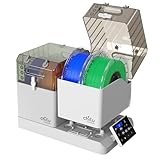
What sets the Comgrow apart in this set is size against capacity. At 9 x 9.2 x 6.4 in and 3.31 lb, it is the most compact 2-spool box here, and it is the cheapest of the six. Comgrow says the inner space fits two rolls of 1kg spools in PLA, ABS or silk. That is real desk value: two materials staged and dry, in a body smaller than the Creality Space Pi Plus by inches on every side.
The trade-off is heat. Comgrow lists an adjustable range of 40 to 50°C, with 50°C as the ceiling, and a timer from 6 to 12 hours. That covers PLA and PETG comfortably. It does not reach the 70°C that nylon and some ASA want, so this is a PLA-and-PETG tool, not an everything tool. The transparent body lets you eyeball a spool without opening it, and the listing notes real-time temperature and humidity readouts. Against the pricier picks, you give up a stated warranty and the higher heat, and you gain the quietest, smallest footprint of the group.
Pros:
- Smallest footprint of any pick, 9 x 9.2 x 6.4 in
- Cheapest of the six
- Holds two 1kg spools despite the compact body
- Transparent body for at-a-glance spool checks
- Low 50°C ceiling means a cooler, quieter run
Cons:
- 50°C max is too low for nylon or PC
- No warranty stated on the listing
- Timer caps at 12 hours, shorter than rivals
- Only two sellers list it
2. 2026 New Official CREALITY Space Pi Filament Dryer Plus — Best upgrade
The Space Pi Plus is the step up when you want two spool types staged and a one-key preset for each filament.
Best for: someone drying two spool types at once between calls Skip it if: your desk cannot spare a 13-inch-wide footprint
The Space Pi Plus is the pick that buyers reach for most often in this set, and the reason shows in the listing. Creality says it holds two 1kg rolls, adds four filament holes and two PTFE pipes for drying while printing, and offers one-key temperature presets for up to 12 filament types. For a remote worker, that preset menu is the appeal: you pick the material, it sets the heat, and you get back to work.
It also claims double 360° PTC hot-air heating and a 4-inch LCD touch screen. At 4.19 lb it is light for its class, though its 13.3 x 8.6 x 11.8 in body is the widest of the 2-spool group and wider than the whole Comgrow. Creality lists lifetime technical support on this model, which is worth noting even without a formal warranty figure.
The trade-off is the footprint. You are paying a mid-range position and giving up desk space for the preset convenience and the dual-drying pipes. If your printer runs one material at a time, the Comgrow does the same job smaller and cheaper. If you juggle two, this is the more capable box.
Pros:
- One-key presets for up to 12 filament types, per the listing
- Two PTFE pipes for drying while printing
- Light at 4.19 lb for a dual-bay unit
- 4-inch LCD touch screen for clear readouts
- Lifetime technical support stated by Creality
Cons:
- Widest 2-spool body here at 13.3 in
- No maximum temperature published on the listing
- Mid-range price for the same 2-spool capacity as the Comgrow
- Only two sellers list it
3. SUNLU Official Filament Dryer S2 — Most versatile
The S2 is the single-spool pick that still reaches 70°C, so it covers occasional nylon without taking much room.
Best for: a single-printer setup that occasionally runs TPU or nylon Skip it if: you need to dry more than one spool at a time
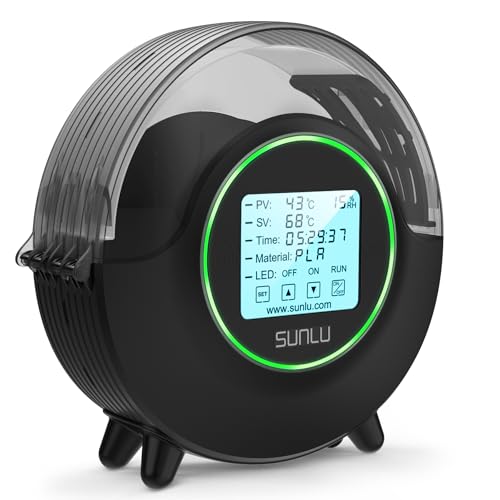
The S2 earns "most versatile" on heat range, not size. SUNLU says the maximum temperature can be set to 70°C, which is 20°C above the Comgrow's ceiling and enough to touch nylon, PA, PC and TPU. The listing calls out compatibility with 1.75, 2.85 and 3.00mm filaments across PLA, PETG, ABS, TPU, nylon, PA and PC. For a home printer that mostly runs PLA but sometimes needs more, that headroom is the point.
It carries a 4.6-inch LCD touch screen showing temperature, time, humidity, filament type and countdown, and SUNLU claims 360° circular heating to fight stringing and clogging. It weighs 3.3 lb, close to the Comgrow, and its body measures 10.9 x 4 x 9.8 in, a narrow 4-inch depth that suits a tight shelf. A 1-year warranty is listed.
The limit is capacity. The S2 holds a single spool, so it cannot stage two materials at once the way the Comgrow or the Space Pi Plus can. It is the versatile option for one-spool workflows, and the wrong tool the moment you want two ready together.
Pros:
- 70°C max covers nylon, PC and TPU per SUNLU
- Narrow 4-inch depth fits a tight shelf
- 4.6-inch LCD shows humidity and filament type
- 1-year warranty listed
- Broad diameter support, 1.75 to 3.00mm
Cons:
- Single-spool capacity only
- Cannot stage two materials at once
- Heavier per spool than the multi-bay picks
- Slower seller than the top two picks here
4. SUNLU S4 3D Printer Filament Dryer — Best warranty
The S4 is the four-spool workhorse with a stated 1-year warranty, built for printers who run long jobs across materials.

Best for: a heavy printer who wants four spools and a stated warranty Skip it if: shelf space or a quiet desk matters more than capacity
The S4 is where this list stops being desk-friendly and starts being serious. SUNLU says it dries up to four 1kg spools at once, uses three circulation fans for even heat, and runs a 350W PTC heater, the highest published wattage of the six. Its temperature range is 35-70°C and its timer stretches to 99 hours, far beyond the Comgrow's 12. Eight filament exit holes let several printers feed from one box.
For a remote worker, the honest note is size. At 12.2 x 18.1 x 8.66 in and 8.82 lb, it is the biggest and heaviest pick here. This is a floor or bench unit, not a desk one. The upside is the 1-year warranty, matched only by the S2 in this group, plus the sheer throughput of four spools kept dry together.
Against the Creality X4, which also holds four spools, the S4 trades the X4's higher 85°C ceiling for a stated warranty and a lower mid-range price. If your filament stays under 70°C and you want cover on the purchase, the S4 is the more reassuring buy.
Pros:
- Four 1kg spools dried at once
- 350W PTC heater, highest published wattage here
- Timer runs to 99 hours
- Eight exit holes for multiple printers
- 1-year warranty listed
Cons:
- Biggest footprint in the set, 18.1 in wide
- Heaviest pick at 8.82 lb
- Too large for most desks
- 70°C ceiling below the premium picks
5. Chitu Systems E1 Filament Dryer 4 Spools — Best minimal setup
The E1 is the hands-off four-spool box, built to hold a set humidity and get out of your way.
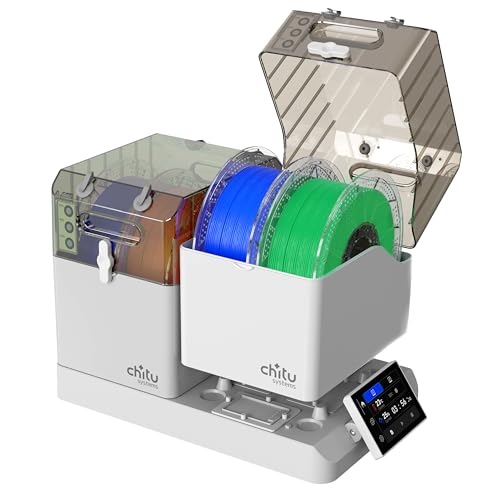
Best for: an AMS Lite owner who wants set-and-forget humidity holding Skip it if: you want the widest published spec sheet for the money
The E1 is the pick for someone who does not want to think about drying. Chitu Systems says it holds four spools across two removable chambers, each with independent heating, and that a high-precision humidity sensor holds a target automatically. The listing calls out AMS Lite compatibility, which matters if you run a multi-material setup and want the dryer to feed it.
It uses two 120W PTC heaters with dual fans for 360° circulation, plus a 4-inch touch screen. At 7.72 lb it is lighter than the SUNLU S4 while matching its four-spool count. The separate-chamber design means you can dry two materials at different needs at once, then leave it holding while you work.
The catch is the thin spec sheet. The listing publishes no dimensions, no temperature range and no warranty, so you are trusting the auto-humidity claim more than a numbers table. It is also the slowest seller of the six and sits at a premium price. If you value published detail over hands-off convenience, the S4 or the X4 tell you more before you buy. If you want to set it and forget it, the E1 is built for exactly that.
Pros:
- Auto-humidity hold for hands-off running
- Four spools across two removable chambers
- AMS Lite compatible per the listing
- Independent heating per chamber
- Lighter than the SUNLU S4 at 7.72 lb
Cons:
- No dimensions, temperature range or warranty published
- Premium price for a thin spec sheet
- Slowest seller of the six
- Only two sellers list it
6. Official Creality Filament Dryer — Best premium
The Space Pi X4 is the pick for engineering filament, with dual independent chambers reaching 85°C.
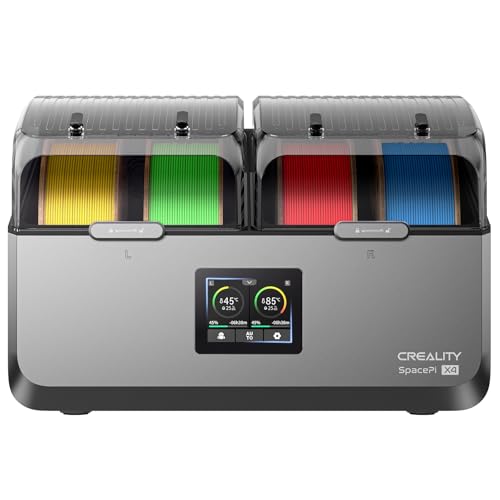
Best for: an engineering-filament user drying two types at different temps Skip it if: you only ever print PLA and want to spend the least
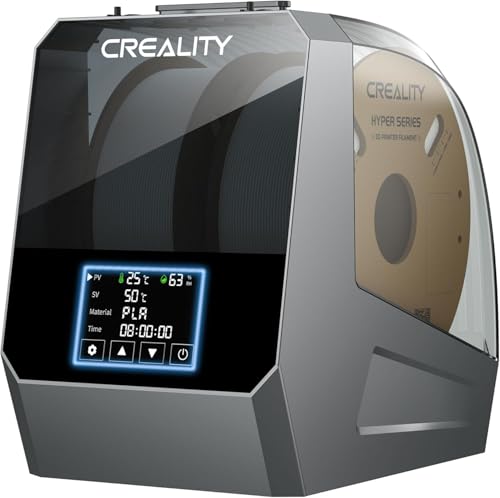
The X4 is the only pick here that reaches 85°C, and that single figure is why it sits at the top of the price positions. Creality says it uses dual 200W PTC heaters, one per chamber, with insulated walls so each chamber holds an independent temperature. That means you can dry PETG in one side and nylon in the other, at once, at the heat each needs. For anyone running PC, PA or ASA, that is the feature that justifies the spend.
It holds four spools and lists a DB-05 model number. Curiously, its published weight is just 2.2 lb, the lightest of the four-spool group by a wide margin, though the listing gives no dimensions to judge the footprint. Creality also flags a note about using heat-resistant trays, which is a fair warning at 85°C.
The trade-off is plain: it is the most expensive pick here, and every degree above 70°C is wasted if you only print PLA and PETG. For an engineering workflow it is the strongest tool in the set. For a PLA desk, the Comgrow does the job for far less.
Pros:
- 85°C max, highest published temperature here
- Dual independent chambers for two materials at once
- Dual 200W PTC heaters per the listing
- Four-spool capacity
- Single or dual chamber modes for lower energy use
Cons:
- Most expensive pick in the set
- No dimensions published to judge footprint
- 85°C is wasted on PLA-only printing
- Only two sellers list it
How much heat does your filament really need?
Heat is the spec buyers overthink. Match the ceiling to what you actually print, and most of these units become interchangeable at the low end.
Here is the order that decides it:
- PLA and PETG. These dry comfortably at the bottom of every range here. The Comgrow's 50°C ceiling handles both, which is why capacity, not heat, decides your pick.
- TPU, ABS. A little more headroom helps. The SUNLU S2 and S4 both reach 70°C, which is ample.
- Nylon, PA, PC, ASA. These want real heat. The Creality X4's 85°C is the only ceiling in this group built for them, and its dual chambers let you run them beside a lower-temp spool.
If you buy more heat than your filament needs, you pay for a spec that never runs. The best filament dryer for remote workers is usually the one with just enough heat and the right capacity, not the hottest box on the shelf. Read your filament's dry temperature, add a small margin, and stop there.
What the listings do not tell you
A spec sheet leaves gaps. These are the ones worth knowing before you commit.
- Noise levels. No listing publishes a decibel figure, and every unit here runs a fan. If you are on calls, favour the lower-heat, smaller-heater units, which generally run quieter.
- True footprint. The Chitu E1 and the Creality X4 publish no dimensions at all. Measure your shelf and treat both as unknowns until the box arrives.
- Warranty. Only the SUNLU S2 and S4 state a 1-year warranty. Creality lists lifetime technical support on the Space Pi Plus, which is support, not a replacement guarantee.
- Power draw. Wattage appears on some listings: 350W on the S4, dual 120W on the E1, dual 200W on the X4. A home office on a shared circuit should note the higher figures.
Two of these boxes, the E1 and the X4, ask you to trust the maker's word more than the others because their spec sheets are thin. That is a fair reason to prefer the fuller-documented Comgrow, S2 or S4 unless a specific feature pulls you to the premium picks.
The verdict
The best filament dryer for remote workers is the Comgrow 3D Printer Filament Dryer Box. It holds two 1kg spools, fits a shelf at 9 x 9.2 x 6.4 in, weighs just 3.31 lb, and runs cool at a 50°C ceiling that keeps it quiet near a desk. It is also the cheapest of the six. For a home office running PLA and PETG, nothing else here balances capacity, size and calm as well.
Two conditions flip that call. If you print nylon, PC or ASA, the Comgrow's 50°C is not enough, and the Official Creality Filament Dryer wins on its 85°C dual chambers, letting you dry two materials at their own temperatures at once. And if you run long multi-material jobs, the SUNLU S4 holds four spools with a 350W heater and a 99-hour timer, backed by a stated 1-year warranty.
The Creality X4's exact advantage over the Comgrow is heat: 85°C versus 50°C, plus independent chambers the Comgrow simply does not have. You pay the top price for it, so buy it only if your filament earns that heat. For most remote workers, it does not, and the Comgrow is the smarter default.
FAQ
Is a filament dryer worth it for a home office?
A filament dryer is worth it for a home office if you print unattended. Wet filament causes stringing, clogging and failed overnight jobs, and a dryer keeps a spool ready between other work. The compact Comgrow, at 3.31 lb, sits on a shelf and runs at 50°C without dominating a desk, which is the whole appeal for a remote setup.
How much should I spend on a good filament dryer?
How much you should spend depends on capacity and heat, not brand. The cheapest pick here, the Comgrow, covers PLA and PETG for a single desk with two-spool capacity. Paying more buys higher temperature, like the Creality X4's 85°C, or more spools, like the SUNLU S4's four. Buy the heat and capacity you use, and no more.
Which is better, the Comgrow or the SUNLU S2?
Between the Comgrow and the SUNLU S2, capacity and heat decide it. The Comgrow holds two 1kg spools but caps at 50°C. The S2 holds one spool but reaches 70°C, covering nylon and TPU. Pick the Comgrow if you stage two PLA or PETG materials. Pick the S2 if you run one spool but sometimes need higher heat.
What temperature does a filament dryer need to reach?
The temperature a filament dryer needs to reach depends on your material. PLA and PETG dry well at 50°C, which the Comgrow supports. TPU and ABS want closer to 70°C, matched by both SUNLU units. Nylon, PC and ASA need up to 85°C, which only the Creality X4 delivers here. Match the ceiling to your filament, not the highest number.
Does capacity or heat matter more for a filament dryer?
Capacity matters more than heat for most home printers. Almost everything a remote worker prints, PLA and PETG, dries at the low end of every range in this set, so heat is rarely the limit. How many spools you stage at once is the real question. Only nylon, PC and ASA users should let heat lead the decision instead.
Start by counting the spool types you actually swap between in a week. If it is one or two PLA and PETG rolls, the Comgrow ends the search: it is the smallest, quietest and cheapest way to keep them dry on a shelf. Move up only when your filament forces it, to the SUNLU S4 for four-spool throughput or the Creality X4 for real engineering heat. The Comgrow wins as the default because it solves the common problem, wet PLA on a home desk, without asking you to give up space, quiet or budget for specs your printer will never use.