Best Ergonomic Lightweight Mouse by Weight and Grip

Seven vertical mice ranked by published weight, grip size and connection type, with the trade-offs each one makes against the rest of the set.

By Samuel HarrisUpdated 16 min read
On this page
- Best ergonomic lightweight mouse at a glance
- How I narrowed seven vertical mice to a ranking
- 1. Anker 2.4G Wireless Ergonomic Mouse — Best overall
- 2. Logitech Lift Vertical Ergonomic Wireless Mouse — Best premium
- 3. TECKNET Ergonomic Mouse — Most versatile
- 4. UGREEN Ergonomic Wireless Mouse — Best for families
- 5. ProtoArc EM11 NL Wireless Ergonomic Vertical Mouse — Best for quiet operation
- 6. TECKNET Wireless Mouse — Best budget pick
- 7. Lekvey Ergonomic Mouse — Best upgrade
- Why the weight number on the box misleads you
- Does a lightweight vertical mouse really ease wrist strain?
- How do I match a vertical mouse to my hand size?
- What the listings leave out
- The verdict
- FAQ
The best ergonomic lightweight mouse for most people is the Anker 2.4G Wireless Ergonomic Mouse, a right-hand vertical shape that weighs 4.48 oz and lands three DPI steps for everyday work. If your hand runs small to medium and you'd rather have a certified upright shape, the 4.41 oz Logitech Lift is the better buy. The word "lightweight" is worth a caution here: Amazon's search treats it loosely, and the weights across these seven picks land close together rather than in a clear light-versus-heavy split. So the real question is how weight, grip size and connection type combine for your hand.
Best ergonomic lightweight mouse at a glance
| Pick | Weight | Connection | Price |
|---|---|---|---|
Best overall Anker 2.4G Wireless Ergonomic Mouse |
4.48 oz | 2.4G receiver | Check Price |
Best premium Logitech Lift Vertical Ergonomic Wireless Mouse |
4.41 oz | Wireless | Check Price |
Most versatile TECKNET Ergonomic Mouse |
4.32 oz | BT + 2.4G, 3 devices | Check Price |
Best for families UGREEN Ergonomic Wireless Mouse |
6 oz | BT + 2.4G, 3 devices | Check Price |
Best for quiet operation ProtoArc EM11 NL Wireless Ergonomic Vertical Mouse |
0.55 lb | BT + USB-A, 3 devices | Check Price |
Best budget pick TECKNET Wireless Mouse |
Not stated | 2.4G receiver | Check Price |
Best upgrade Lekvey Ergonomic Mouse |
3.36 oz | Wireless, rechargeable | Check Price |


How I narrowed seven vertical mice to a ranking
I started by throwing out picks for the wrong reasons before I judged the good ones. Three cuts shaped this list.
- No stated weight, no top spot. A best ergonomic lightweight mouse ranking has to lean on published weight, and one pick here lists none. That kept the budget TECKNET out of contention for the top slots even though it's the cheapest of the seven.
- Grip that doesn't match the promise. One pick uses a classic low-profile shape rather than a true vertical grip. It's still ergonomic and compact, but it competes on a different idea of comfort.
- Left-handers and large hands. Several picks say plainly they suit right hands, or hand lengths under a set limit. Those constraints narrow who each one serves.
What survived, I ranked on three things I could actually read off the listings: published weight, stated grip size, and connection flexibility. Weight came first because it's the phrase in the search and the one figure comparable across almost every pick. I treated feature bullets as the maker's claims, not measured fact. Where a spec was missing, I ranked around it rather than guessing.
1. Anker 2.4G Wireless Ergonomic Mouse — Best overall
The Anker is the best ergonomic lightweight mouse for a right-handed desk worker who wants a settled, proven vertical shape without fuss.
Best for: a right-handed desk worker who wants a proven vertical shape Skip it if: you refuse to keep AAA batteries on hand
At 4.48 oz, the Anker sits right in the middle of this set's weight range, lighter than the 6 oz UGREEN and heavier than the 3.36 oz Lekvey. Its body measures 4.72"L x 2.94"W, which reads as a full-size vertical grip rather than a travel shrink. Anker lists three DPI steps of 800, 1200 and 1600, plus next and previous buttons for browsing. That's a simpler ladder than the six-step TECKNET, but it covers everyday reading and editing.
The listing describes an 8-minute power-saving mode that fully cuts power, which points to careful battery use. The catch is those batteries: it runs on 2 AAA cells that aren't included, so this is the only top pick here that isn't rechargeable. It also connects through a single 2.4G receiver, with no Bluetooth. Against the multi-device TECKNET and UGREEN, that's the trade this pick makes. What it gives back is a straightforward vertical shape at a moderate weight, and that combination is why it leads.
Pros:
- Balanced 4.48 oz weight, mid-pack in this set
- Full-size 4.72"L grip suits average right hands
- Three DPI steps for reading and editing
- Power-saving mode cuts power after 8 minutes
Cons:
- Runs on 2 AAA batteries, not included
- Single 2.4G receiver, no Bluetooth
- The most expensive of the entry-and-mid picks
- Right hand only
2. Logitech Lift Vertical Ergonomic Wireless Mouse — Best premium
The Logitech Lift earns the premium slot with a 4.41 oz body, a 57-degree angle and a shape Logitech says was checked by ergonomists.
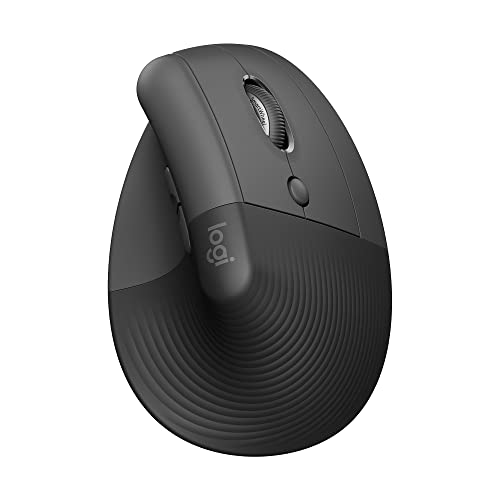
Best for: small to medium right hands wanting a certified upright shape Skip it if: your hand is large or you're left-handed
The Lift is the lightest full-size vertical here at 4.41 oz, just under the Anker. Its dimensions run 3 x 5.6 x 3.4 in, and Logitech pitches it at small to medium right hands. The company calls the shape ergo-certified, meaning designed and tested to criteria set by ergonomists, and describes a 57-degree tilt meant to keep the forearm relaxed. Those are Logitech's claims, worth weighing rather than taking as measured comfort.
It carries a textured grip, a thumb rest, whisper-quiet clicks by Logitech's description, and a SmartWheel for scrolling. A 1-year manufacturer warranty backs it, and this is a 2022 design, the most recent among the picks with a stated release. The honest weaknesses are fit and price: it's the most expensive pick of the seven, and the small-to-medium sizing rules out large hands. There's a left-handed version elsewhere, but the one here is right-hand only. If your hand fits, this is the most polished shape in the group.
Pros:
- Lightest full-size vertical at 4.41 oz
- 57-degree tilt claim for a relaxed forearm
- Shape Logitech says was checked by ergonomists
- Recent 2022 design with 1-year warranty
Cons:
- The most expensive pick in this set
- Small to medium right hands only
- No Bluetooth detail listed alongside the wireless spec
3. TECKNET Ergonomic Mouse — Most versatile
This TECKNET is the pick to grab if you jump between a work laptop, a personal machine and a tablet, thanks to three-device switching.

Best for: someone switching between three devices all day Skip it if: you need the side buttons to work on a Mac
At 4.32 oz, this TECKNET is the lightest pick that also carries full multi-device features, undercutting the 6 oz UGREEN by a clear margin. It runs Bluetooth 5.0 and 3.0 plus 2.4GHz, and TECKNET says you can pair three devices and switch between them. That flexibility, paired with the low weight, is what sets it apart from the single-receiver Anker.
It lists six DPI levels from 800 up to 4800, the widest ladder in the set, and TECKNET describes silent clicks quiet enough for a library. A 3-year warranty is the longest stated here, doubling the 1-year cover on the Logitech and UGREEN. The compatibility note is where you slow down: TECKNET says the side buttons don't work on Mac, so Mac users lose the browsing shortcuts. Only one seller lists it, and it sits at the higher end of this group's pricing. For a Windows user who lives across several devices, though, the combination is hard to match.
Pros:
- Lightest multi-device pick at 4.32 oz
- Bluetooth and 2.4G, switches three devices
- Six DPI levels from 800 to 4800
- Longest stated warranty at 3 years
Cons:
- Side buttons don't work on Mac, per TECKNET
- Only one seller lists it
- Higher-end pricing in this group
- No published weight for the count of items in the box
4. UGREEN Ergonomic Wireless Mouse — Best for families
The UGREEN suits a shared household because it pairs three ways and stays the second-cheapest pick in the set.

Best for: a shared household that pairs to laptops and tablets Skip it if: you want the lightest body on this list
The UGREEN is the second-cheapest of the seven, which matters when you're buying more than one for a family. It weighs 6 oz, the heaviest published figure in this group, so it's the pick that stretches the "lightweight" label the furthest. UGREEN describes a vertical handshake shape meant to cut wrist rotation, a five-button layout, and silent clicks for a calm workspace.
Connection is the strong point. UGREEN lists Bluetooth and 2.4G with a 10m range and switching across three devices, so it moves easily between a laptop and a tablet. Four DPI levels run from 1000 to 4000, and the maker points to PTFE glide feet for smoother tracking. A 1-year warranty backs it. The trade against the top picks is that weight: at 6 oz it's noticeably heavier than the 4.32 oz TECKNET or the 4.41 oz Logitech. If a family shares one mouse and cares more about easy pairing and price than shaving grams, that's a fair swap.
Pros:
- Second-cheapest pick in the set
- Bluetooth and 2.4G across three devices
- Four DPI levels from 1000 to 4000
- Silent-click and PTFE glide claims from UGREEN
Cons:
- Heaviest published weight at 6 oz
- Only 1-year warranty
- Two sellers listed, limited availability
5. ProtoArc EM11 NL Wireless Ergonomic Vertical Mouse — Best for quiet operation
The ProtoArc EM11 NL fits a small-handed user in a shared room, with a rechargeable battery and a compact vertical body.

Best for: a small-handed user in a shared or quiet room Skip it if: your hand is longer than 7.5 inches
The EM11 NL is built around a clear fit rule: ProtoArc says it targets hand lengths under 7.5 inches. Its body measures 3.54 x 2.76 in in the two usable dimensions, the most compact vertical footprint here. It weighs 0.55 lb by the listing, which is about 8.8 oz, so despite the small shape it isn't the featherweight the size suggests. That gap between size and stated weight is worth noting before you buy.
Power is a plus. A built-in 500mAh battery recharges over the included Type-C cable, so there are no AAA cells to buy, unlike the Anker. It pairs via Bluetooth or the included USB-A receiver, and ProtoArc notes a USB-C receiver is not included and the cable is for charging only. Connection covers up to three devices. A 2-year warranty sits between the Logitech's single year and the TECKNET's three. The main limit is the fit rule: larger hands will find it cramped. For smaller hands wanting a rechargeable, quiet vertical mouse, it's a tidy match.
Pros:
- Most compact vertical footprint here
- Rechargeable 500mAh battery, Type-C included
- Bluetooth or USB-A across three devices
- 2-year warranty
Cons:
- Fit capped at hand lengths under 7.5 inches
- 0.55 lb stated weight, heavy for its size
- No USB-C receiver in the box
- Only one seller lists it
6. TECKNET Wireless Mouse — Best budget pick
This TECKNET is the cheapest of the seven and the only classic low-profile shape, made for a bag rather than a fixed desk.

Best for: a traveller who wants a small classic-shaped mouse Skip it if: you specifically want a vertical grip
The budget TECKNET is the cheapest pick in the set, and it takes a different path to comfort. Instead of a vertical grip it uses a contoured low-profile body measuring 4.09 x 2.68 x 1.49 in, which TECKNET says fits the natural curve of the hand. That makes it the true travel option here, small enough to disappear into a bag.
It lists five DPI levels from 800 to 2600 and a USB-A receiver with connectivity up to 49 feet across Windows, Mac, Chrome OS and Linux. TECKNET claims up to 24 months of battery life with a power-saving mode and an on/off switch. A 2-year warranty is stated. The honest weakness for this roundup is grip: it isn't vertical, so if your reason for shopping is a near-upright wrist angle, this isn't it. The listing also gives no weight figure, which is why it can't claim a lightweight crown despite its small size. As a cheap, portable everyday mouse, it does the job.
Pros:
- Cheapest pick in the set
- Compact 4.09 in body for travel
- Five DPI levels from 800 to 2600
- 24-month battery-life claim from TECKNET
Cons:
- Classic shape, not a vertical grip
- No published weight
- Single 2.4G receiver, no Bluetooth
7. Lekvey Ergonomic Mouse — Best upgrade
The Lekvey is the lightest mouse in the set at 3.36 oz, a real draw if grams are your top concern.

Best for: anyone chasing the lowest published weight Skip it if: you want a current design with a long warranty
If the search word "lightweight" is what pulled you in, the Lekvey answers it most directly: 3.36 oz is the lowest published weight of the seven, under a full ounce lighter than the Anker. Its body measures 3.9 x 4.6 x 2.7 in, a mid-size vertical shape. Lekvey describes the handshake angle as encouraging a neutral wrist, plus page back and forward buttons for browsing.
It's rechargeable, with a built-in battery Lekvey rates at over 150 hours per charge, so no AAA cells here. Compatibility spans Windows and Mac by the listing. The reasons it lands last rather than higher are age and support: this is a 2018 design, the oldest in the set, and it carries only a 1-year warranty against the TECKNET's three and the ProtoArc's two. It also lists a single wireless mode without the multi-device switching newer picks offer. For a shopper who values the lowest weight above features, it's the upgrade in that one dimension.
Pros:
- Lightest pick at 3.36 oz
- Rechargeable, over 150 hours per charge claimed
- Page back and forward browsing buttons
- Works with Windows and Mac
Cons:
- Oldest design, from 2018
- Only 1-year warranty
- Single wireless mode, no multi-device switching
- Only one seller lists it
Why the weight number on the box misleads you
Weight is the headline word in this category, but it decides less than shoppers expect. Across these picks the gap runs from 3.36 oz on the Lekvey to 6 oz on the UGREEN, with most clustered near 4.3 to 4.5 oz. That's a narrow band. You'll feel grip angle and body size long before you feel a half-ounce difference during a work session.
Two things confuse the comparison:
- Different units. The ProtoArc lists 0.55 lb, about 8.8 oz, while the others use ounces. Convert before you rank, or the compact ProtoArc looks lighter than it is.
- Missing figures. The budget TECKNET publishes no weight at all, so "light" there is a guess, not a number.
What actually decides comfort is whether the shape matches your hand and how upright the grip sits. A well-fitted 4.48 oz vertical mouse beats a lighter one that's too small for your palm. Read the weight, then read the grip size right after it.
Does a lightweight vertical mouse really ease wrist strain?
A lightweight vertical mouse eases wrist strain mainly through its angle, not its weight. Every vertical pick here rests your palm at a near-upright position, which the makers say reduces the forearm twist of a flat mouse. Logitech cites a 57-degree tilt and an ergo-certified design. Those are manufacturer claims worth testing against your own comfort.
Here's the practical read on the set:
- The angle does the work. Anker, Logitech, TECKNET, UGREEN, ProtoArc and Lekvey all use a handshake grip. That posture is the shared benefit.
- Weight is a comfort tiebreaker. Once the angle is right, a lighter body reduces the effort of dragging across a desk. That's where the 3.36 oz Lekvey stands out.
- Fit gates everything. A vertical shape too big or small for your hand undoes the benefit. Match size first.
No mouse is a medical fix. If wrist pain is persistent, treat these as comfort tools, not treatment.
How do I match a vertical mouse to my hand size?
To match a vertical mouse to your hand, measure from wrist crease to fingertip, then compare against each listing's stated fit. The picks here split cleanly by size, so this is one spec you can act on directly.
- Small hands: The ProtoArc EM11 NL caps its fit at hand lengths under 7.5 inches and has the most compact footprint, at 3.54 x 2.76 in.
- Small to medium hands: The Logitech Lift is aimed at that range, in a 3 x 5.6 x 3.4 in body.
- Average to larger right hands: The Anker's 4.72"L x 2.94"W grip and the Lekvey's 3.9 x 4.6 x 2.7 in shape give more to hold.
If you're between sizes, size down on a vertical mouse rather than up. A grip slightly too small still lets your fingers reach the buttons, while one too large forces your hand to spread and defeats the upright posture you bought it for.
What the listings leave out
Product pages tell you the shape and the DPI, but they stay quiet on a few things that shape daily use.
- Real battery runtime under load. The Anker cites an 8-minute idle cutoff, Lekvey claims over 150 hours per charge, and the budget TECKNET claims 24 months. Those are best-case numbers, and none states how heavy use changes them.
- Left-handed options. Every vertical pick here reads as right-hand. If you're left-handed, none of these is confirmed to fit.
- Click feel over time. UGREEN, TECKNET and ProtoArc all promise silent clicks, but a listing can't tell you how the switches age.
- What comes in the box. The Anker notes 2 AAA batteries aren't included; the ProtoArc notes a USB-C receiver isn't included. Read the fine print before you assume.
Treat every feature bullet as the maker's claim. Where a spec is simply absent, assume nothing and buy for the figures you can actually see.
The verdict
The best ergonomic lightweight mouse for most people is the Anker 2.4G Wireless Ergonomic Mouse. It pairs a moderate 4.48 oz weight with a full-size 4.72"L x 2.94"W vertical grip, which is the combination that suits the widest range of right hands. It isn't the lightest and it runs on AAA batteries, but the shape is the safe default, and shape decides more than grams in this category.
Two conditions flip that choice. If your hand runs small to medium and you'd pay more for the most polished, recent design, the Logitech Lift wins on its 4.41 oz weight, 57-degree tilt and 2022 build. If you switch between three devices all day, the 4.32 oz TECKNET takes it, with Bluetooth plus 2.4G, six DPI steps and the longest stated warranty at 3 years.
Chasing the lowest number alone points you to the 3.36 oz Lekvey, but its 2018 design and single wireless mode are the price of that gram count. For a shared home on a budget, the UGREEN's three-way pairing and low price outweigh its heavier 6 oz body. Match the shape to your hand first, then let weight break the tie.
FAQ
Is a lightweight vertical mouse worth it over a flat one?
A lightweight vertical mouse is worth it if a flat mouse leaves your wrist twisted or sore, since the upright grip keeps your forearm more neutral. Every vertical pick here rests the palm near-vertical. The gain is posture, not speed. If your current flat mouse feels fine, the switch buys little beyond a different grip.
Which is better, the Anker or the Logitech Lift?
Between the Anker and the Logitech Lift, the Anker suits average and larger right hands with its 4.72"L grip, while the Lift targets small to medium hands at 4.41 oz. The Anker uses AAA batteries and a single receiver; the Lift is a newer 2022 design that Logitech says was checked by ergonomists. Pick by hand size first.
Does the weight difference between these mice actually matter?
The weight difference matters less than the spread suggests. These picks run from 3.36 oz on the Lekvey to 6 oz on the UGREEN, with most near 4.3 to 4.5 oz. In everyday use you'll notice grip angle and body size long before a half-ounce gap. Treat weight as a tiebreaker once the shape fits your hand.
Are these mice a good value for the money?
For value, the budget TECKNET is the cheapest of the seven and the UGREEN is the second-cheapest, both entry-priced. The UGREEN adds Bluetooth, 2.4G and three-device switching, which the single-receiver budget TECKNET lacks. If you want a true vertical grip on a budget, the UGREEN gives more capability for a small step up in price.
What's the biggest mistake buyers make with vertical mice?
The biggest mistake buyers make is ignoring hand size and buying on weight alone. A vertical mouse too large or small for your palm undoes its posture benefit. The ProtoArc caps fit under 7.5 inches, the Logitech targets small to medium hands, and the Anker suits larger grips. Measure your hand, then match the listing before you compare grams.
The fastest way to a decision here is to measure your hand this minute, then read the grip size on each listing before anything else. For a right-handed desk worker who wants one dependable choice, the Anker's mix of a moderate 4.48 oz weight and a roomy 4.72"L vertical shape makes it the pick that works for the most hands without a fuss. Size the shape to your palm, let weight settle the ties, and the rest of these fall into place around who you are and how you connect.