Best Premium USB C Docking Station: Acer Leads

A ranked comparison of five USB-C laptop docks, from an 8-in-1 travel hub to a 3-year-warranty desk dock, with the port counts and wattage figures that actually decide which one belongs under your monitor.

By Samuel HarrisUpdated 15 min read
On this page
- Best premium USB C docking station at a glance
- How I screened these five docks
- What more money actually buys in a dock
- Does a triple-display dock really give you three screens?
- 1. Acer 13-in-1 Laptop Docking Station — Best overall
- 2. Dell Pro Laptop Docking Station WD25 — Best premium
- 3. Anker Laptop Docking Station — Most versatile
- 4. VVB USB C Laptop Docking Station Dual Monitor HDMI USB C — Best upgrade
- 5. Anker Laptop Docking Station Dual Monitor — Best budget pick
- Will your laptop charge from this dock?
- Which dock fits your desk and bag?
- The verdict
- FAQ
The best premium USB C docking station is the Acer 13-in-1, because it ships with its own 110W power adapter and pushes 100W back into the laptop while driving three screens across 2x HDMI and 1x DisplayPort 1.4. If you care more about support than ports, the Dell Pro WD25 carries a 3-year limited hardware warranty with advanced exchange, the longest here by a wide margin.
Docks in this category sort into three loose tiers. At the entry end you get a pocketable hub with two HDMI ports and no adapter in the box, so your existing charger does the work. In the middle you get a bundled brick, a DisplayPort, Ethernet and enough USB-A to retire your old dongle drawer. At the top you get vendor warranty terms, firmware support and a body built to sit under a monitor for five years. Amazon's results for this search mix all three, so "premium" here describes the top of this set rather than a verified tier.
Best premium USB C docking station at a glance
| Pick | Ports & displays | Power to laptop | Price |
|---|---|---|---|
Best overall Acer 13-in-1 Laptop Docking Station |
13 ports 2x HDMI + 1x DP 1.4 |
100W claim 110W adapter included |
Check Price |
Best premium Dell Pro Laptop Docking Station WD25 |
DisplayPort + HDMI up to 4 displays claim |
100W claim | Check Price |
Most versatile Anker Laptop Docking Station |
13 ports 2x HDMI + DP |
85W claim 135W adapter included |
Check Price |
Best upgrade VVB USB C Laptop Docking Station |
14 ports 2x HDMI + DP |
87W out claim 100W input |
Check Price |
Best budget pick Anker Laptop Docking Station Dual Monitor |
8 ports 2x HDMI |
85W pass-through claim no adapter |
Check Price |



How I screened these five docks
I started with the listings Amazon returns for the best premium USB C docking station and lined up the published specifications side by side. Port counts, display outputs, wattage figures, warranty length, dimensions and weight. Then I cut anything I couldn't compare.
Three screening rules did most of the work:
- A published display configuration. Every pick here states how many external monitors it drives and through which connector. Vague "multi-display support" wording without a port list got dropped.
- A stated power figure. Each of the five publishes a wattage number for what it sends to the host laptop. That single number decides whether the dock replaces your charger or joins it on the desk.
- A warranty term in writing. The five run from 1 year to 3 years. A dock lives on your desk for years, so an unstated warranty is a real gap.
What survived is a set that spans the whole field: an 8-in-1 hub at 3.2 oz, a 14-port slab, a vertical 13-port tower, a 13-port bar from a laptop maker, and Dell's WD25 at 1.21 lb.
Note the word "premium" in the search. Amazon's results don't filter by tier here, and two of these five sit at the cheap end of the set. I've flagged where each pick actually lands rather than pretending all five qualify.
What more money actually buys in a dock
Move up through this set and you're mostly buying two things: the power brick and the support term.
The cheapest pick, Anker's 8-in-1, ships with no adapter. Anker's listing spells out the catch: a 100W PD wall charger and a USB-C to C cable are required for its 85W pass-through. So the sticker is only part of the outlay.
Step up and the brick arrives in the box. Acer includes a 110W adapter. Anker's 13-port tower includes a 135W adapter, the largest figure published in this group, and claims 85W to the laptop plus 18W to a phone at the same time.
At the top, Dell's WD25 spends your money differently. It's the most expensive pick here and it doesn't publish the biggest port count. What it publishes instead is a 3-year limited hardware warranty with advanced exchange, a 2025 release date and a claim of up to 72% lower standby power draw. You're buying longevity and vendor firmware support, not sockets.
That's the honest split in the best premium USB C docking station category. Ports scale with the middle of the market. Warranty and refresh cadence scale with the top.
Does a triple-display dock really give you three screens?
Sometimes, and the fine print matters more than the port count.
Three of these picks advertise triple display. All three lean on MST, a Windows and ChromeOS feature. Acer states triple independent screens for Windows laptops via MST. Anker's 13-port tower states extended triple displays on Windows 10/11 and ChromeOS with MST. VVB states dual and triple display support for Windows. macOS handles MST differently, so a Mac user should treat the third screen as unconfirmed regardless of which of these boxes arrives.
Resolution is the second trap. Anker's tower publishes an honest number: three monitors at 1080p@60Hz, or one display at 4K@60Hz through HDMI or DisplayPort. Its cheaper 8-in-1 sibling is blunter still, at 4K@60Hz on a single screen dropping to 4K@30Hz when both HDMI ports are in use. That 30Hz figure is visible on a mouse cursor.
So read the port list, then read the refresh rate beside it:
- Three ports does not mean three 4K screens at 60Hz.
- Dual HDMI often halves the refresh rate when both are live.
- DisplayPort 1.4, as on the Acer, generally carries more bandwidth headroom than HDMI on the same box.
1. Acer 13-in-1 Laptop Docking Station — Best overall
The Acer is the pick that arrives complete: 13 ports, three display outputs and a 110W adapter in the box, with nothing left to buy.
Best for: a Windows desk setup running two or three monitors Skip it if: you need a warranty longer than a year
What separates this one inside the set is the display arrangement. Two HDMI plus one DisplayPort 1.4 gives you a third output on the higher-bandwidth connector, and Acer states three independent screens for Windows laptops through MST. Only the Acer and the VVB pair dual HDMI with a DisplayPort at a mid price position.
The power story is equally tidy. Acer bundles a 110W adapter and claims 100W delivered to the host laptop over USB-C PD. That's a real figure for a 14-inch or 15-inch Windows machine under load, and it means the dock replaces your charger rather than sitting next to it.
The body is a flat bar at 0.94 x 7.89 x 3.25 in, so it tucks under a monitor stand instead of eating desk width. Acer lists 1 USB-C and 3 USB-A for data alongside networking, storage and audio, plus a lock slot the listing frames as theft deterrence.
The trade-off is coverage after the sale. One year of warranty is the shortest term in this group, half of Anker's 18 months and a third of Dell's. Only one seller lists it, too, which narrows your options if something goes wrong.
Pros:
- 110W adapter included, no extra charger needed
- 100W to the laptop, the joint-highest claim here
- DisplayPort 1.4 alongside two HDMI outputs
- Slim 0.94 in profile fits under a monitor
- 13 ports covering Ethernet, storage and audio
Cons:
- 1 Year Warranty, the shortest in this set
- Only one seller lists it
- Triple display needs Windows MST, so Mac users lose the third screen
- No published weight figure
2. Dell Pro Laptop Docking Station WD25 — Best premium
The WD25 is the only pick here with a 3-year warranty and advanced exchange, which is what "premium" should actually mean in a dock.
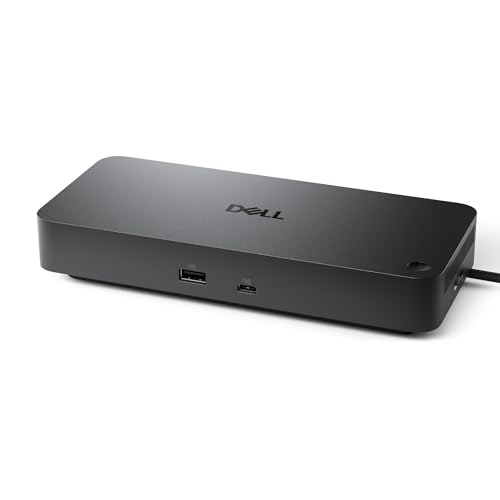
Best for: anyone who wants the longest support window here Skip it if: you want a bundled adapter spec published up front
This is the newest design in the group, listed as a 2025 release, and it's the only one from a company that also builds the laptops. Dell states 100W to new mainstream Dell AI PCs and native support for up to four high-resolution displays, the highest display claim in this comparison. It publishes DisplayPort and HDMI outputs, so a two-monitor setup is straightforward.
Two details show where the design attention went. The USB-C host cable is ambidextrous and routes left or right, which matters when your laptop's only USB-C port is on the wrong side of the chassis. Dell also cites a redesigned USB-C connector built for durability, the part of any dock that fails first.
Then there's the standby claim: up to 72% lower power consumption when idle. In an office with a dock per desk, that adds up.
The costs are real. This is the most expensive pick in the set, and it publishes no total port count, so a shopper counting sockets can't compare it against a 13-in-1 on paper. The bundled power supply isn't specified in the listing either, and the compatibility language centres on Dell machines. At 1.21 lb and 8.07 in wide, it's also the heaviest and second-widest here.
Pros:
- 3-year limited warranty with advanced exchange, longest here
- Claims native support for up to four displays
- Reversible USB-C host cable routes either direction
- 2025 design, the newest in this set
- 72% standby power reduction claim
Cons:
- Most expensive pick in the set
- No published total port count to compare
- Power adapter specification not stated in the listing
- Heaviest at 1.21 lb, and compatibility language leans Dell
3. Anker Laptop Docking Station — Most versatile
Thirteen ports in a vertical body measuring 4.95 x 3.49 in on the desk, with a 135W adapter that runs a laptop and a phone at once.

Best for: cramped desks that still need 13 ports Skip it if: you need three monitors above 1080p
The port list here is the most fully specified of any pick: 2x HDMI, DisplayPort, 3x USB-C (85W host, 18W PD, 10Gbps data), 3x USB-A at 5Gbps, Gigabit Ethernet, and both SD and microSD. Anker publishes the speed of each port rather than a single headline number, which makes it the easiest dock here to plan a desk around.
The 135W adapter is the largest bundled brick in this comparison. Anker splits it deliberately: 85W to the laptop and 18W to a phone at the same time, so your handset charges without stealing a USB-A port.
The shape is the other differentiator. It stands vertically at 1.64 x 4.95 x 3.49 in and weighs 0.82 lb, so it occupies a book's worth of desk instead of a bar's worth. An 18-month warranty sits comfortably above Acer's year.
Its honesty is also its limitation. Three monitors run at 1080p@60Hz, and 4K@60Hz is a single-display figure through HDMI or DisplayPort. If you own two 4K panels, that ceiling rules this one out. It's also the second-most expensive pick here while delivering 85W rather than the 100W the Acer and Dell claim.
Pros:
- 13 ports with speeds published individually
- 135W adapter included, largest here
- 85W laptop plus 18W phone charging together
- Vertical body needs only 3.49 in of desk depth
- 18-month warranty beats the Acer's term
Cons:
- Triple display capped at 1080p@60Hz
- 85W to the laptop, below two rivals' 100W claims
- Second-highest price position in this set
- Extended triple display needs Windows or ChromeOS MST
4. VVB USB C Laptop Docking Station Dual Monitor HDMI USB C — Best upgrade
Fourteen ports, the highest count in this set, in a 0.65 in slab that costs less than three of the picks above it.

Best for: someone stepping up from a single-HDMI dongle Skip it if: brand support history matters to you
If you're replacing a two-port dongle, this is the biggest jump per dollar in the group. VVB lists 14 ports from a single USB-C or Thunderbolt 3/4 connection, including 2x HDMI at 4K, a DisplayPort at 4K, a 100W USB-C power input, Gigabit Ethernet and 2x USB-A 3.1 rated at 10Gbps. Those 10Gbps USB-A ports are faster on paper than the 5Gbps USB-A on Anker's 13-port tower.
The power figures are stated with unusual precision: input up to 100W, with safe charging output limited to 87W. That's the kind of detail most listings bury, and it tells you the dock won't fully feed a 100W-hungry laptop even though it accepts a 100W supply.
At 6.22 x 3.15 x 0.65 in it's the thinnest pick here, thin enough to live under a laptop rather than beside it. VVB names Thunderbolt 3/4/5 and USB-C laptops with video output as compatible, and calls out Dell Latitude machines specifically.
The gaps are in what isn't published. No weight, no model number, no release year, and the shortest warranty tier at 1 Year. Only one seller lists it. VVB is also the least established brand of the five, which is a genuine risk on a device that carries your only charger connection.
Pros:
- 14 ports, the highest count in this set
- USB-A rated at 10Gbps, faster than some rivals
- Thinnest body here at 0.65 in
- Publishes both 100W input and 87W output limits
- Second-cheapest pick in the group
Cons:
- 1 Year warranty, tied for shortest here
- Charging output capped at 87W despite 100W input
- No published weight, model number or release year
- Only one seller lists it, and the brand is the least established
5. Anker Laptop Docking Station Dual Monitor — Best budget pick
At 3.2 oz and 0.69 in thick, this is the only pick in the set you'd actually carry, and it's the one buyers choose most often here.

Best for: travellers who dock at two screens occasionally Skip it if: you want a power adapter in the box
This is a hub, not a desk dock, and that's the point. It weighs 3.2 oz and measures 0.69 x 4.65 x 2.01 in, so it slides into a laptop sleeve. Every other pick here needs its own bag space. It's also the cheapest of the five and sells faster than the rest of this set.
The 8 ports cover the essentials: USB-C PD-IN, 2x USB-A data, 2x HDMI, Ethernet, and a microSD/SD reader. Anker states compatibility with USB-C, USB4 and Thunderbolt, plus Windows 10 and 11, ChromeOS and any laptop with DP Alt Mode and Power Delivery.
Understand the display ceiling before you buy. One screen runs 4K@60Hz. Two screens drop to 4K@30Hz each. For a spreadsheet and a browser on a hotel desk, fine. For daily photo or video work, not fine.
The cost of that size shows up twice. There's no adapter included, and Anker's own listing says a 100W PD wall charger plus a USB-C to C cable are required to reach the 85W pass-through. There's also no DisplayPort and no third display output, so this is a two-monitor device at best. The 2020 release date makes it the oldest design here.
Pros:
- Cheapest pick in this set
- 3.2 oz and 0.69 in thick, genuinely portable
- 8 ports including Ethernet and SD/microSD
- 18-month warranty, longer than two rivals
- Two sellers list it, unlike three of the picks
Cons:
- No power adapter or cable included
- Dual displays drop to 4K@30Hz
- Two display outputs only, no DisplayPort
- 2020 design, the oldest in the group
Will your laptop charge from this dock?
Check three numbers before you order, in this order.
One: what your laptop draws. A 13-inch ultrabook is usually happy on 65W. A 15-inch machine with a discrete GPU often wants 90W or more. Match that against the dock's output claim, not its input claim.
Two: what the dock actually sends out. Acer and Dell both claim 100W to the host. Both Anker picks state 85W. VVB accepts 100W in but limits charging output to 87W. Those are three distinct tiers, and the gap between 85W and 100W is the gap between charging under load and slowly draining.
Three: whether an adapter is in the box. Acer ships 110W. Anker's 13-port tower ships 135W. The Anker 8-in-1 ships nothing and needs a 100W charger you supply. Dell's listing doesn't publish an adapter figure, so ask the seller before ordering if that matters to you.
Here's the trick with the best premium USB C docking station decision: the port count is the headline, but the wattage is the specification that decides whether you end up with one cable on your desk or two.
Which dock fits your desk and bag?
Footprints vary more here than port counts do, and it's the easiest thing to get wrong.
- Under a monitor stand: the Acer at 0.94 in tall and the VVB at 0.65 in both slide beneath a riser.
- Tightest desk depth: Anker's 13-port tower stands vertically and needs just 3.49 in of depth.
- Widest on the desk: Dell's WD25 at 8.07 in, closely followed by the Acer at 7.89 in.
- In a laptop bag: only the Anker 8-in-1, at 3.2 oz.
- Heaviest: the WD25 at 1.21 lb, then Anker's tower at 0.82 lb.
Colour is worth a glance too. The Acer is Space Gray, three picks are Gray, and only the Dell is Black. On a dark desk with dark monitor bases, that's the one that disappears.
Most shoppers measure the monitor gap and forget the cable run. A dock 8 in wide with ports on the back needs several more inches of clearance behind it before the wall.
The verdict
Three tiers, three answers.
At the entry end, Anker's 8-in-1 is the correct buy if the dock travels. Nothing else here weighs 3.2 oz, and the 8 ports cover Ethernet, dual HDMI and card slots. Just accept 4K@30Hz on two screens and budget for the 100W charger it doesn't include. VVB's 14-in-1 sits at the same end of the price scale with double the ports and a 0.65 in body, so it's the value pick for a fixed desk instead of a bag.
In the middle, the Acer 13-in-1 wins the whole comparison. It bundles a 110W adapter, claims 100W back to the laptop, and pairs two HDMI outputs with DisplayPort 1.4 for a third screen. That combination of included power and display flexibility isn't matched anywhere else in this set. Its 1 Year Warranty is the honest cost.
At the top, the choice narrows to what you value. Anker's 13-port tower gives you the biggest bundled adapter at 135W and the most detailed port specification, but caps three screens at 1080p@60Hz. Dell's WD25 gives you a 3-year limited warranty with advanced exchange, a 2025 design and a four-display claim. If a five-year desk life matters more than a port count, that warranty is the deciding line.
FAQ
Is a premium USB C docking station worth the money over a cheap hub?
A premium USB C docking station earns its money in two places: the bundled power adapter and the warranty. The Acer includes a 110W brick and Dell backs the WD25 for 3 years. A cheap hub like Anker's 8-in-1 needs you to supply a 100W charger separately, which closes much of the gap once you add it up.
What is the best premium USB C docking station for a triple-monitor setup?
The best premium USB C docking station for three screens is the Acer 13-in-1, because it pairs 2x HDMI with DisplayPort 1.4 and states three independent displays for Windows laptops via MST. Anker's 13-port tower also does three, but caps them at 1080p@60Hz. Both need Windows or ChromeOS for extended triple display.
How much power does a dock need to charge my laptop?
The power a dock needs depends on your machine. A 13-inch ultrabook typically runs on 65W, while a 15-inch laptop with discrete graphics often wants 90W or more. Acer and Dell both claim 100W to the host, both Anker picks state 85W, and VVB limits its charging output to 87W despite accepting 100W in.
Acer 13-in-1 or Dell Pro WD25: which should I buy?
Between the Acer 13-in-1 and the Dell Pro WD25, pick the Acer if you want a complete package now: 13 ports, three display outputs, and a 110W adapter in the box. Pick the WD25 if support matters more, since its 3-year limited warranty with advanced exchange triples Acer's 1 Year term and the 2025 design is newer.
What mistake do first-time dock buyers make?
The mistake first-time dock buyers make is reading port counts and ignoring refresh rates. Two HDMI ports sound like two 4K screens, but Anker's 8-in-1 drops both to 4K@30Hz when they're used together, and its 13-port sibling caps three screens at 1080p@60Hz. Check the resolution beside each output before you commit.
Start with the number your laptop actually needs from the wall, then work outward. If that number is near 100W and you want three screens on a Windows machine, the Acer 13-in-1 covers it out of the box with no second charger and no extra cable order. If your dock will still be under that monitor in 2030, Dell's 3-year advanced exchange term is the thing you'll be glad you paid for. And if it lives in a bag rather than on a desk, none of the desk-bound picks make sense at all, which is exactly why the 3.2 oz Anker earned its place here.