Best Rugged External SSD for a Home Office Desk
Five portable SSDs, ranked by the one thing most buyers ignore: what the housing is actually rated to survive. Includes a 4,000MB/s USB4 option and a sub-2-ounce pick.

By Samuel HarrisUpdated 15 min read
On this page
- Best rugged external SSD for home office at a glance
- How I screened this shortlist down to five
- What actually protects a drive on a desk?
- 1. Sandisk 2TB Extreme Portable SSD — Best overall
- 2. Corsair EX400U Survivor 2TB USB4 External SSD — Best premium
- 3. Samsung T9 Portable SSD 1TB — Best warranty
- 4. Samsung T7 Portable SSD 1TB Titan Gray — Most versatile
- 5. Sandisk 1TB Portable SSD — Best budget pick
- Speed ratings: where does the extra bandwidth go?
- Does a home office need a rugged drive at all?
- What the listings do not tell you
- The verdict
- FAQ
The best rugged external SSD for home office use is the SanDisk 2TB Extreme Portable SSD, because it pairs a 3-meter drop rating and IP65 sealing with a 1.76 oz body that still holds 2TB. If your machine has a Thunderbolt 4 port and you edit off the drive, the Corsair EX400U Survivor 2TB and its claimed 4,000MB/s read speed is the better buy.
Here is the specification that actually splits this field: drop protection. Three of these five drives publish a drop rating, and the numbers differ by a full meter.
Best rugged external SSD for home office at a glance
| Pick | Drop / ingress rating | Rated read speed | Price |
|---|---|---|---|
Best overall Sandisk 2TB Extreme Portable SSD |
3 m drop, IP65 claim | 1,050MB/s claim | Check Price |
Best premium Corsair EX400U Survivor 2TB USB4 External SSD |
IP55 claim, sealed housing | 4,000MB/s claim | Check Price |
Best warranty Samsung T9 Portable SSD 1TB |
None published | 2,000MB/s claim | Check Price |
Most versatile Samsung T7 Portable SSD 1TB Titan Gray |
None published | 1,050MB/s claim | Check Price |
Best budget pick Sandisk 1TB Portable SSD |
2 m drop claim | 800MB/s claim | Check Price |





How I screened this shortlist down to five
I worked from published specifications only, lining up the size, weight, dimensions, warranty and stated durability figures side by side. Everything else is the manufacturer's own wording, and I've labelled it that way throughout.
Amazon's search for a rugged external SSD for home office use does not filter for either half of that phrase. It returns portable SSDs, and durability shows up only where the brand chose to print it. So I sorted the field on three things:
- A published durability figure. A drop rating in meters or an IP number, stated on the listing rather than implied by a rubber shell.
- A published warranty term. Three of these five carry five years; two carry three.
- Capacity and physical size in the same row. A 2TB drive that weighs 1.76 oz is a different object from a 1TB drive that weighs 4.32 oz.
Two picks survived on speed and warranty rather than sealing, and I've said so in their sections. That matters, because a rugged external SSD for home office duty is often really a desk drive that occasionally travels, and the trade-off you accept depends on which of those two jobs dominates.
What actually protects a drive on a desk?
Most guides to the best rugged external SSD for home office setups compare read speeds. Read speed does not decide this. What decides it is the failure you are actually protecting against, and in a home office that failure is almost never a fall from a roof.
It is the cable snag. The drive sits on the desk, the USB-C cable runs to a laptop, someone knocks the laptop and the drive goes over the edge. That is a fall of roughly desk height. SanDisk's Extreme listing claims 3-meter drop protection; the SanDisk 1TB Portable SSD claims two meters. Both clear a desk with margin. Samsung publishes no drop figure for either the T7 or the T9.
The second failure is spilled liquid. The Extreme carries an IP65 claim, meaning dust-tight with resistance to water jets, per SanDisk's own rating. Corsair states IP55 on the EX400U Survivor, a step below on both counts.
The third is heat during a long transfer, and only Samsung addresses it in writing, describing a "dynamic thermal guard" on the T9.
- Drop protection matters if the drive ever leaves the desk surface.
- Ingress rating matters if it shares a desk with a coffee mug.
- Thermal design matters if you move hundreds of gigabytes at a stretch.
- Weight matters more than you think: a 1.44 oz drive is easy for a cable to drag.
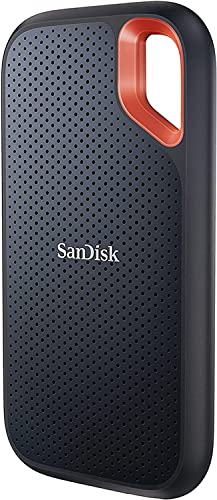
1. Sandisk 2TB Extreme Portable SSD — Best overall
The only drive here that publishes both a 3-meter drop rating and an IP65 seal, and it does it at 1.76 oz with 2TB inside.
Best for: a desk drive that also travels between home and client sites Skip it if: you need USB4 speeds for 4K timeline editing
Within this set, nothing else combines a stated drop figure with a stated ingress figure. SanDisk claims up to 3-meter drop protection and IP65 water and dust resistance, noting on the listing that earlier versions were rated at two meters and IP55. That one-meter jump is the single largest durability gap in this comparison.
The physical numbers are the other half of the case. At 0.38 x 3.97 x 2.07 in and 1.76 oz, it's the flattest drive here and the second-lightest, despite carrying 2TB. The 1TB Samsung T9 weighs 4.32 oz, nearly two and a half times as much, for half the capacity.
SanDisk states up to 1,050MB/s read and 1,000MB/s write over its NVMe interface, plus 256-bit AES hardware encryption with password protection included. The warranty is five years, matching the T9 and the Corsair. Model number is SDSSDE61-2T00-G25, released in 2020.
The trade-off is bandwidth. The Corsair claims almost four times the read speed, and the T9 claims roughly double. If you edit directly off the drive rather than archiving to it, that gap is real.
Pros:
- 3 m drop protection claim, highest in this set
- IP65 rating claimed, the strongest ingress figure here
- 2TB in a 1.76 oz body
- Five-year limited manufacturer warranty
- 256-bit AES hardware encryption included
Cons:
- 1,050MB/s claimed read is a quarter of the Corsair's figure
- The 2020 design is the oldest here
- Only two sellers list it
- Sits in the higher price positions of this group
2. Corsair EX400U Survivor 2TB USB4 External SSD — Best premium
A sealed USB4 drive claiming 4,000MB/s read, which is roughly four times the fastest SanDisk figure in this comparison.

Best for: video editors working off the drive on a Thunderbolt 4 machine Skip it if: your ports are USB 3.2 and staying that way
This is the fastest drive in the set on paper and the newest, released in 2025. Corsair states up to 4,000MB/s read and 3,600MB/s write over USB4 at 40Gbps, and notes that maximum performance requires a USB4 or Thunderbolt 4 host. On a standard USB 3.2 port you will not see those numbers, which is the whole condition attached to this pick.
Durability is stated as a heavy-duty, environmentally sealed housing with IP55 protection. That's dust-protected and resistant to low-pressure water jets, a rung below the Extreme's IP65 claim. No drop rating appears on the listing, which is a notable gap on a drive named Survivor.
The dimensions tell you what sealing costs: 0.67 x 3.23 x 1.57 in makes it the thickest drive here by a wide margin, nearly double the Extreme's 0.38 in depth. It's also the shortest and narrowest, so it's a chunky block rather than a flat card. Weight is 2.82 oz for 2TB, and the warranty runs five years.
Corsair also lists plug-and-play operation over a single USB-C cable for power and data, with iOS and iPadOS 13 support.
Pros:
- 4,000MB/s claimed read, fastest here
- 2TB capacity with a five-year warranty
- Sealed IP55 housing claim
- Newest design in the group, released 2025
Cons:
- No published drop rating despite the Survivor name
- 0.67 in thick, the bulkiest drive in this comparison
- Full speed needs USB4 or Thunderbolt 4
- Only one seller lists it, and it holds the top price position
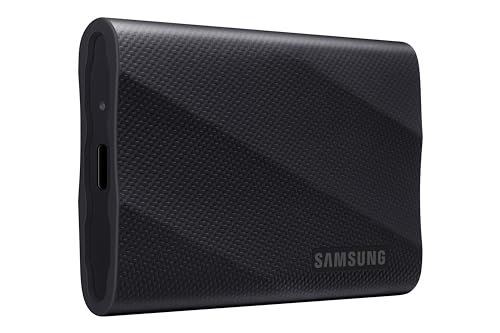
3. Samsung T9 Portable SSD 1TB — Best warranty
Five years of coverage and a stated thermal design, at the second-cheapest price position in this set.
Best for: sustained large transfers where the drive gets warm Skip it if: you carry the drive loose in a bag
The T9 is the value anomaly here. It sits at the second-cheapest position of the five while carrying a five-year limited warranty, the same term as the far pricier Corsair and the SanDisk Extreme. Both SanDisk-branded competitors on capacity parity give you three years or five depending on the model; the 1TB SanDisk gives three.
Samsung states sustained read and write speeds up to 2,000MB/s over USB 3.2 Gen 2x2, and specifically describes a dynamic thermal guard that controls heat under heavy load. It's the only listing in this group that puts thermal behaviour in writing, and that's the differentiator worth paying attention to if your work involves moving a few hundred gigabytes at once rather than saving a file and walking away.
What it does not publish is any durability rating. No drop figure, no IP number. The listing uses words like "strong, solid, stable" and "dares to go the distance," which is marketing language, not a specification.
Physically it's the outlier: 4.32 oz and 0.55 x 3.46 x 2.36 in, making it the heaviest drive here for the smallest capacity tier. Model MU-PG1T0B, released 2023. Samsung's Magician software handles firmware and encryption.
Pros:
- Five-year warranty at a low price position
- 2,000MB/s sustained claim, second-fastest here
- Only drive publishing a thermal control design
- Magician software for firmware and drive health
Cons:
- No drop rating or IP figure published at all
- 4.32 oz, heaviest in this set for 1TB
- Needs USB 3.2 Gen 2x2 for full speed
- Half the capacity of the two 2TB picks
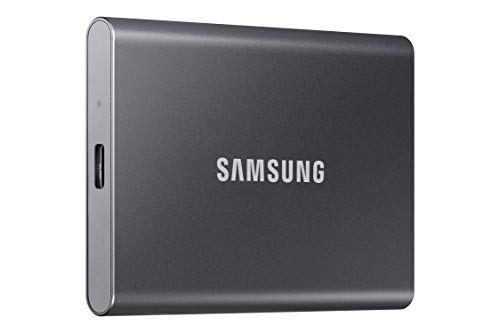
4. Samsung T7 Portable SSD 1TB Titan Gray — Most versatile
The thinnest drive here at 0.3 in, with Samsung listing support across PCs, phones, cameras and consoles.
Best for: phone, tablet and laptop backups from one small drive Skip it if: the drive will live in a toolbag or on a job site
The T7 wins on compatibility breadth as stated. Samsung lists PC, mobile phone and camera support, including recording 4K 60fps video directly to the drive, and specifically names iPhone 15 Pro Res 4K at 60fps. If one drive has to serve a laptop, a phone and a camera, that's the listing that spells it out.
It's also the slimmest here. At 0.3 x 3.3 x 2.2 in it beats even the SanDisk Extreme's 0.38 in depth, and it weighs 2.08 oz. Read and write speeds are stated at up to 1,050 and 1,000MB/s over USB 3.2 Gen 2, matching the Extreme's figures on a more common interface, which means fewer conditions attached to hitting them.
The gaps are the reason this sits fourth rather than first. There is no published drop rating and no IP number, same as the T9. The warranty is three years, the shortest term here alongside the 1TB SanDisk. And the T7 is a 2020 design, model MU-PC1T0T, so you're buying the older Samsung while the T9 sits at a lower price position with two more warranty years.
That combination is a genuine trade-off rather than a flaw: you get the smallest body and the widest stated compatibility, and you give up durability documentation and coverage length.
Pros:
- 0.3 in thick, thinnest drive in this comparison
- 1,050MB/s claim on widely available USB 3.2 Gen 2
- Stated camera and phone recording support
- 2.08 oz in a metal-bodied enclosure
Cons:
- Three-year warranty, two years shorter than the T9
- No drop or IP rating published
- 2020 design competing against a 2023 sibling
- Priced above the T9 despite lower stated speed
5. Sandisk 1TB Portable SSD — Best budget pick
The cheapest of the five and the lightest at 1.44 oz, with a 2-meter drop claim that clears desk height.

Best for: a document and photo archive that stays on the desk Skip it if: you move working video files daily
This is the entry point, and it's honest about what it is. SanDisk states up to 800MB/s read speeds, the slowest figure in this set, and up to two-meter drop protection based on internal testing. No IP rating appears on the listing, so treat it as drop-resistant rather than sealed.
Two meters is still more than any desk is tall, which is the point. Against the two Samsungs, which publish no drop figure at all, a stated 2 m claim is a real advantage for the cheapest drive here.
At 1.44 oz it is the lightest of the five, and 0.39 x 3.81 x 1.85 in makes it the narrowest of the flat-card designs. There's a rubber hook for tethering it to a bag strap, which is the same idea as the Extreme's carabiner loop in cheaper form. Warranty is three years. Model SDSSDE30-1T00-G26, released 2023.
The honest trade-off: 800MB/s is roughly a fifth of the Corsair's claimed figure and a quarter of the T9's. For archiving finished work, backing up a documents folder or holding a photo library you browse occasionally, that gap will not change your day. For scrubbing a video timeline, it will.
Pros:
- Cheapest of the five picks
- 1.44 oz, lightest drive here
- 2 m drop protection claim
- Rubber hook for tethering to a bag
Cons:
- 800MB/s claimed read, slowest in this comparison
- No IP rating published
- Three-year warranty
- 1TB only, half the capacity of the top two picks
Speed ratings: where does the extra bandwidth go?
The read figures in this set span 800MB/s to 4,000MB/s, a five-fold range, and it's worth being clear about where that difference shows up. It shows up in one place: moving a large single file, or reading a file you're actively working inside.
- 800MB/s (SanDisk 1TB) handles document archives, photo libraries and finished video files.
- 1,050MB/s (SanDisk Extreme, Samsung T7) is the common tier, and it saturates the USB 3.2 Gen 2 ports most laptops actually have.
- 2,000MB/s (Samsung T9) needs a USB 3.2 Gen 2x2 host to reach the claim.
- 4,000MB/s (Corsair EX400U) needs USB4 or Thunderbolt 4, per Corsair's own note.
Here's the trick most shoppers miss: your port sets the ceiling, not the drive. If your machine tops out at USB 3.2 Gen 2, the T9 and the Corsair will both behave like roughly 1,050MB/s drives, and you'll have paid for headroom you can't reach. Check the port specification on your laptop before you let a speed number decide the purchase.
Does a home office need a rugged drive at all?
Honest answer: only if the drive moves. A best rugged external SSD for home office recommendation makes sense for a specific pattern, and it's worth naming the pattern before you spend.
You want the sealing and drop rating if the drive commutes in a bag, sits on a shared table where drinks live, travels to client sites, or goes into a bag with keys and chargers. You do not need it if the drive plugs in behind a monitor and never moves. In that case the T9's five-year warranty and thermal design is the better use of the same money, and the absence of a drop rating costs you nothing.
Where the rugged framing earns its keep is the in-between case, which is most home offices now. The drive lives on the desk four days a week and goes in a backpack on the fifth. That's the SanDisk Extreme's exact profile: 3 m drop claim, IP65 claim, 1.76 oz, flat enough to slide into a laptop sleeve.
What the listings do not tell you
A few things are absent from all five listings, and you should plan around the gaps rather than assume the answer.
None of these listings states the included cable length or how many cables are in the box. None states whether a USB-C-to-USB-A adapter is included. Corsair specifies one USB Type-C cable carrying power and data, but not its length.
Encryption coverage is uneven in the documentation. SanDisk names 256-bit AES hardware encryption with password protection on the Extreme, and Samsung references extra encryption through Magician software on the T9. The other two listings say nothing on the subject, which is not the same as saying no.
Availability is thin on one pick: only a single seller lists the Corsair EX400U Survivor, while the other four each have two. That's worth knowing if you like having a fallback seller.
Finally, none of these drives publishes an endurance rating in terabytes written. For a home office archive that's rarely the binding constraint, but if you're writing a full drive's worth of footage every week, it's a number you'd want and won't find here.
The verdict
The SanDisk 2TB Extreme Portable SSD is the best rugged external SSD for home office use, and the reason is narrow and specific: it's the only drive in this set that publishes both a drop rating and an ingress rating, at 3 meters and IP65 respectively. It does that while holding 2TB in a 1.76 oz, 0.38-inch-thick body, and it carries a five-year warranty. For a drive that lives on a desk and travels sometimes, that combination is unmatched here.
Two conditions flip it. First, if your machine has a USB4 or Thunderbolt 4 port and you edit video directly off the drive, the Corsair EX400U Survivor 2TB claims 4,000MB/s read against SanDisk's 1,050MB/s. That's the single biggest performance gap in this comparison, and it's the Corsair's exact advantage. You give up the published drop rating and accept a 0.67-inch-thick body.
Second, if the drive genuinely never leaves your desk, the Samsung T9 Portable SSD 1TB is the smarter spend. Five years of warranty, a stated 2,000MB/s sustained figure, and a documented thermal design at the second-cheapest position here. The missing durability ratings stop mattering the moment the drive stops moving.
FAQ
Is a rugged external SSD worth the extra money over a plain one?
A rugged external SSD is worth the premium when the drive travels, and not otherwise. Sealing and drop ratings buy you protection against desk-height falls and spills, which is a real risk in a shared workspace. If your drive sits behind a monitor permanently, put the money toward warranty length or capacity instead. The Samsung T9 makes that case well.
What is the cheapest way into a rugged external SSD for home office use?
The cheapest way into this category here is the SanDisk 1TB Portable SSD, the lowest price position of the five. It publishes a 2-meter drop claim, which still clears any desk, and weighs 1.44 oz. You accept 800MB/s claimed read speeds, no IP rating, and a three-year warranty rather than five. For archiving, that's a reasonable set of compromises.
SanDisk Extreme or Corsair EX400U Survivor: which should I buy?
SanDisk Extreme or Corsair depends entirely on your port. Both hold 2TB with five-year warranties. The Extreme publishes a 3 m drop rating and IP65 sealing at 0.38 in thick. The Corsair claims 4,000MB/s read but needs USB4 or Thunderbolt 4 to deliver it, publishes no drop figure, and measures 0.67 in deep. Ports first, then durability.
Will these drives work with an iPad or a phone?
These drives work with tablets and phones according to their listings, though the detail varies. Samsung states extensive compatibility for the T7 including 4K 60fps recording from cameras and phones, and names iPhone 15 Pro Res support. Corsair lists iOS and iPadOS 13 and later for the EX400U. The SanDisk listings do not specify mobile device support in the same terms.
What is the most common mistake buying an external SSD?
The most common mistake is buying bandwidth your computer cannot use. A 4,000MB/s drive on a USB 3.2 Gen 2 port behaves like a 1,050MB/s drive, so the extra speed rating goes nowhere. Check your laptop's port specification first. The second mistake is treating a rubber shell as a durability rating when no drop figure is published.
Start by opening your laptop's port list, because that single check decides whether the Corsair's speed claim is money spent or money wasted. Once you know your ceiling, the choice narrows fast: 2TB with a published 3-meter drop rating and IP65 sealing in a 1.76 oz body is a hard package to argue with for a drive that has to survive both a desk and a backpack. The SanDisk Extreme is the safe default here not because it's the fastest, but because it's the only one that tells you in numbers what it can survive.