Best Silent Docking Station by Ports and Power

Six USB-C docks compared on published ports, wattage, weight and warranty, with a clear note on which ones publish nothing about cooling at all.

By Samuel HarrisUpdated 17 min read
On this page
- Best silent docking station at a glance
- Why I cut most docks before comparing them
- 1. Anker Laptop Docking Station Dual Monitor — Best overall
- 2. HODO USB C Docking Station Dual Monitor for HP — Best budget pick
- 3. Acer Laptop Docking Station 3 Monitors — Best for pros
- 4. Dell Pro Laptop Docking Station WD25 — Best minimal setup
- 5. Plugable USB C Triple Display Docking Station — Best upgrade
- 6. Anker Prime Docking Station — Best premium
- Does a silent docking station actually exist?
- How many displays do you really need?
- Wattage, warranty and the numbers that matter
- When a different pick wins
- The verdict
- FAQ
The best silent docking station for most desks is the Anker Laptop Docking Station Dual Monitor, an 8-in-1 unit that weighs 3.2 oz and adds two HDMI ports without a power brick of its own. Step up to the Anker Prime DL7400 only if you need a 140W upstream port and three 4K screens, because it's the one pick here that publishes an active fan mode. The deciding specification isn't port count. It's whether the dock moves video through DisplayLink software or native DisplayPort Alt Mode, and that single split explains almost every difference in heat, CPU load and display refresh rate across these six.
Best silent docking station at a glance
| Pick | Displays | Laptop charging | Price |
|---|---|---|---|
Best overall Anker Laptop Docking Station Dual Monitor |
2x HDMI 4K@30Hz dual claim |
85W pass-through claim | Check Price |
Best budget pick HODO USB C Docking Station Dual Monitor for HP |
2x HDMI, DP, VGA 4K@60Hz claim |
100W in, 87W out claim | Check Price |
Best for pros Acer Laptop Docking Station 3 Monitors |
2x HDMI, 1x DP 8K@30Hz claim |
100W in, 85W out claim | Check Price |
Best minimal setup Dell Pro Laptop Docking Station WD25 |
DisplayPort + HDMI four displays claimed |
100W claim | Check Price |
Best upgrade Plugable USB C Triple Display Docking Station |
3x HDMI 1x 4K@30Hz, 2x 1080p@60Hz |
100W claim | Check Price |
Best premium Anker Prime Docking Station |
2x HDMI, 1x DP triple 4K claim |
140W upstream claim | Check Price |




Why I cut most docks before comparing them
Three things knocked listings out of this shortlist before I compared a single port.
The first was missing display specifications. A dock that says "supports dual monitors" without publishing a resolution and refresh rate is asking you to buy on faith. Every pick here states at least one figure, from 1080p at 60Hz on the Plugable to 8K at 30Hz on the Acer's DisplayPort.
The second was no stated power figure for the laptop side. A dock that charges your machine is doing the job of a wall charger, and the wattage decides whether a 16-inch laptop keeps its charge under load. All six publish a number, ranging from 85W to 140W.
The third was no warranty language at all. That one cut hardest. Docks fail at the cable and the connector, and a warranty is the only durability signal available from a listing.
What survived is a set that splits neatly in two: small bus-powered hubs you can throw in a bag, and desk-bound units with their own housing and a claimed fan mode. That split matters more than any port count, and it's what the rest of this best silent docking station guide is built around.
1. Anker Laptop Docking Station Dual Monitor — Best overall
The smallest and second-cheapest pick here still delivers two HDMI outputs, gigabit Ethernet and a card reader, and it does it in a body that weighs 3.2 oz.
Best for: a two-monitor desk that needs to stay compact Skip it if: you need three displays or gigabit-plus data speeds
This is the one buyers choose most often here, and the specifications explain why. At 0.69 x 4.65 x 2.01 in it disappears behind a monitor stand. Anker lists eight functions: a USB-C PD input, two USB-A data ports, two HDMI ports, Ethernet, and a microSD/SD reader. The company says video runs at 4K@60Hz to a single screen or 4K@30Hz across both HDMI ports, and that pass-through charging reaches 85W with a 100W wall charger and a USB-C to C cable you supply.
The 18-month warranty is mid-pack for this set. The 2020 release date shows in the port spec: two USB-A ports, no high-speed USB-C downstream, and 30Hz once you go dual. That refresh rate is fine for spreadsheets, code and documents. It's visibly stuttery for cursor-heavy design work.
Against the rest of this set, the trade-off is capacity. The Acer and the Plugable both drive three screens; this drives two. You're paying less and carrying less in exchange for a ceiling you'll hit if a third monitor ever arrives.
Pros:
- Lightest pick here at 3.2 oz
- Two HDMI outputs plus Ethernet and card reader
- 85W pass-through charging claim
- Second-cheapest of the six
- Two sellers list it
Cons:
- Dual-display drops to 4K@30Hz by Anker's own claim
- USB-A ports only, no downstream USB-C
- 100W charger and cable not included
- No published cooling or fan information
2. HODO USB C Docking Station Dual Monitor for HP — Best budget pick
The cheapest of the six and the only one with a VGA port, which matters if a projector or an older monitor is part of your setup.

Best for: mixing older HDMI, DisplayPort and VGA monitors Skip it if: you move large files over USB
Four video outputs on the cheapest unit here is unusual: two HDMI, one DisplayPort and one VGA. HODO claims 4K@60Hz on one HDMI and on the DisplayPort, 4K@30Hz on the second HDMI, and 1080p on VGA. That's the widest spread of display connector types in this best silent docking station lineup, and it saves you buying adapters for a monitor that predates USB-C.
The charging claim is 100W in and 87W out, which is the highest output figure of the three compact hubs here. Warranty terms cover one year of refund and replacement for defective units.
The compromise sits in the USB ports. All three are USB 2.0 at a stated 480Mbps. That's fine for a keyboard, a mouse and a flash drive you use once a week. Copy a video project to an external SSD through this dock and you'll notice. HODO also publishes no dimensions, only a 4.59 oz weight, so plan cable routing without a footprint number.
Against the Anker, you gain video flexibility and lose data speed. That's the whole deal.
Pros:
- Cheapest pick in this set
- Only one here with a VGA output
- Four video connectors across three standards
- Claims 87W safe output to the laptop
Cons:
- USB ports capped at USB 2.0, 480Mbps claimed
- No published dimensions
- Shortest warranty term of the six
- Only one seller lists it
3. Acer Laptop Docking Station 3 Monitors — Best for pros
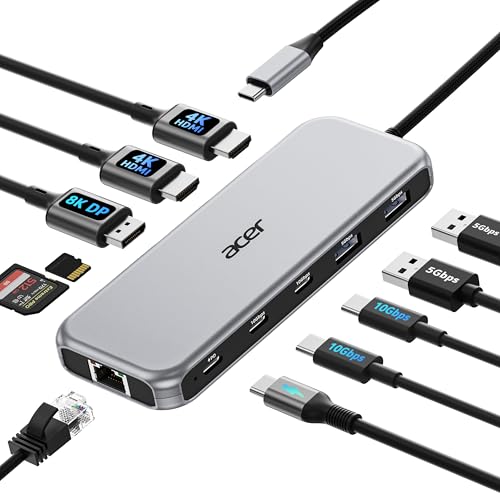
Eleven functions including two 10Gbps USB-C ports and an 8K@30Hz DisplayPort, which is the fastest published data spec among the compact picks.
Best for: a three-screen desk with fast external drives Skip it if: you want a long warranty or published dimensions
The Acer ODK5A0 is where the data speeds finally get serious. Acer lists two USB-C ports at 10Gbps, two USB-A at 5Gbps, gigabit Ethernet, and SD/MicroSD slots rated at 104Mbps. That 10Gbps figure is roughly twenty times the HODO's claimed USB 2.0 speed, and it's the reason this sits third rather than fifth in my ranking.
Video is three outputs: two HDMI at a claimed 4K@60Hz and one DisplayPort at 8K@30Hz. Charging is 100W in, 85W out by Acer's stated numbers. It's the middle of the price positions here and the slowest seller among the three cheapest picks, which reads more like brand recognition in this category than a knock on the hardware.
Two gaps stop it winning. The warranty is one year, the shortest formal term in the set. And Acer publishes neither weight nor dimensions, so if you're planning a tight cable-managed desk you're buying blind on footprint. The Plugable and Dell both publish full measurements.
Against the Anker, you get a third screen and far quicker ports. You give up the 18-month cover and any idea of how big the thing is.
Pros:
- Two 10Gbps USB-C downstream ports claimed
- Three video outputs including 8K@30Hz DisplayPort claim
- Gigabit Ethernet plus SD and MicroSD slots
- Mid-range price position for eleven functions
Cons:
- One-year warranty, shortest formal term here
- No published weight or dimensions
- Slowest seller of the three cheapest picks
- Card reader rated at 104Mbps, slower than the USB-C ports
4. Dell Pro Laptop Docking Station WD25 — Best minimal setup
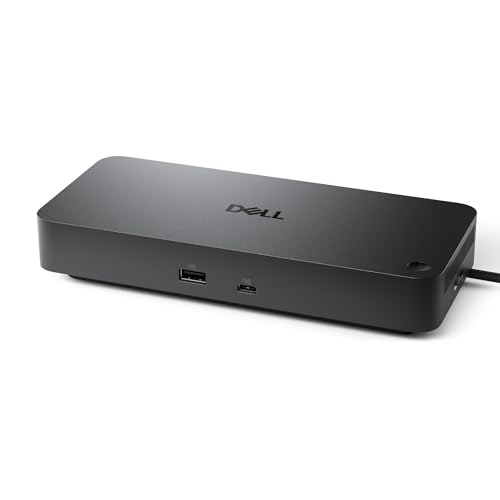
A three-year limited hardware warranty with advanced exchange, which is double the cover of anything else in this set.
Best for: a Dell laptop owner who wants the longest warranty here Skip it if: you need card readers and lots of USB-A
Warranty is the headline. Three years with advanced exchange means a replacement ships before you return the failed unit, and no other pick in this best silent docking station comparison publishes anything close. The Anker pair sit at 18 months, Plugable at two years, Acer and HODO at one.
The 2025 release date shows in the design details Dell publishes. The USB-C cable is ambidextrous and routes left or right, the connector is described as rebuilt for durability, and Dell claims up to a 72% reduction in standby power draw. Native support for up to four high-resolution displays is claimed, via DisplayPort and HDMI. It weighs 1.21 lb and measures 1.39 x 8.07 x 3.54 in.
The port list is where it thins out. The listing names DisplayPort, HDMI and 100W power, and doesn't publish the USB-A count or a card reader. If you plug in six peripherals, look at the Plugable instead. And the compatibility language leans heavily on new mainstream Dell machines, so verify against your own laptop's port spec first.
Pros:
- Three-year warranty with advanced exchange, longest here
- Newest release in this set at 2025
- Claimed 72% standby power reduction
- Reversible cable routing, left or right
- Full published dimensions and weight
Cons:
- Published port list is the thinnest of the six
- No card reader mentioned in the listing
- Compatibility claims centre on Dell laptops
- Fourth of six on price for fewer stated ports
5. Plugable USB C Triple Display Docking Station — Best upgrade
Six USB 5Gbps ports and three HDMI outputs, which is the most peripheral capacity per port here, backed by a two-year parts and labor warranty.

Best for: six USB peripherals across mixed operating systems Skip it if: you want 4K at 60Hz on more than one screen
If your desk has a keyboard, mouse, webcam, headset, printer and a drive all plugged in, this is the answer. Six USB ports at 5Gbps each, three HDMI outputs, and 100W power delivery in a 0.73 lb body measuring 1.18 x 7.87 x 3.54 in.
The catch is how those displays are driven, and Plugable states it plainly: one HDMI runs 4K at 30Hz through Alt Mode, the other two run 1080p at 60Hz through DisplayLink. DisplayLink is a software-driven display method, so a driver install is required and your CPU handles some of the compositing work. On macOS 11 and later, Plugable says drivers are mandatory. That's the honest limit here. Two of your three screens top out at 1080p.
In exchange you get the broadest stated compatibility of the six, covering Windows, macOS and ChromeOS, plus a two-year parts and labor warranty and North American technical support with a compatibility guarantee.
Against the Acer, which claims 4K@60Hz on two HDMI ports natively, the Plugable trades resolution for port count and support depth. Pick based on which of those two you actually run out of first.
Pros:
- Six USB ports at 5Gbps, most in this set
- Three HDMI outputs on one unit
- Two-year parts and labor warranty
- Stated support across Windows, macOS and ChromeOS
- Full published size and weight
Cons:
- Two of three displays capped at 1080p@60Hz
- DisplayLink driver install required, mandatory on macOS
- Second-highest price position here
- USB ports are 5Gbps, not the 10Gbps the Acer claims
6. Anker Prime Docking Station — Best premium
Fourteen ports, a claimed 140W upstream feed and a smart display that reports fan cooling mode, making this the only pick that publishes anything about active cooling.

Best for: a 140W laptop driving three 4K screens Skip it if: you work in a quiet room and dislike active cooling
The DL7400 is the biggest and heaviest pick at 1.84 lb and 1.89 x 7.67 x 3.62 in, and the most expensive pick here. Anker lists fourteen connections: a 140W 10Gbps USB-C upstream port, two 100W 10Gbps USB-C ports, one 100W 5Gbps USB-C port, two HDMI, one DisplayPort, and more. Every USB-C port is stated to handle both charging and data. Triple 4K displays are claimed, using DisplayLink, on Windows 10 and 11.
That 140W upstream figure is the highest number in this set by 40W, and it's the reason to buy. A power-hungry workstation laptop under sustained load can outrun a 100W dock. This one has headroom.
Now the awkward part for this particular search. Anker's own feature copy names a fan cooling mode readable from the front display. Real-time fan monitoring is a genuinely useful feature. It is also confirmation that this unit has a fan, and no pick here publishes a decibel figure. If ambient noise is your primary concern, that disclosure works against it.
Warranty is 18 months, the same as the cheaper Anker, and only one seller lists it. It's also the slowest seller of the six.
Pros:
- 140W upstream claim, highest in this set
- Fourteen connections including three 10Gbps ports
- Smart display reports power and cooling state
- Every USB-C port claimed for charging and data
Cons:
- Only pick that publicly confirms a fan, with no decibel figure published
- Heaviest and largest unit here at 1.84 lb
- Triple 4K relies on DisplayLink and Windows 10/11
- Most expensive pick with an 18-month warranty
- Only one seller lists it
Does a silent docking station actually exist?
Here's the honest answer, and it shapes how you should read every pick above. None of these six listings publishes a decibel figure. Not one. So no product in this guide can be described as verified silent, and I won't pretend otherwise.
What the specifications do let you infer is a probability. Docks that draw their power from your laptop's USB-C bus and weigh a few ounces have no room for a fan and no thermal load that demands one. The Anker at 3.2 oz and the HODO at 4.59 oz are in that class. Larger housings that pass 100W or more of power to a laptop while driving three screens generate real heat, and some of them cool it actively.
The Anker Prime is the only unit here that removes all doubt, and not in the direction you want: its feature copy names fan cooling mode on the front display. That's a transparency win and a noise flag at the same time.
If a quiet room is the whole reason you're shopping for a silent docking station, do this:
- Prefer bus-powered hubs under 8 oz.
- Check the manufacturer's own page for the words fan, active cooling or thermal.
- Assume a 140W desktop unit makes some noise unless the maker says otherwise.
- Avoid stacking a dock on top of a laptop vent, which makes any dock run hotter.
Coil whine is the other noise source, and no listing anywhere discloses it. That one you can only judge once the unit is on your desk.
How many displays do you really need?
Display count is where most buyers overspend, because the marketing number and the usable number are different things.
Three of these picks claim three or more screens: the Acer with two HDMI plus DisplayPort, the Plugable with three HDMI, and the Anker Prime with two HDMI plus DisplayPort. The Dell claims native support for up to four. But look at what each screen actually runs.
- Acer: 4K@60Hz on HDMI, 8K@30Hz on DisplayPort, both native claims
- Plugable: 4K@30Hz on one HDMI, 1080p@60Hz on the other two via DisplayLink
- Anker Prime: triple 4K via DisplayLink, Windows 10/11 only
- Anker 8-in-1: 4K@60Hz single, 4K@30Hz dual
- HODO: 4K@60Hz on HDMI and DP, 4K@30Hz on the second HDMI
Two figures matter more than the count. Refresh rate at 30Hz makes mouse movement look smeared, which is fine for static documents and bad for anything you drag. And DisplayLink is a driver, not a chip in your laptop, so it borrows CPU cycles and needs software kept current.
My rule: if you genuinely use two screens, buy a native dual-output dock and get 60Hz. If you need a third, decide whether that third screen is for a reference document, in which case 1080p is fine, or for real work, in which case the Acer's native outputs beat the Plugable's DisplayLink pair.
Wattage, warranty and the numbers that matter
Two specifications separate a dock you'll keep for five years from one that ends up in a drawer.
Power output to the laptop. Every pick states an input figure and most state a safe output. The Anker 8-in-1 claims 85W pass-through, the Acer 85W from a 100W input, the HODO 87W from 100W, the Dell 100W, the Plugable 100W, and the Anker Prime 140W upstream. If your laptop ships with a 65W charger, anything here has headroom. If it ships with a 130W or 140W brick, only the Prime matches it, and everything else will slowly drain the battery under sustained load.
Warranty length. This is the durability proxy in a category where the failure point is a connector that gets plugged and unplugged daily.
- Dell WD25: 3-year limited hardware warranty with advanced exchange
- Plugable: 2-year limited parts and labor, plus lifetime technical support
- Both Ankers: 18 months
- HODO: 1-year refund and replacement
- Acer: 1 year manufacturer
The spread runs from twelve months to thirty-six. Advanced exchange on the Dell is the standout term, because it means you aren't without a dock while a claim processes. That's worth more than two extra USB ports if the dock is how you work every day.
When a different pick wins
The Anker 8-in-1 is my default, but four specific conditions flip it.
If your laptop needs more than 100W to charge, the Anker Prime is the only pick with a 140W upstream claim. No workaround exists for that gap. A dock that undersupplies your machine means the battery drops during long video calls.
If you plug in more than four USB peripherals, the Plugable's six 5Gbps ports solve a problem the others don't. The Anker 8-in-1 gives you two USB-A. Adding a second hub to a dock stacks latency and failure points.
If you copy large files to external drives daily, the Acer's claimed 10Gbps USB-C ports are the answer, and the HODO's USB 2.0 ports are specifically the wrong choice. A 50GB transfer over 480Mbps is a coffee break. Over 10Gbps it's a moment.
If the dock lives in a shared quiet space, stay with the smallest bus-powered units and away from the 140W desktop class. The Anker 8-in-1 at 3.2 oz and the HODO at 4.59 oz are the safest bets in this best silent docking station set on that basis, even though neither publishes a noise figure.
One more flip worth naming: if you own a recent Dell laptop and value the longest support term, the WD25's three-year advanced exchange warranty beats every other pick on paper.
The verdict
The best silent docking station for a typical two-monitor desk is the Anker Laptop Docking Station Dual Monitor. It's the second-cheapest pick, the lightest at 3.2 oz, and the one buyers choose most often in this set. Eight functions cover the ports most people actually use: two HDMI, Ethernet, two USB-A, a card reader and 85W pass-through charging. Its small bus-powered body is also the least likely of the six to need active cooling, though no listing here publishes a decibel figure to confirm that.
Two conditions flip the recommendation. First, if your laptop demands more than 100W, the Anker Prime DL7400 and its claimed 140W upstream port is the only pick that keeps up, and you accept a confirmed fan mode as the price. Second, if you need a third screen at usable speed, the Acer ODK5A0 claims 4K@60Hz on both HDMI outputs natively plus 10Gbps USB-C data, which beats the Plugable's DisplayLink 1080p pair for real work.
The Plugable's exact advantage over my winner is peripheral capacity: six USB ports at 5Gbps against the Anker's two USB-A, plus a two-year parts and labor warranty and stated ChromeOS and macOS support. If your desk is crowded rather than your monitor count high, buy that one instead.
FAQ
Is a silent docking station worth paying more for?
A silent docking station is worth paying more for only when the noise is confirmed in writing, and none of these listings publish a decibel figure. Spend the extra on things you can verify instead: the Dell's three-year advanced exchange warranty, the Acer's 10Gbps ports, or the Anker Prime's 140W upstream claim. Those are checkable specifications, not inferences.
Which docking station gives the most ports for the money?
The most ports for the money comes from the Acer ODK5A0. It sits third of six on price and lists eleven functions, including two 10Gbps USB-C ports, two USB-A at 5Gbps, gigabit Ethernet, dual HDMI, DisplayPort and card slots. The HODO is cheaper with eight functions, but its three USB ports are limited to USB 2.0 at a claimed 480Mbps.
What is DisplayLink and does it affect performance?
DisplayLink affects performance because it drives displays through software rather than your laptop's native video output. The Plugable uses it for two of three HDMI ports, capped at 1080p@60Hz, and the Anker Prime uses it for triple 4K on Windows 10 and 11. It needs a driver install, mandatory on macOS 11 and later, and it consumes some CPU capacity.
Anker 8-in-1 or Acer 11-in-1: which should I buy?
Choose between the Anker 8-in-1 and Acer 11-in-1 on screen count and data speed. The Anker weighs 3.2 oz, costs less, and drives two HDMI displays with an 18-month warranty. The Acer adds a third output with an 8K@30Hz DisplayPort claim and 10Gbps USB-C ports, but publishes no weight or dimensions and covers you for just one year.
Will any dock charge a high-wattage laptop properly?
Not every dock will charge a high-wattage laptop properly, and this is the most common mistake in the category. Four picks here claim 85W to 87W of safe output, and two claim 100W. Only the Anker Prime states a 140W upstream port. Check the wattage printed on your laptop's original charger, then match or exceed it, or expect slow battery drain under load.
Start by counting two numbers on your own desk: the wattage on your laptop's charger and the number of monitors you'll actually keep plugged in. Those two figures pick your dock faster than any port list. For most people the answer lands on the Anker 8-in-1, because two 4K-capable HDMI outputs and 85W of pass-through power cover the standard hybrid-work desk in a 3.2 oz body that generates almost nothing to cool. Buy bigger only when a specific number on your hardware forces it, not because fourteen ports sound better than eight.