Best Silent External SSD for Graphic Designers
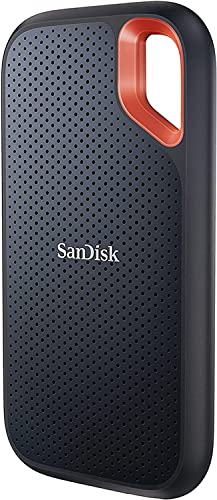
Six external SSDs ranked for a designer's workflow, with read speeds, capacities and warranties compared side by side. The SanDisk 2TB Extreme takes the top spot on capacity and coverage.

By Samuel HarrisUpdated 14 min read
On this page
- Best silent external SSD for graphic designers at a glance
- How I screened these six drives
- Why silence is easier than you think here
- What decides an SSD for design work?
- 1. Sandisk 2TB Extreme Portable SSD — Best overall
- 2. Samsung T7 Portable SSD 1TB Titan Gray — Best for heavy use
- 3. Lexar ES3 1TB Portable SSD Silver — Best for families
- 4. SSK 256GB Portable SSD External Hard Drive Solid State — Best budget pick
- 5. Sandisk 1TB Portable SSD Lavender — Best lightweight
- 6. Lexar 2TB ES3 External SSD — Best premium
- How much capacity does a designer actually need?
- When a different pick wins
- The verdict
- FAQ
The best silent external SSD for graphic designers is the SanDisk 2TB Extreme Portable SSD, which pairs up to 1050MB/s read speeds with a 5-year warranty and 2TB of room for layered files. If you move huge working files every single day, the Samsung T7 is the better buy, with claimed 1050/1000MB/s speeds and a compact 0.3-inch profile. The deciding factor here is not noise. It's capacity, warranty and read speed, and those split this field cleanly.
Most guides tell you to hunt for a quiet drive. That's the wrong worry. An external SSD has no fan and no spinning platter, so silence is a property of the whole category, not a feature you shop for. What actually separates these six is how much you can store, how fast the drive reads back your files, and how long the maker will stand behind it. This guide ranks all six on those terms.
Best silent external SSD for graphic designers at a glance
| Pick | Capacity | Read speed | Price |
|---|---|---|---|
Best overall Sandisk 2TB Extreme Portable SSD |
2TB | up to 1050MB/s claim | Check Price |
Best for heavy use Samsung T7 Portable SSD 1TB |
1TB | up to 1050MB/s claim | Check Price |
Best for families Lexar ES3 1TB Portable SSD |
1TB | up to 1050MB/s claim | Check Price |
Best budget pick SSK 256GB Portable SSD |
256GB | up to 550MB/s claim | Check Price |
Best lightweight Sandisk 1TB Portable SSD Lavender |
1TB | up to 800MB/s claim | Check Price |
Best premium Lexar 2TB ES3 External SSD |
2TB | up to 1050MB/s claim | Check Price |




How I screened these six drives
I started with the published listings and lined up the numbers that matter to a design workflow. Capacity, read speed, weight, warranty and price position all went into one table. Then I cut anything that couldn't hold a real project.
Here's what I looked at, in order:
- Capacity. Layered PSD files, raw photo libraries and video assets fill space fast. I favored drives that give you room to work.
- Read speed. How quickly you can pull a large file back onto your machine.
- Warranty. A design drive lives a hard life. Longer coverage lowers your risk.
- Weight and size. A drive you carry between studio and home should be pocketable.
- Price position within the set. What you actually get for spending up.
The 256GB SSK survived on price alone, not on room to work. The two entry drives read slower than the rest. Everything in this list is silent by nature, so noise never entered the scoring. That freed the ranking to focus on the specs that separate one drive from the next.
Why silence is easier than you think here
Silence is the premise of this whole category, not a spec you chase. Every drive here is a solid state drive. That means no fan and no moving platter, so none of them makes noise you can hear across a quiet room. This matters because the keyword promises silence, and it's worth being honest: Amazon's search didn't filter for it, and no listing here publishes a decibel figure.
So don't pay a premium for a "silent" label. You'd be paying for a trait that comes free with the technology. What you should judge instead:
- Whether the drive gets warm during long transfers, which the Lexar 2TB ES3 addresses with claimed double-layer graphite sheets
- Whether the enclosure rattles in a bag, a function of weight and build
- Whether cable strain adds mechanical noise, which is on your desk setup, not the drive
Judge the silence claim for yourself. Every option in this guide is fanless. The real decision sits elsewhere.
What decides an SSD for design work?
What decides an SSD for design work is the combination of read speed, capacity and warranty, not the "silent" tag in the search box. A designer opens large files repeatedly and needs them back fast. A designer also fills space quickly. And a working drive that fails mid-project is a disaster, so coverage counts.
Read speed is the headline number. Four of these six claim up to 1050MB/s: the SanDisk 2TB Extreme, the Samsung T7, the Lexar ES3 1TB and the Lexar 2TB ES3. The SanDisk 1TB Lavender claims up to 800MB/s. The SSK claims up to 550MB/s, the slowest here.
Capacity is the quiet decider. Two drives offer 2TB, three offer 1TB, and one offers 256GB. Warranty splits the field too: the SanDisk Extreme carries a 5-year limited warranty, the longest published in this set. Both Lexar drives and the Samsung list 3 years. Two listings publish no warranty at all. When you shop the best silent external SSD for graphic designers, weigh those three numbers together.
1. Sandisk 2TB Extreme Portable SSD — Best overall
The SanDisk 2TB Extreme wins on the strongest mix here: 2TB of room, a claimed 1050MB/s read, and the only 5-year warranty in the set.
Best for: designers who want the most capacity and the longest warranty in one drive Skip it if: you only need a small scratch disk
This drive gives you the most complete package in the group. It's one of two 2TB options, which means room for layered files, raw libraries and video assets without constant housekeeping. SanDisk claims NVMe performance up to 1050MB/s read and 1000MB/s write, matching the fastest here on paper.
The warranty is where it pulls ahead. Its 5-year limited manufacturer warranty is the longest published in this set, and for a drive that travels between locations, that coverage is real value. SanDisk also lists up to 3-meter drop protection and an IP65 water and dust rating, plus 256-bit AES hardware encryption through its Memory Zone app.
At 1.76 oz and 0.38 x 3.97 x 2.07 in, it's still pocketable. The trade-off: it sits at a premium price position, the second-most expensive of the six, so you pay for that capacity and coverage. If you don't need 2TB, cheaper drives here do the job.
Pros:
- Full 2TB, the joint-largest capacity here
- Longest published warranty at 5 years
- Claimed up to 1050MB/s read, fastest tier
- IP65 rating and 3-meter drop protection claimed
- 256-bit AES hardware encryption included
Cons:
- Premium price position, second-highest in the set
- Listed as an older model
- Heaviest but one of the pockets, at 1.76 oz
2. Samsung T7 Portable SSD 1TB Titan Gray — Best for heavy use
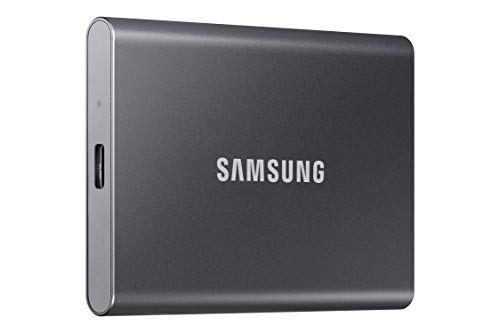
The Samsung T7 is the drive to grab when you push large working files all day, thanks to claimed 1050/1000MB/s speeds in a thin body.
Best for: designers moving large working files day after day Skip it if: you need more than 1TB in one drive
The T7 is built around fast, repeated transfers. Samsung says it uses PCIe NVMe technology for read and write speeds up to 1,050/1,000 MB/s, and it markets the drive at makers who file photographs and back up video. For a designer cycling assets on and off a laptop, that matters more than raw capacity.
At 0.3 x 3.3 x 2.2 in, it's the thinnest drive here by the published dimensions, so it slides into a laptop sleeve without a bulge. It weighs 2.08 oz, the heaviest of the six, though that's still light. Samsung claims 4K 60fps recording directly to the drive, which helps designers who shoot video for their work.
The warranty is 3 years, solid but two years short of the SanDisk. And at 1TB, it holds half what the two 2TB drives do. The trade-off is clear: you get proven speed and a slim shell, but you give up top capacity and the longest coverage.
Pros:
- Claimed up to 1050/1000MB/s read and write
- Thinnest body here by published dimensions
- 3-year limited warranty
- Claimed 4K 60fps direct recording
- Mid-range price position
Cons:
- 1TB caps below the two 2TB drives
- Heaviest of the six at 2.08 oz
- Warranty two years shorter than the winner
3. Lexar ES3 1TB Portable SSD Silver — Best for families
The Lexar ES3 1TB is the easy pick for a shared household, blending a claimed 1050MB/s read with the lightest 1TB body here.

Best for: shared households backing up mixed files Skip it if: you want the longest warranty possible
The ES3 1TB is the drive I'd hand to a family that shares design projects, school files and photo backups on one disk. Lexar says it supports USB 3.2 Gen 2 up to 1050MB/s read and 1000MB/s write, so it keeps pace with the fastest drives here on paper. Wide device support is the selling point: Lexar lists iPhone 17 series, Android, laptops, cameras and consoles.
It's tiny. At 1.59 oz and 0.39 x 3.94 x 1.97 in, Lexar describes it as smaller than a card and just 10.5mm thick. That makes it easy to pass around a busy home. It also includes Lexar DataShield 256-bit AES encryption to lock private files.
The warranty runs 3 years, matching the Samsung but short of the SanDisk. Only one seller lists it, which can limit your buying options. The trade-off against the winner: same claimed speed, but half the capacity and two fewer warranty years.
Pros:
- Claimed up to 1050MB/s read
- Lightest 1TB drive here at 1.59 oz
- Broad device compatibility listed
- 256-bit AES encryption included
- Mid-range price position
Cons:
- 1TB only, half the top capacity
- Just one seller listed
- No MagSafe on this version, per the listing
4. SSK 256GB Portable SSD External Hard Drive Solid State — Best budget pick
The SSK 256GB is the cheapest way into this set, a small silent scratch disk for spillover files rather than a main working drive.

Best for: designers who want a cheap scratch disk Skip it if: you edit large raw files
The SSK is the entry point, the cheapest of the six. It's built for a narrow job: a small, quiet drive for overflow files, exports or a portable font and asset kit. SSK claims speeds up to 550MB/s over USB 3.2 Gen 2, the slowest read here by a clear margin.
Capacity is the real limit. At 256 GB, this is far below everything else, and SSK notes it shows as around 232GB on Windows. For a designer editing layered raw files, that fills fast. SSK claims SLC caching to keep large transfers steady, plus S.M.A.R.T. monitoring and TRIM. It ships with a USB-C cable and a USB-A adapter, so it plugs into older machines too.
At 1.52 oz and 0.4 x 2.5 x 1.3 in, it's the smallest drive here. No warranty is published on this listing, which is the risk you accept at this price. The trade-off is stark: you save the most, but give up capacity, speed and coverage.
Pros:
- Cheapest drive in the set
- Smallest body here at 0.4 x 2.5 x 1.3 in
- USB-C cable and USB-A adapter included
- Claimed SLC caching for steady transfers
Cons:
- 256 GB, far below the rest
- Slowest read at up to 550MB/s claim
- No warranty published on the listing
- Usable space shows around 232GB on Windows
5. Sandisk 1TB Portable SSD Lavender — Best lightweight
The SanDisk 1TB Lavender is the one to carry everywhere, the lightest drive here at 1.44 oz with everyday drop protection.

Best for: designers who carry a drive everywhere Skip it if: peak transfer speed matters most
If your drive lives in a bag and moves with you between coffee shops, studio and home, this is the featherweight. At 1.44 oz, it's the lightest of all six. The lavender finish makes it easy to spot in a crowded pocket, and SanDisk includes a rubber hook to clip it to a belt loop or backpack.
The catch is speed. SanDisk claims up to 800MB/s read, faster than the SSK but slower than the four 1050MB/s drives. For carrying finished files, browsing a photo library or quick backups, that's plenty. For scrubbing through large working files, the faster picks pull ahead.
It offers 1TB, matching the middle of the pack on capacity, and sits at an entry price position, the second-cheapest here. SanDisk lists up to 2-meter drop resistance for everyday knocks. No warranty is published on this listing. The trade-off: you get carry-friendly weight and a low price, but slower reads and no stated coverage.
Pros:
- Lightest drive here at 1.44 oz
- 1TB capacity at an entry price
- Rubber hook for easy carry
- Claimed 2-meter drop resistance
- Second-cheapest of the six
Cons:
- Up to 800MB/s claim, slower than the top four
- No warranty published on the listing
- No dimensions published to confirm pocket fit
6. Lexar 2TB ES3 External SSD — Best premium
The Lexar 2TB ES3 pairs full 2TB capacity with claimed graphite cooling, aimed at designers who run long, back-to-back transfers.

Best for: designers who want 2TB with graphite cooling Skip it if: a longer warranty is your priority
The Lexar 2TB ES3 is the newest drive here, released in 2024, and it's built for sustained work. Lexar claims read speeds up to 1050MB/s and write up to 1000MB/s, matching the fastest tier. What sets it apart is thermal design: Lexar says built-in double-layer graphite sheets conduct heat away to keep the drive cool during blazing transfers. For long export sessions, that claim is worth noting.
It's one of two 2TB drives, so capacity is not a compromise. Lexar lists 2-meter drop resistance and a plug-and-play 2-in-1 USB-C/USB-A cable, which means it connects to almost any machine out of the box.
This is the most expensive pick here, so you pay top price. The warranty is 3 years, two short of the SanDisk winner, which is the real reason it lands below it. Only one seller lists it. The trade-off against the SanDisk: same capacity and a cooling claim, but a shorter warranty at a higher price.
Pros:
- Full 2TB capacity
- Claimed up to 1050MB/s read
- Graphite cooling sheets claimed
- 2-in-1 USB-C/USB-A cable included
- Newest drive here, released 2024
Cons:
- Most expensive pick in the set
- 3-year warranty, short of the winner's 5
- Only one seller listed
- No weight or dimensions published
How much capacity does a designer actually need?
How much capacity a designer actually needs depends on what you edit and how often you archive. Layered files, raw photos and video eat space fast, and running out mid-project is worse than any speed penalty. Here's how the sizes in this set map to real use:
- 256 GB (SSK): a scratch disk, an export drop, or a portable asset kit. Not a main working drive for large files.
- 1TB (Samsung T7, Lexar ES3 1TB, SanDisk Lavender): enough for active projects and a photo library, if you archive regularly.
- 2TB (SanDisk Extreme, Lexar 2TB ES3): room for layered work, raw sets and video without constant housekeeping.
My rule: buy one tier above what you think you need. Design files grow, and you'll fill the space. If you edit video or hold large raw libraries, start at 2TB. If you mostly finish and archive, 1TB stretches further than it sounds.
When a different pick wins
The SanDisk 2TB Extreme is the default, but three conditions flip that.
- You move huge files all day. Then the Samsung T7 earns its place, with claimed 1050/1000MB/s speeds and the thinnest body here at 0.3 in thick.
- You carry your drive everywhere. Then the SanDisk 1TB Lavender wins on weight, at 1.44 oz, the lightest of the six.
- You need cooling for long exports. Then the Lexar 2TB ES3 and its claimed graphite sheets make sense, if you'll accept a 3-year warranty over a 5-year one.
The cutoff is capacity. Below 1TB, only the SSK qualifies, and only as a scratch disk. At 1TB, you have three strong choices. At 2TB, the SanDisk Extreme and Lexar ES3 both fit, and warranty breaks the tie.
The verdict
If you want one drive to cover a full design workflow, buy the SanDisk 2TB Extreme Portable SSD. If your day is nonstop file movement, buy the Samsung T7. The cutoff between them is capacity: choose the SanDisk when 2TB matters and the coverage of a 5-year warranty gives you peace of mind, and choose the Samsung when 1TB is enough and you'd rather have the thinnest body here, at 0.3 in thick.
The SanDisk wins the overall call because it stacks the three numbers that decide this category. It offers 2TB, the joint-largest capacity. It claims up to 1050MB/s read, matching the fastest tier. And it carries the only 5-year limited warranty in the set, two years longer than the Samsung and both Lexar drives.
The Samsung's exact advantage is form and focus. Its slim shell and claimed 1050/1000MB/s speeds suit a designer who cycles large assets constantly and doesn't need 2TB. Every drive here is silent, so noise never tips the scale. Capacity, read speed and warranty do, and on those the SanDisk leads.
FAQ
Is a silent external SSD worth it for graphic designers?
A silent external SSD is worth it for graphic designers, but not because of the silence. Every solid state drive here is fanless and quiet by nature, so you don't pay extra for that. You pay for capacity, read speed and warranty. The SanDisk 2TB Extreme delivers all three, with 2TB, a claimed 1050MB/s read and a 5-year warranty.
What is the best value pick in this set?
The best value pick depends on your budget floor. The SSK 256GB is the cheapest, useful as a scratch disk but limited at 256 GB and up to 550MB/s. For most designers, the SanDisk 1TB Lavender offers better value: 1TB at an entry price, the lightest drive here at 1.44 oz, though its read speed is capped at 800MB/s.
How fast does an SSD need to be for design work?
How fast an SSD needs to be for design work comes down to file size. Four drives here claim up to 1050MB/s read: the SanDisk Extreme, Samsung T7, Lexar ES3 1TB and Lexar 2TB ES3. That top tier suits scrubbing large working files. The SanDisk Lavender at 800MB/s handles backups fine. The SSK at 550MB/s is the slowest here.
Should I choose the SanDisk 2TB Extreme or the Lexar 2TB ES3?
Choose the SanDisk 2TB Extreme or the Lexar 2TB ES3 based on warranty and price. Both offer 2TB and a claimed 1050MB/s read. The SanDisk carries a 5-year warranty and sits at a lower price position. The Lexar is the newest here, from 2024, and claims graphite cooling sheets, but its warranty is 3 years and it's the most expensive pick.
What mistake do designers make buying an external SSD?
The mistake designers make buying an external SSD is chasing a "silent" label. Silence comes free with every solid state drive, since none has a fan or moving parts. Amazon's search didn't filter for it, and no listing here publishes a decibel figure. Judge capacity, read speed and warranty instead. Those three numbers separate a scratch disk from a real working drive.
Start by deciding how much room your projects need, then match it to warranty and read speed. For most designers, the SanDisk 2TB Extreme is the safe default: it gives you 2TB to work in, a claimed 1050MB/s read to pull files back fast, and a 5-year warranty that few external drives match. Every drive in this guide runs silent, so let that worry go and buy on the numbers that carry your work. Open the listings, compare the capacities against your own file sizes, and pick the drive that leaves you room to grow.