Best USB C Docking Station for a CAD Workstation

Six USB-C docks compared on the specs that matter for drafting work: refresh rate at 4K, data port speed, power passthrough and warranty length. One clear default, with three conditions that change the answer.

By Samuel HarrisUpdated 17 min read
On this page
- Best USB C docking station for CAD at a glance
- Why three picks got cut before the shortlist
- Does a docking station help with CAD work at all?
- Dual 4K at 60Hz or dual 4K at 30Hz: which side is your dock on?
- 1. Anker Laptop Docking Station Dual Monitor — Best overall
- 2. HODO USB C Docking Station Dual Monitor for HP — Runner-up
- 3. UGREEN USB C Docking Station Dual Monitor — Best budget pick
- 4. Dell Pro Laptop Docking Station WD25 — Best premium
- 5. Anker Laptop Docking Station 13-in-1 — Best for pros
- 6. VVB USB C Docking Station 14-in-1 — Best minimal setup
- How much data speed does your external drive need?
- What more money buys across these six
- When a different pick wins
- The verdict
- FAQ
The best USB C docking station for CAD work is the Anker 8-in-1 Dual Monitor Dock, because it drives a single display at 4K@60Hz, passes 85W back to the laptop, and carries an 18-month warranty in a 3.2 oz body. If you need a third screen or a four-display layout, the Dell Pro WD25 is the better buy at 1.21 lb with a three-year limited hardware warranty.
Get this choice wrong and you'll feel it inside an hour. A dock that tops out at 4K@30Hz turns every orbit and pan into a stutter, and no driver update fixes it.
Best USB C docking station for CAD at a glance
| Pick | Max dual-display claim | Power passthrough claim | Price |
|---|---|---|---|
Best overall Anker Laptop Docking Station Dual Monitor |
2x 4K@30Hz 1x 4K@60Hz |
85W claim | Check Price |
| 4K@60Hz + 4K@30Hz claim | 100W in / 87W out claim | Check Price | |
Best budget pick UGREEN USB C Docking Station Dual Monitor |
2x 4K@60Hz claim (needs DP 1.4) | 100W claim | Check Price |
Best premium Dell Pro Laptop Docking Station WD25 |
Up to 4 displays claim | 100W claim | Check Price |
Best for pros Anker Laptop Docking Station 13-in-1 |
3x 1080p@60Hz 1x 4K@60Hz |
85W host + 18W PD claim | Check Price |
Best minimal setup VVB USB C Docking Station 14-in-1 |
2x 4K + triple display claim | 100W in / 87W out claim | Check Price |




Why three picks got cut before the shortlist
I started with the docking station listings in this category and cut on three grounds before ranking anything.
- No published refresh rate for the second display. A listing that says "dual 4K" without naming 30Hz or 60Hz is hiding the number that matters most for drafting. If the manufacturer won't print it, I won't guess it.
- No stated warranty term. Docks fail at the cable joint and the power stage. Every one of the six survivors publishes a warranty period or a replacement policy, from HODO's one-year refund and replacement window up to Dell's three-year limited hardware warranty with advanced exchange.
- No power passthrough figure. A dock that can't feed the laptop forces a second cable and a second wall socket. All six here publish a wattage claim, from Anker's 85W up to the 100W input figures on the UGREEN, VVB, HODO and Dell.
What survived is six docks that publish enough to compare. Two are entry price positions, two sit mid-range, two are the priciest of the set. Sales data tells its own story: the Anker 8-in-1 is the one buyers choose most often here, and the 13-in-1 Anker is the slowest seller of the six despite being the more capable dock on paper.
Does a docking station help with CAD work at all?
Here's the honest answer, and it's the reason this guide is built the way it is. None of these six listings mentions CAD, drafting, SolidWorks, AutoCAD or 3D rendering anywhere. Not one. The word doesn't appear in a single specification or feature claim, so no dock here can be sold to you as CAD-certified.
A dock does not add GPU horsepower. It moves your laptop's existing display output, data and power through one cable. What it can do for drafting work is real but narrow:
- Hold two or three reference views open at once, so your model tree, drawing sheet and viewport stop fighting for the same screen.
- Keep the refresh rate high enough that orbiting a large assembly stays smooth.
- Move project archives off the laptop over a fast USB port instead of a slow one.
- Feed the machine enough power that it doesn't throttle mid-session.
That last point deserves emphasis. Everything a dock does for a drafting workflow is about screen real estate, refresh rate, data throughput and sustained power. Judge these six on those four numbers, and treat any CAD promise you see elsewhere with suspicion.
Dual 4K at 60Hz or dual 4K at 30Hz: which side is your dock on?
Most guides to the best USB C docking station for CAD count ports. Port count is close to meaningless here. The number that decides your day is the refresh rate on the second display at 4K.
At 4K@30Hz, cursor motion smears. Rotating an assembly looks like a slideshow. You'll notice it in ten minutes and resent it for years. At 4K@60Hz, it's just a monitor.
The split across these six runs like this:
- Anker 8-in-1: 4K@60Hz on one display, or 4K@30Hz on both.
- UGREEN 7-in-1: claims 4K@60Hz on both HDMI ports, conditional on your laptop supporting DP 1.4.
- HODO 8-in-1: claims one HDMI at 4K@60Hz and the second at 4K@30Hz, with a 4K@60Hz DisplayPort alongside.
- Anker 13-in-1: three displays at 1080p@60Hz, or a single 4K@60Hz output.
- Dell WD25: claims native support for up to four high-res displays.
- VVB 14-in-1: claims 4K dual output and triple display on Windows, without publishing per-port refresh rates.
The conditional on the UGREEN is the trap. DP 1.4 with Display Stream Compression is what makes two 4K@60Hz streams fit down one USB-C lane. If your laptop only does DP 1.2, that claim collapses to something closer to the Anker's numbers, and no dock can rescue it.
1. Anker Laptop Docking Station Dual Monitor — Best overall
The most sensible default here: a 3.2 oz dock that delivers 4K@60Hz where it counts, backed by 18 months of coverage.
Best for: a two-monitor desk that needs 4K@60Hz on the primary display Skip it if: you need a third monitor or a wired 87W-plus output
This is the pick that gets the priorities right. Anker publishes the refresh rate honestly: 4K@60Hz on a single display, or 4K@30Hz across both HDMI ports. That's the real behaviour of most DP Alt Mode laptops, stated plainly rather than buried behind a compatibility footnote.
The port mix suits drafting work. Two HDMI, two USB-A data ports, Gigabit Ethernet, a microSD/SD reader and a USB-C PD input, all in a 0.69 x 4.65 x 2.01 in body weighing 3.2 oz. Ethernet matters when you're pulling large assemblies off a network drive and Wi-Fi keeps dropping the transfer. The card reader matters if you shoot site photography.
Power passthrough is rated at 85W by Anker, and the listing notes you'll need a 100W wall charger and a USB-C to C cable, neither included. Compatibility covers USB-C, USB4 and Thunderbolt on Windows 10 and 11 and ChromeOS. Released in 2020, and it's the one buyers choose most often across this set.
Against the others, it gives up the third monitor the 13-in-1 Anker offers and the four-display headroom Dell claims. That's the trade for the smallest footprint here and the third price position.
Pros:
- 4K@60Hz single-display output, honestly stated
- Just 3.2 oz and 0.69 in thick
- Gigabit Ethernet plus microSD/SD reader
- 18-month warranty published
- Sells fastest of the six
Cons:
- Both monitors drop to 4K@30Hz together
- 85W passthrough is the lowest figure here
- Wall charger and USB-C cable not included
- No third-monitor option at all
2. HODO USB C Docking Station Dual Monitor for HP — Runner-up
Four video outputs across four different connector types, which makes it the fixer for a mismatched monitor collection.

Best for: a mixed monitor collection with an older VGA or DisplayPort screen Skip it if: you move large project files over USB
Nobody else in this set carries VGA. HODO claims two HDMI ports at 4K@60Hz and 4K@30Hz respectively, a 4K@60Hz DisplayPort and a 1080p VGA, which is four video outputs on a 4.59 oz dock. If you have a good older panel that only speaks DisplayPort or VGA, this is the only pick here that talks to it without a second adapter in the chain.
The listing claims up to 100W input with 87W safe output to the laptop, which is a higher passthrough figure than the Anker 8-in-1 above it. Warranty is a one-year refund and replacement policy for defective items.
Then comes the compromise, and it's a big one. The three USB-A ports are USB 2.0, rated at 480Mbps by HODO. That's fine for a keyboard, a mouse and a licence dongle. It's painful for copying a project folder off an external drive, where the UGREEN's 10Gbps ports are more than twenty times the claimed figure.
It's the second-cheapest option here and it sells briskly, ranking behind only the Anker 8-in-1 in this set. Note also that no dimensions are published, so plan desk space loosely.
Pros:
- Only pick here with a VGA output
- Four video ports across HDMI, DP and VGA
- 87W safe output claim beats the Anker 8-in-1
- Second-cheapest of the six
Cons:
- USB-A ports are USB 2.0 at a claimed 480Mbps
- No published dimensions
- No Ethernet port
- Warranty is a one-year replacement policy, not a multi-year term
3. UGREEN USB C Docking Station Dual Monitor — Best budget pick
The cheapest dock here is also the only one claiming 4K@60Hz on both HDMI ports, with one condition attached.

Best for: a DP 1.4 laptop driving two 4K@60Hz panels on a tight budget Skip it if: you need Ethernet or a card reader
Read the condition before you buy. UGREEN claims dual 4K@60Hz through two HDMI ports, then adds that your laptop must support DP 1.4. That's the whole ballgame. On a DP 1.4 machine, this is the cheapest route to two full-speed 4K screens in this set. On a DP 1.2 machine, the claim doesn't apply to you.
Data handling is the strongest here on paper: two 10Gbps USB-A ports and two 10Gbps USB-C ports, described as USB 3.2. For anyone shuffling large model files or rendering output to an external SSD, that spread of fast ports is worth more than an extra video connector. Power passthrough is claimed at 100W, though the charging cable and adapter aren't included.
The aluminium body measures 0.49 x 3.1 x 0.8 in at 3.21 oz, the smallest footprint of the six by a wide margin. The 2-year warranty is the second-longest here, behind only Dell's three-year term.
What you give up is expansion breadth. Seven ports and no Ethernet, no SD reader. It's also the slowest-moving of the entry-price picks, and only one seller lists it.
Pros:
- Dual 4K@60Hz claim, unique in this set
- Four 10Gbps data ports
- 2-year warranty
- Smallest body at 0.49 x 3.1 x 0.8 in
- Cheapest of the six
Cons:
- Dual 4K@60Hz needs DP 1.4 on your laptop
- No Ethernet port
- No SD or microSD reader
- Only one seller lists it
- Charging cable and adapter not included
4. Dell Pro Laptop Docking Station WD25 — Best premium
A three-year limited hardware warranty with advanced exchange, plus a four-display claim no other pick matches.
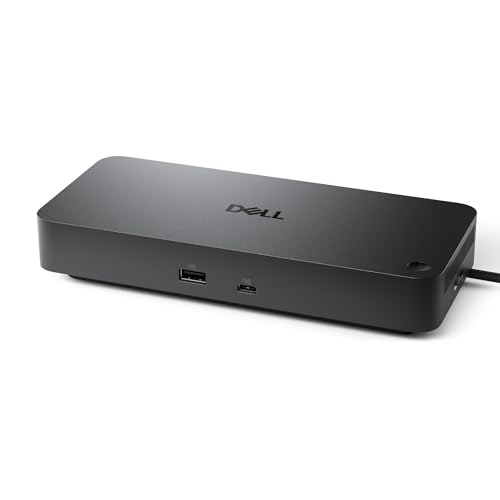
Best for: a Dell laptop owner who wants four displays and a three-year warranty Skip it if: you run a non-Dell machine or want the cheapest route to two screens
Warranty is the reason to buy this one. Three years of limited hardware coverage with advanced exchange is unmatched in this set, where the next best is UGREEN's 2 year term. For a machine that sits on a desk earning money five days a week, that difference is worth real money.
Dell claims native support for up to four high-res displays and 100W of power delivery, with USB-C and both DisplayPort and HDMI on board. It's the heaviest and largest pick here at 1.21 lb and 1.39 x 8.07 x 3.54 in, which reads less like a travel hub and more like permanent desk furniture. That's fine for a fixed drafting station.
Two details from the listing are worth flagging. The USB-C cable is described as ambidextrous, routable left or right, which sounds trivial until your dock lives on the wrong side of the desk. And Dell claims up to 72% lower power consumption on standby. Released in 2025, so it's the newest here.
The catch is scope. Dell frames the compatibility claim around Dell AI PCs, and it's the most expensive pick in this set. If your laptop isn't a Dell, the cheaper picks get you two screens for far less.
Pros:
- 3-year limited hardware warranty with advanced exchange
- Four-display support claim, highest here
- 100W power delivery claim
- Newest design in the set, released 2025
- Reversible cable routing
Cons:
- Most expensive pick here
- Heaviest and bulkiest at 1.21 lb
- Compatibility claim framed around Dell machines
- No published USB data speed figure
- No card reader mentioned
5. Anker Laptop Docking Station 13-in-1 — Best for pros
Thirteen ports and a 135W power adapter in the box, which is the only bundled brick in this set.

Best for: a three-monitor reference layout at 1080p with a bundled power brick Skip it if: all three of your monitors are 4K
Every other pick here tells you to buy your own charger. This one ships a 135W power adapter, and Anker rates the dock at 85W to the laptop plus 18W to a phone at the same time. Add up what a decent 100W brick costs on its own and the price gap to the cheaper picks narrows considerably.
The port list is the longest that's fully published: 2 HDMI, DisplayPort, three USB-C including an 85W host and a 10Gbps data port, three USB-A at 5Gbps, Gigabit Ethernet, SD and microSD. It stands upright at 1.64 x 4.95 x 3.49 in and 0.82 lb, so it takes almost no desk width.
Now the honest limit. Triple display runs at 1080p@60Hz using MST on Windows 10, 11 and ChromeOS. A single 4K@60Hz display is the alternative. There's no triple-4K mode. For a drafting workflow where the main viewport is 4K and two side panels hold a model tree and a browser, that's a reasonable split. For three 4K panels, it isn't.
It's a premium price position and the slowest seller of these six, which is odd given the bundled adapter.
Pros:
- 135W power adapter included in the box
- 13 published ports including Ethernet and dual card readers
- 85W laptop plus 18W phone charging claim
- Vertical body saves desk width
- 18-month warranty
Cons:
- Triple display caps at 1080p@60Hz
- USB-A ports run 5Gbps, not 10Gbps
- Premium price position
- Slowest-moving pick in this set
6. VVB USB C Docking Station 14-in-1 — Best minimal setup
Fourteen ports on one cable, aimed squarely at anyone tired of a drawer full of adapters.

Best for: one cable that replaces a drawer full of adapters Skip it if: you want a published weight and a long warranty
Fourteen ports is the highest count in this set. VVB lists two HDMI at 4K, a 4K DisplayPort, a 100W USB-C power input, two USB-A 3.1 ports claimed at 10Gbps, a USB-C data port and Gigabit Ethernet, with dual and triple display support on Windows. Power output to the laptop is capped at 87W for safety, per the listing.
The 6.22 x 3.15 x 0.65 in slab is the longest body here, which is a feature rather than a flaw when you want ports spread out instead of stacked. If your current setup is a USB-C hub plus an HDMI dongle plus an Ethernet adapter, this consolidates all of it.
Two gaps hold it back. VVB doesn't publish a weight, and it doesn't publish per-port refresh rates for the dual 4K claim, which is exactly the figure that matters most for drafting. When Anker and HODO both name 30Hz or 60Hz for each port, silence reads as a warning.
The 1 Year warranty is the shortest fixed term in this set, and only one seller lists it. That said, it sells well for a mid-range pick, ranking third-fastest of the six.
Pros:
- Highest port count here at 14
- 10Gbps USB-A 3.1 ports claimed
- Gigabit Ethernet plus 87W safe output
- Long body spreads ports out
- Triple display support on Windows
Cons:
- No published per-port refresh rates
- No published weight
- 1 Year warranty, shortest fixed term here
- Only one seller lists it
How much data speed does your external drive need?
USB port speed is the second-most-overlooked spec after refresh rate, and the gap across these six is enormous.
- 480Mbps (USB 2.0): the HODO's three USB-A ports. Keyboard, mouse, dongle territory.
- 5Gbps: the three USB-A ports on the Anker 13-in-1.
- 10Gbps: claimed on the UGREEN's four ports and the VVB's two USB-A 3.1 ports.
For drafting work, this matters when you archive. A finished project folder with linked references and rendered output runs into gigabytes, and the difference between a claimed 480Mbps and a claimed 10Gbps port turns a coffee break into a lunch break. If you back up to an external SSD daily, the UGREEN's four 10Gbps ports are the standout in this set.
If your external storage is a spinning hard drive, the drive itself becomes the bottleneck long before the port does, and 5Gbps is plenty. Match the port to the drive, not to the biggest number on the box.
What more money buys across these six
The price ladder here doesn't buy what you'd expect, which is worth knowing before you spend.
The two entry picks get you the extremes. The UGREEN gives you the fastest data ports and the boldest refresh-rate claim in the whole set, with the fewest ports. The HODO gives you the widest range of video connectors and the slowest data ports. Neither is a compromise pick; each is a specialist.
The two mid-range picks buy balance. The Anker 8-in-1 adds Ethernet and a card reader to a genuinely pocketable body with an honest 4K@60Hz claim. The VVB buys port count above all else.
The two premium picks buy support and scale. Dell's three-year warranty with advanced exchange and four-display claim, or the Anker 13-in-1's bundled 135W adapter and 13 published ports. Neither buys a higher refresh rate than the cheaper picks claim, which is the surprise. More money here buys longevity, breadth and a power supply, not pixels per second.
When a different pick wins
Three conditions flip the recommendation away from the Anker 8-in-1, and each one is checkable in five minutes.
- Your laptop supports DP 1.4. Check your machine's display specification. If it does, the UGREEN's dual 4K@60Hz claim applies to you, and it's the cheapest pick here. That combination is hard to argue with.
- You need more than two screens. The Anker 13-in-1 runs three at 1080p@60Hz with a 135W adapter included. The Dell WD25 claims four high-res displays. Two screens is where the 8-in-1 stops.
- One of your monitors is old. VGA or DisplayPort only, no HDMI? The HODO is the only pick here with all four connector types on board.
And one condition that flips it on grounds other than specs: if the dock is part of a fleet you support, Dell's three-year advanced exchange warranty beats every other coverage term in this set. Replacement logistics matter more than a port count when a dock dies on a deadline week.
The verdict
If you run two monitors and want one of them at full 4K@60Hz, the Anker 8-in-1 is the best USB C docking station for CAD in this set. It publishes its refresh rates honestly, adds Ethernet and a card reader, weighs 3.2 oz, and carries an 18-month warranty. It's also the one buyers choose most often here, at a mid-range price position.
If you support the dock rather than just use it, the Dell Pro WD25 is the pick. Three years of limited hardware warranty with advanced exchange, a four-display claim and a 2025 design justify the premium price position for a permanent desk installation, provided your laptop is a Dell.
The cutoff between them is your display count. Two screens and the Anker wins on size, price and honesty. Three or four screens and you're choosing between the Dell's four-display claim and the Anker 13-in-1's three 1080p@60Hz outputs with a 135W adapter in the box.
One caveat worth repeating: the UGREEN undercuts everything here on price while claiming dual 4K@60Hz. Verify DP 1.4 on your laptop first. If it's there, that's the strongest value in this set by a clear margin.
FAQ
Is a USB C docking station worth it for CAD work?
A USB C docking station is worth it for drafting work if screen space is your bottleneck, not GPU power. A dock adds monitors, Ethernet and fast storage ports on one cable. It adds no graphics performance. If your assemblies already render slowly on one screen, a dock won't fix that, but two 4K panels at 60Hz will change how you work.
Which is better, the Anker 8-in-1 or the UGREEN 7-in-1?
Better depends on one specification: whether your laptop supports DP 1.4. The UGREEN claims dual 4K@60Hz on that condition and packs four 10Gbps ports, plus a 2 year warranty, at the lowest price position here. The Anker 8-in-1 adds Ethernet and an SD reader, states its 4K@30Hz dual-display limit plainly, and needs no DP 1.4 gamble.
How do I get the best value from a USB C docking station for CAD?
Best value comes from matching three numbers to your actual hardware before you buy: your laptop's DisplayPort version, your monitors' native resolution, and your external drive's real transfer speed. Pay for a 10Gbps port only if your drive can use it. Pay for four-display support only if you own four displays. Everything else is headroom you won't touch.
Do these docks include a power adapter?
Power adapters are included on only one pick here. The Anker 13-in-1 ships with a 135W adapter. The Anker 8-in-1 states you need your own 100W wall charger and USB-C to C cable. UGREEN says the charging cable and power adapter aren't included. Budget for a brick with the other five, because it's a real cost.
What is the most common mistake when buying a dock?
The most common mistake is counting ports instead of reading refresh rates. A 14-port dock that runs your second 4K monitor at 30Hz is worse for drafting than a 7-port dock at 60Hz. The second mistake is assuming DP 1.4 support. Check your laptop's specification sheet, because a dual 4K@60Hz claim depends entirely on it.
Start by opening your laptop's specification page and finding the DisplayPort version behind its USB-C port. That one line decides which of these six is right for you, and it takes less time than reading this guide. If it says DP 1.4, the UGREEN is the cheapest route to two full-speed 4K screens. If it says DP 1.2, or if you can't find it at all, the Anker 8-in-1 is the safe default: it tells you exactly what it does at each refresh rate, adds the Ethernet port that network drives need, and weighs less than a deck of cards.