Best Wireless Ergonomic Keyboard for All-Day Typing

The Logitech Ergo K860 leads a field of six, but a split frame, a wavy plank, and a three-device budget board each win a different desk. Here's the deciding spec.

By Samuel HarrisUpdated 15 min read
On this page
- Best wireless ergonomic keyboard at a glance
- Which buyer each of these six suits
- Split frame or wavy plank: which layout fits you?
- 1. Logitech Ergo K860 Wireless Ergonomic Split Keyboard with — Best overall
- 2. Logitech Wave Keys Ergonomic Wireless Keyboard with Palm — Best upgrade
- 3. Arteck Split Ergonomic Keyboard with Palm Rest — Best for pros
- 4. Arteck Ergonomic Keyboard with Cushioned Wrist Palm Rest — Best budget pick
- 5. ProtoArc EK01 Plus Backlit Bluetooth Ergonomic Keyboard — Runner-up
- 6. ULSOU Wireless Keyboard and Mouse Combo — Best minimal setup
- How do you connect these, and does it matter?
- What the listings leave out
- When a different pick wins
- The verdict
- FAQ
The best wireless ergonomic keyboard is the Logitech Ergo K860, a certified split board that pairs a curved keyframe with a memory-foam wrist rest and tilt legs at 0, -4 and -7 degrees. If you want the same ergonomic shaping without committing to a full split, the Logitech Wave Keys is the better buy at 2.16 lb. Pick the wrong one and you spend eight hours a day with your wrists bent the exact way the category promised to fix, so the shaping matters more than the price.
Best wireless ergonomic keyboard at a glance
| Pick | Layout | Wrist rest | Price |
|---|---|---|---|
Best overall Logitech Ergo K860 |
Curved split | Memory foam | Check Price |
Best upgrade Logitech Wave Keys |
Wavy one-piece | Cushioned, memory foam | Check Price |
Best for pros Arteck Split HW315 |
Split | Cushioned | Check Price |
Best budget pick Arteck Multi-Device Split |
Split | Cushioned | Check Price |
Runner-up ProtoArc EK01 Plus |
Curved split | Curved cushion | Check Price |
Best minimal setup ULSOU Wave Combo |
Wavy one-piece | Built-in | Check Price |


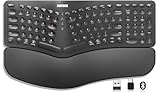


A quick note on the search itself. You typed "wireless," and every board here is wireless, but the ergonomic shaping runs from a full curved split to a gentle wave to a fixed split with no tilt. That range is wide. Two of these six carry a formal ergonomic certification; the rest lean on their own shaping claims. So treat "ergonomic" as a spectrum you have to place yourself on, not a box the search already ticked for you.
Which buyer each of these six suits
The picks split cleanly by who is sitting at the desk. Match yourself to a profile before you compare features.
- The all-day typist wants the Ergo K860: a curved split, a real wrist rest, and three tilt angles down to -7 degrees.
- The near-convert who dislikes full splits wants the Wave Keys, a one-piece board with the wave shaping baked in.
- The power user who wants a split and a stated warranty wants the Arteck HW315, backed by a two-year manufacturer warranty.
- The device-juggler wants the Arteck Multi-Device split, which the listing says connects to three devices at once.
- The dim-room worker wants the backlit ProtoArc EK01 Plus, with three brightness levels.
- The fresh-desk builder wants the ULSOU combo, because a mouse comes in the box.
Read your own week into that list. If you type six hours a day, the shaping and the wrist support decide everything. If you type two hours and move between a laptop and a tablet, the connection story matters more than the curve.
Split frame or wavy plank: which layout fits you?
This is the real deciding criterion in this category, and it is not the price. Ergonomic keyboards fall into two camps, and picking the wrong camp is why people abandon them.
A split board separates the left and right key clusters so each hand approaches at its own angle. The Ergo K860, both Arteck boards, and the ProtoArc all use a split. Splits ask more of your muscle memory up front. In practice, the adjustment takes a few days, and touch typists adapt faster than hunt-and-peck typists.
A wavy one-piece board keeps the keys in one continuous field but curves the rows so your fingers land more naturally. The Wave Keys and the ULSOU combo take this route. There is nothing to relearn. You lose some of the wrist-angle correction a split gives you, but you keep the familiarity.
Here is the cutoff. If your wrists already ache and you're willing to relearn, buy a split. If you want gentler ergonomics you can adopt today, buy a wave. Logitech sells you both, which is why the brand takes the top two spots.
1. Logitech Ergo K860 Wireless Ergonomic Split Keyboard with — Best overall
The Ergo K860 is the best wireless ergonomic keyboard here because it combines a curved split, a memory-foam wrist rest, and three-angle tilt with a formal ergonomic certification.
Best for: full-time typists who want a certified split board with a real wrist rest Skip it if: your desk can't spare 18 inches of width
What separates the K860 from the rest of this set is that it does everything at once. Logitech says the curved, split keyframe reduces muscle strain, that the pillowed memory-foam wrist rest gives 54 per cent more support and 25 per cent less wrist bending than a board without one, and that the tilt legs set to 0, -4 and -7 degrees. That negative-tilt range is the widest published here, and it's the feature the wave boards cannot offer.
Logitech also states the K860 is certified by United States Ergonomics. Only one other board in this set carries that certification. At 2.56 lb it is the heaviest of the six, and its 18-inch length is the longest footprint here, which is the price of the full-size layout and the wrist rest.
The trade-off is size and cost. This is the most expensive pick in the set, and the warranty is only available on request rather than stated as a term.
Pros:
- Widest published tilt range at 0, -4 and -7 degrees
- Certified by United States Ergonomics
- Memory-foam wrist rest, 54% more support claim
- Curved split frame for natural hand angles
Cons:
- Most expensive pick in this set
- Longest footprint at 18 in wide
- Heaviest here at 2.56 lb
- Warranty stated only as available on request
2. Logitech Wave Keys Ergonomic Wireless Keyboard with Palm — Best upgrade
The Wave Keys is the pick for anyone who wants ergonomic shaping without relearning a split, and it's the lightest full board here at 2.16 lb.

Best for: typists who want ergonomic shaping without a full split Skip it if: you need aggressive negative tilt
The Wave Keys earns its place by being the easy convert's keyboard. Logitech describes a wavy design that places your hands, wrists and forearms in a natural typing position, with a cushioned memory-foam palm rest for support through the day. Because the keys sit in one continuous field, there's no split to adapt to. You sit down and type.
It's also the more compact choice among the Logitech pair. At 1.18 x 14.8 x 8.62 in it takes less desk width than the K860, and at 2.16 lb it's the lightest of the full-size boards in this comparison. Like the K860, it's approved by United States Ergonomics, so you're not trading the certification away for the comfort of a familiar layout. Logitech notes you can remap shortcuts through the Logi Options+ app.
The trade-off against the winner is correction. A wave nudges your hands; a split repositions them. If your wrists need the stronger fix, the K860 does more.
Pros:
- Lightest full board here at 2.16 lb
- No split relearning curve
- Memory-foam cushioned palm rest
- Certified by United States Ergonomics
- One-year limited hardware warranty stated
Cons:
- No negative-tilt adjustment claimed
- Milder correction than a true split
- App needed for shortcut remapping
- Only two sellers list it
3. Arteck Split Ergonomic Keyboard with Palm Rest — Best for pros
The Arteck HW315 is the pick for heavy users who want a genuine split and a warranty they can point to, backed by a stated two-year term.

Best for: heavy users who want a split layout and a stated two-year warranty Skip it if: you switch between several devices
The HW315 is the split board for people who work their keyboard hard. Arteck describes a split design that positions wrists and forearms in a relaxed position, plus a soft cushioned wrist rest to support the forearm while typing. What sets it apart in this set is the paired combination of a real split and the longest clearly stated warranty here, a two-year manufacturer term. The winner's warranty is only offered on request; this one is a number.
Battery life is the other selling point. Arteck says the rechargeable lithium battery lasts six months on a single charge, based on two hours of daily use, so you're not hunting for a cable every few weeks. The nano USB receiver stores in the back of the keyboard, and setup is plug and play with no software.
The trade-off is connectivity. This one uses a single 2.4G receiver, so there's no multi-device switching. It sits at a middle price position here for a straightforward split.
Pros:
- Longest clearly stated warranty at two years
- Six-month battery life claim
- True split with cushioned wrist rest
- Plug-and-play, no software needed
Cons:
- Single-device 2.4G connection only
- No tilt-angle figures published
- No weight listed in the specs
- No backlighting
4. Arteck Ergonomic Keyboard with Cushioned Wrist Palm Rest — Best budget pick
This Arteck split is the cheapest board in the set and the only one that connects to three devices at once, which is a rare pairing.

Best for: people who juggle three devices on one keyboard Skip it if: you want published size and weight figures before buying
The value here is unusual. This is the cheapest of the six, yet Arteck says it connects to three devices simultaneously through 2.4G USB-A, 2.4G USB-C and Bluetooth. Nothing else in this comparison claims that. If your day moves between a work laptop, a personal machine and a tablet, this is the board that follows you across all three without repairing.
It keeps the Arteck comfort story: a split design to relax wrists and forearms, a soft cushioned wrist rest, and the same six-month battery life claim on a single charge at two hours a day. For the lowest price in the set, that's a lot of function on paper.
The catch is thin documentation. The listing publishes almost no dimensions or weight, so you're buying the layout on trust rather than on measured numbers. That's the trade-off against the better-documented Logitech pair, and it's the reason it lands as the budget pick rather than higher.
Pros:
- Cheapest board in this set
- Connects to three devices at once, per the listing
- USB-A, USB-C and Bluetooth options
- Six-month battery life claim
Cons:
- Almost no dimensions or weight published
- No warranty term stated in the specs
- Only one seller lists it
- No ergonomic certification claimed
5. ProtoArc EK01 Plus Backlit Bluetooth Ergonomic Keyboard — Runner-up
The ProtoArc EK01 Plus is the pick for dim rooms, the only board here with adjustable backlighting across three brightness levels.

Best for: typists working in dim rooms who want backlighting Skip it if: your desk is shallow
The EK01 Plus is the one you reach for when the lights are low. ProtoArc says it has soft white LED backlighting with three brightness levels, low, mid and high, and none of the other five boards here claim any illumination at all. That single feature is why it stays in the lineup as the runner-up.
The ergonomics follow the familiar pattern: a curved split-frame design that ProtoArc says reduces strain on wrists and forearms, a cushioned wrist rest it credits with 54 per cent more support, and adjustable tilt feet. It's backed by a two-year warranty, matching the longest clearly stated term in this set.
The size is the sticking point. At 1.57 x 19.7 x 10.4 in it's the largest footprint of all six, longer even than the K860, so a shallow or narrow desk feels the difference immediately. ProtoArc's listing also flags typing lag when either the board or the device drops low on battery, which is a caution worth reading before you buy. It sits at a premium price for those trade-offs.
Pros:
- Only board here with adjustable backlighting
- Three brightness levels, per the listing
- Two-year warranty stated
- Curved split with cushioned wrist rest
Cons:
- Largest footprint of all six at 19.7 in long
- Listing warns of lag on low battery
- Only one seller lists it
- Premium price for the added light
6. ULSOU Wireless Keyboard and Mouse Combo — Best minimal setup
The ULSOU combo is the pick for building a fresh desk from nothing, because a matching wireless mouse comes in the box.

Best for: someone setting up a fresh desk who wants a matching mouse in the box Skip it if: you want a warranty longer than a year
The ULSOU wins on completeness. It's the only pick here that arrives as a keyboard and mouse together, and ULSOU says a single 2.4G USB receiver connects both, so you clear one USB port and set up the whole desk in one go. For a first work-from-home rig or a spare station, that matters more than a fractional ergonomic edge.
The keyboard itself takes the wave route, with ULSOU describing a wave key and wrist-rest design that fits the fingers and eases wrist strain, plus an automatic power-saving function. The listing states broad compatibility across Windows versions and Mac. The mouse is contoured for a right hand, so left-handers should note that.
It's the second-cheapest here, which fits the mission. The trade-off is depth: the wave shaping is gentler than any split, the warranty runs one year, and only one seller lists it. Buy it for the convenience of a complete kit, not for the strongest ergonomics.
Pros:
- Matching mouse included in the box
- One receiver runs both devices
- Second-cheapest pick here
- Broad Windows and Mac compatibility claimed
Cons:
- Mouse contoured for right hands only
- Gentle wave shaping, not a split
- One-year warranty only
- Only one seller lists it
How do you connect these, and does it matter?
Connection is where these boards quietly diverge, and it decides more than people expect. Here's how the field breaks down.
- Single 2.4G receiver. The Arteck HW315 and the ULSOU combo use one nano receiver in a USB port. Simple, reliable, no menus. You lose the ability to switch between machines.
- Multi-device. The budget Arteck claims three connections at once, 2.4G USB-A, 2.4G USB-C and Bluetooth, which is the standout in this set. The Wave Keys pairs over wireless and remaps through the Logi Options+ app.
- Bluetooth-first. The ProtoArc EK01 Plus connects over Bluetooth, and its listing warns that low battery on either end can cause typing lag.
Does it matter? Only if you use more than one computer. A single desktop user is well served by any of these. A person moving between a laptop, a desktop and a tablet should weight multi-device support heavily, and that pushes the budget Arteck above its price position for that specific buyer.
What the listings leave out
Read these listings closely and the gaps tell you as much as the specs. A few things to check yourself before buying.
- Actuation and key feel. None of these publish switch type or key travel. Ergonomic boards here are membrane-style by design, so don't expect mechanical feedback.
- Left-handed use. The ULSOU mouse is shaped for a right hand. The keyboards are symmetric, but a bundled mouse is not.
- Missing dimensions. The budget Arteck lists almost no measurements. If desk fit is tight, that absence is a real risk.
- Warranty wording. The K860's warranty is available on request rather than stated as a term, while the Arteck HW315 and ProtoArc both give a clear two-year figure.
The pattern is that the two Logitech boards and the ProtoArc document themselves fully, while the cheaper picks leave you filling blanks. That's not a dealbreaker, but it's the reason a spec-first shopper leans premium in this category.
When a different pick wins
The Ergo K860 is the default, but three concrete situations flip the recommendation.
- If your desk is under 16 inches deep or width is tight, the K860's 18-inch span and the ProtoArc's 19.7-inch length both become a problem. Drop to the Wave Keys at 14.8 in wide instead.
- If you split your day across three devices, the multi-device Arteck earns its place over the winner, because it's the only board here claiming three simultaneous connections.
- If you type in a dark room, none of the Logitech boards light up. The ProtoArc EK01 Plus is the only pick with backlighting, so it wins that desk outright.
Each of those is checkable in a second: measure your desk, count your machines, look at your lighting. The winner holds for most people, but these three thresholds decide the exceptions.
The verdict
The best wireless ergonomic keyboard for most people is the Logitech Ergo K860. It's the only board here that pairs a curved split, a memory-foam wrist rest with a 54 per cent support claim, and three tilt angles down to -7 degrees, all under a formal United States Ergonomics certification. That combination is what a full-time typist actually needs, and no other pick delivers every piece of it.
Two conditions flip that choice. If your desk can't take the 18-inch footprint, or you'd rather not relearn your typing on a split, the Logitech Wave Keys is the smarter buy. It keeps the same ergonomic certification and the memory-foam palm rest in a lighter 2.16 lb one-piece body you can use the day it arrives. The runner-up, the ProtoArc EK01 Plus, earns its keep on one feature the K860 lacks entirely: three-level backlighting for dim rooms, backed by a stated two-year warranty. Its 19.7-inch length is the price you pay for that light. Match the board to your desk and your habits, and the shaping does the work.
FAQ
Is a wireless ergonomic keyboard worth it for occasional typing?
A wireless ergonomic keyboard is worth it mainly if you type for hours, not minutes. Light users get less from the split shaping and the wrist support, so a gentler wave board like the Wave Keys or the ULSOU combo makes more sense. Heavy daily typists are the ones who feel the K860's -7 degree tilt and wrist rest pay off.
What is the best wireless ergonomic keyboard for a small desk?
The best wireless ergonomic keyboard for a small desk is the Logitech Wave Keys at 14.8 in wide, the most compact full board here. The K860 spans 18 in and the ProtoArc EK01 Plus stretches to 19.7 in, both of which crowd a shallow or narrow surface. Measure your available depth before committing to either of the larger split boards.
How do split and wave keyboards differ in comfort?
Split and wave keyboards differ in how far they correct your hands. A split, like the K860 and both Arteck boards, separates the key clusters so each hand sits at its own angle, which asks for a few days of relearning. A wave, like the Wave Keys, curves the rows in one field, gentler on adjustment but milder on correction.
Which is better, the Ergo K860 or the Wave Keys?
Which is better between the Ergo K860 and the Wave Keys depends on your wrists. The K860 offers a full split and three tilt angles to -7 degrees, the stronger fix for aching wrists. The Wave Keys is lighter at 2.16 lb, narrower, and needs no relearning. Choose the K860 for correction, the Wave Keys for easy comfort.
What mistake do first-time ergonomic keyboard buyers make?
The mistake first-time ergonomic keyboard buyers make is picking a split when they won't stick with the relearning. If your muscle memory resists change, a wave board keeps your speed while still improving hand position. The other common miss is ignoring footprint. The ProtoArc runs 19.7 in long, which overwhelms a desk that a 14.8-in Wave Keys would suit.
Start by measuring your desk and counting the machines you type on, then match those two numbers to the profiles above. For most full-time typists, the Logitech Ergo K860 is the right default because it corrects wrist angle harder than anything else here, with a certification and a tilt range no wave board can match. If it's too wide, step down to the Wave Keys and keep the ergonomics. Either way, buy for the eight hours a day your hands spend on the keys, not the ten seconds you spend reading the price.