Best Business Laptops for Writers by Screen & Keys

A writer needs a keyboard that survives 5,000 words a day, a screen that stops eye ache by page thirty, and enough RAM to keep the browser honest. Six laptops, ranked on those three things.

By Samuel HarrisUpdated 18 min read
On this page
- Who this is not for, and where they should go instead
- Best business laptop for writers at a glance
- What actually decides a writer's laptop
- How I screened the six by weight, keys and RAM
- 1. HP 17 inch Business Laptop Computer 2026 Edition — Best overall
- 2. HP 17 Laptop Business 2025 — Best premium
- 3. HILLSUSU 2026 Premium 15.6" FHD Business Laptop — Runner-up
- 4. HILLSUSU 2026 15.6" FHD Business Laptop with Office — Best for small spaces
- 5. MELIUNA 15.6" AI Laptop with Office 365 — Best budget pick
- 6. ZAQTG 15.6" AI Laptop with Office 365 — Best for beginners
- How do the two HP 17-inch models compare?
- What the listings do not tell you about writing on these
- Is a 15.6-inch screen enough for long documents?
- The verdict
- FAQ
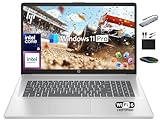
The best business laptop for writers is the HP 17 inch Business Laptop Computer 2026 Edition, a 17.3-inch Ryzen 5 machine with 16GB of RAM, a 512GB SSD and a full-size keyboard with numeric keypad in a 0.81 x 15.8 x 10.2 in body. If you want more storage and a docking bundle on day one, the HP 17 Laptop Business 2025 pairs 16GB of RAM with 1TB of combined storage (500GB SSD plus 500GB external) and an 8-core Intel Core i3-N305 in a 4.6 lb chassis.
Who this is not for, and where they should go instead
Writers who edit 4K video between chapters, run local AI models, or need a colour-accurate panel for cover design should not shop this set. None of these six is a workstation, and none carries a discrete GPU in its published specifications. If you want a machine that renders while you write, this is not the roundup for you.
This is a roundup for people who write. Long documents, footnotes, side-by-side sources, a browser with a reference manager, maybe Scrivener or Word, maybe Google Docs. That workload is bound by three things: keyboard feel, screen size, and how many browser tabs your RAM can hold before the fan speaks up. Everything else is decoration.
The best business laptop for writers, framed that way, is the one with the largest keyboard, the biggest screen for the money, and 16GB of RAM. Two of the six qualify on all three counts. The other four make trade-offs, and I've named exactly what each one gives up.
One note on the search: the qualifier "for writers" is not a specification any manufacturer publishes, so treat any listing that promises to be built for writers as marketing. The picks below earn the label on their published specifications, not on their bullet points.
Best business laptop for writers at a glance
| Pick | Screen & RAM | Keyboard | Price |
|---|---|---|---|
Best overall HP 17 inch Business Laptop Computer 2026 |
17.3" FHD 16GB |
Full-size, numeric keypad | Check Price |
Best premium HP 17 Laptop Business 2025 |
17.3" HD+ 16GB |
Full-size (numeric keypad claimed) | Check Price |
Runner-up HILLSUSU 2026 Premium 15.6" |
15.6" FHD 16GB |
Backlit, numeric keypad | Check Price |
Best for small spaces HILLSUSU 2026 15.6" with Office |
15.6" FHD IPS 8GB |
Standard (narrow-bezel body) | Check Price |
Best budget pick MELIUNA 15.6" AI Laptop |
15.6" FHD IPS 6GB |
Standard, 180° hinge | Check Price |
Best for beginners ZAQTG 15.6" AI Laptop |
15.6" FHD IPS 6GB |
Standard | Check Price |



What actually decides a writer's laptop
Most guides to a business laptop for writers reach for the processor first. That is the wrong lever. A modern Ryzen 5 or Core i3 chip will out-type any human, and drafting a document is not a CPU-bound task. The bottleneck sits somewhere else.
Three things decide it, in this order:
- Keyboard geometry. A 15.6-inch laptop can carry a numeric keypad, and a 17.3-inch laptop almost always does. Two of these six list a numeric keypad in their published specifications, and one of the 15.6-inch picks lists a backlit keyboard. A writer who works at night notices the backlight by chapter three.
- Screen size for two documents side by side. A 17.3-inch panel at FHD gives you two half-width pages that are readable without squinting. A 15.6-inch panel does not, quite. Half these picks are 15.6-inch and half are 17.3-inch, so the choice is real.
- RAM headroom for the browser tabs your research demands. 16GB is the safe floor for a writer running a browser, a word processor and a PDF reader together. Three picks here list 16GB. Two list 6GB. One lists 8GB. That is the shortlist right there.
Nothing else on the spec sheet moves the needle nearly as much. Storage matters, but 256GB is enough for years of manuscripts; the choice between 128GB and 1TB is about what else lives on the machine. Weight matters at 4.6 lb versus 3.53 lb, but only if you carry it daily.
How I screened the six by weight, keys and RAM
The screening criteria came from the workflow first, then the specifications, then the trade-offs each pick makes against the others.
- Criterion one, weighted highest: RAM. 16GB clears the bar for a writer's browser plus word processor. 8GB is workable for shorter documents. 6GB is the entry line, and the two picks that carry it live near the bottom of the ranking for that reason alone.
- Criterion two: screen and keyboard together. A 17.3-inch panel with a numeric keypad is the desk-first configuration. A 15.6-inch panel with a backlit keyboard is the portable-first configuration. Both are legitimate for a writer; a 15.6-inch panel with a standard keyboard and no backlight is the compromise.
- Criterion three: weight and dimensions. 3.53 lb versus 4.6 lb is a real gap in a shoulder bag. Two of the 15.6-inch picks tie at 3.53 lb; the 17.3-inch HP 2025 is the heaviest at 4.6 lb.
- Criterion four: warranty and support, as a tiebreaker. Two picks publish a 2-year warranty. Two publish a 1-year warranty. Two publish no warranty term at all. That gap decided one of the ranking positions.
The category profile here is telling. Half the picks sell faster than the rest of this set, and the two 17.3-inch HP models sit at opposite ends of the price positions in the group. The full-size chassis costs more than the 15.6-inch chassis, and only one seller lists the 17.3-inch HP 2025, so availability may be narrower than for the smaller machines.
1. HP 17 inch Business Laptop Computer 2026 Edition — Best overall
A 17.3-inch FHD panel, 16GB of RAM and a full-size keyboard with numeric keypad — the writer's laptop by geometry alone.
Best for: a writer who drafts long documents at a desk with a numeric keypad in reach Skip it if: you carry your laptop between cafes every day
This is the pick because it wins on all three of the criteria that matter. The 17.3-inch FHD anti-glare display gives you a canvas wide enough for two half-width pages, or a document and a source, without shrinking type to eye-strain size. The listing describes the keyboard as a "brushed full-size keyboard with 10-key number pad", and at 15.8 inches wide, the chassis has the room to make that promise real. 16GB of RAM is the safe floor for a writer's browser plus word processor, and the 512GB SSD is enough for years of drafts.
The Ryzen 5 CPU is over-specified for pure drafting, which is a good thing: it means the machine will not slow down when your research browser has thirty tabs open and a PDF reader in the background. HP lists it as the 2026 Edition, and the chassis measures 0.81 x 15.8 x 10.2 in.
The trade-off is portability. A 17.3-inch laptop is not a cafe machine. It also sits at the higher end of the price positions in this set, and only two sellers list it, so the buying window may be narrower.
Pros:
- 17.3-inch FHD anti-glare panel, the largest here
- Full-size keyboard with 10-key numeric keypad
- 16GB RAM and 512GB SSD, both at the top of the set
- Windows 11 with Office 365 for the Web preloaded
- Sells faster than the rest of this set
Cons:
- 17.3-inch chassis is a desk-first machine
- Sits among the higher price positions in this set
- No stated warranty term in the published specifications
2. HP 17 Laptop Business 2025 — Best premium
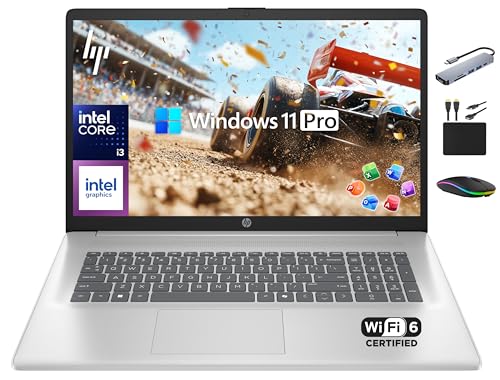
16GB of RAM, 1TB of combined storage and an accessory bundle that includes a 6-in-1 USB-C dock — the desk-first writer's setup out of the box.
Best for: a writer who wants 1TB of combined storage and a docking bundle out of the box Skip it if: weight in a shoulder bag is a daily concern
The HP 17 Laptop Business 2025 is the premium sibling of the winner, and it earns the label on two counts. First, storage: 1TB total, split as 500GB SSD plus a 500GB external drive, which is the largest storage figure in the set by a wide margin. A writer with a decade of research files, audio interviews and reference PDFs will notice that on day one. Second, the accessory bundle: HP lists a 6-in-1 USB-C docking station hub with USB 3.0, 4K HDMI, USB-C connection and an SD/TF card reader, plus a wireless mouse and cables. That turns the laptop into a desktop the moment you set it down.
The 8-core Intel Core i3-N305 runs up to 3.8 GHz, which is more than a writer needs, and Windows 11 Pro adds features like BitLocker that a business user may value. The 17.3-inch HD+ panel is described as non-reflective and low gloss.
The trade-off is weight. At 4.6 lb, this is the heaviest pick in the set, and roughly a pound heavier than the 15.6-inch picks. Only one seller lists it. It also sits at the top of the price positions in the group, and the slowest seller among the six.
Pros:
- 1TB combined storage (500GB SSD plus 500GB external)
- 6-in-1 USB-C dock and wireless mouse included per the listing
- Windows 11 Pro preloaded
- 8-core Intel Core i3-N305 with a 3.8 GHz max boost claim
- 17.3-inch HD+ panel described as non-reflective
Cons:
- 4.6 lb, the heaviest of the six
- Only one seller lists it
- The slowest seller of the six
- HD+ resolution rather than the FHD panel on the winner
3. HILLSUSU 2026 Premium 15.6" FHD Business Laptop — Runner-up
A 3.53 lb 15.6-inch laptop with 16GB of RAM, a backlit keyboard with numeric keypad and a stated 2-year warranty — the portable pick for a writer.

Best for: a writer who wants a backlit keyboard and a two-year warranty in a 3.53 lb chassis Skip it if: you need a 17-inch canvas for side-by-side documents
The HILLSUSU 2026 Premium is the compromise pick, and it is a good compromise. You lose the 17.3-inch canvas, but you gain a machine that fits in a shoulder bag at 3.53 lb and 0.8 x 13 x 9 in, and you keep the 16GB of RAM and 512GB SSD that make browser-heavy research workflows livable. HILLSUSU says the keyboard is backlit with a full numeric keypad, which is a rare combination at this size.
The listing also states a Core i5 processor with up to 2.8 GHz and Windows 11 Pro preloaded. HILLSUSU claims a 2-year manufacturer's warranty with 24/7 support, which is longer than most published warranty terms in this set and one of two 2-year figures among the six.
Two things pull this pick behind the HP 17 winner. First, the 15.6-inch panel is not big enough for comfortable two-page side-by-side work. Second, HILLSUSU is a less familiar brand than HP, and the manufacturer's marketing bullets do the heavy lifting on this listing rather than a long HP spec sheet. That said, the published specifications are strong, and the trade-off it makes against the winner is portability for canvas, which is a fair exchange for many writers.
Pros:
- 3.53 lb chassis, tied for the lightest here
- Backlit keyboard with full numeric keypad per the listing
- 16GB RAM and 512GB SSD
- Windows 11 Pro preloaded
- HILLSUSU claims a 2-year warranty and 24/7 support
Cons:
- 15.6-inch panel, not a two-page canvas
- Newer brand with less category history than HP
- Sits in the middle price positions in this set
4. HILLSUSU 2026 15.6" FHD Business Laptop with Office — Best for small spaces
A 15.6-inch FHD IPS narrow-bezel laptop in a 13-inch-wide body, sized for a cafe table or a small home desk.

Best for: a writer working from a small desk or a cafe table in a 13-inch footprint Skip it if: you keep dozens of tabs open while drafting
The HILLSUSU 2026 with Office earns its label on the footprint alone. Its 15.6-inch FHD IPS panel sits in a 13-inch-wide chassis (0.8 x 13 x 9 in) thanks to a narrow-bezel design, so it takes up the desk space of a smaller laptop while giving you a full-size screen. At 3.7 lb, it is a hair heavier than the runner-up, and the manufacturer lists a 2-year warranty.
The reason it sits at number four rather than higher is the RAM. HILLSUSU lists this configuration with 8GB of RAM and a 256GB SSD, which is workable for a writer who lives in one document at a time but tight for one who keeps a browser research window open with a reference manager and cloud sync running underneath. The 256GB SSD is also the smallest primary drive among the picks that list an SSD-only configuration.
Windows 11 Pro is preloaded with Office, which the listing bundles as a starting configuration. The trade-off this pick makes against the runner-up is straightforward: half the RAM, half the storage, but the smallest footprint in the set for the screen size it delivers.
Pros:
- Narrow-bezel 15.6-inch FHD IPS panel in a 13-inch-wide body
- 3.7 lb chassis, easy to carry
- Windows 11 Pro and Office bundled per the listing
- Stated 2-year warranty
- Sells the fastest among the 15.6-inch picks here
Cons:
- 8GB RAM, half the winner's figure
- 256GB SSD, the smallest primary drive in the set
- No backlit keyboard listed in the published specifications
5. MELIUNA 15.6" AI Laptop with Office 365 — Best budget pick
A 15.6-inch FHD IPS panel, a 180-degree hinge and a 7000mAh battery at the cheapest price position in the set — the entry point for a writer.

Best for: a writer on a strict budget who mostly works in a single document Skip it if: your workflow lives in a browser with many tabs
The MELIUNA is the cheapest of the six, and it makes the trade-offs you would expect. You get a 15.6-inch FHD IPS panel at 1920x1080, a Celeron J4105 processor, 6GB of DDR4 RAM and a 128GB M.2 SSD. That configuration will run a word processor and a handful of browser tabs, and the IPS panel means the screen looks fine from an angle. MELIUNA says the 7000mAh battery delivers all-day runtime, and the 180-degree hinge lets you lay the screen flat, which is a small but genuine benefit if you sit across from an editor.
The chassis is 3.53 lb and 0.8 x 14 x 9 in, tied for the lightest here, and the port list is generous: USB 3.2, Type-C, Mini HDMI and a 3.5mm audio jack. MELIUNA lists a 1-year warranty.
Where it falls behind the higher picks is the RAM and the storage. 6GB is the entry line for a Windows 11 laptop, and 128GB fills up faster than a writer expects once Office, updates and a handful of PDF archives land on it. The Celeron J4105 is also a slower chip than the Ryzen 5 or the Core i5 in the higher picks; it will type fine, but it will not encourage a heavy research workflow.
Pros:
- The cheapest of the six
- 3.53 lb chassis, tied for the lightest
- 180-degree hinge and 7000mAh battery claim
- FHD IPS panel with wide viewing angles
- Stated 1-year warranty
Cons:
- 6GB RAM, near the entry line for Windows 11
- 128GB SSD fills up quickly
- Celeron J4105 is the slowest CPU class among the picks that name a processor
6. ZAQTG 15.6" AI Laptop with Office 365 — Best for beginners
A simple 15.6-inch FHD IPS laptop with a claimed 6 to 8 hours of battery and a complete port selection — the starter machine for someone new to laptop writing.

Best for: someone starting out who wants a simple Windows 11 machine for drafting Skip it if: you already juggle research tabs, a reference manager and cloud sync
The ZAQTG earns the "beginners" label because it strips the decision down to essentials. A 15.6-inch FHD IPS panel at 1920x1080, a Celeron J4105 processor, 6GB of DDR4 RAM, a 128GB M.2 SSD, Windows 11 preloaded with Office 365 access, and a port set that covers USB 3.2, Type-C, Mini HDMI and a 3.5mm jack. ZAQTG claims 6 to 8 hours of runtime from the 7000mAh battery.
The chassis is 3.66 lb and 0.8 x 14 x 9 in, close in size to the MELIUNA but a fraction heavier. The manufacturer lists a 1-year warranty.
Two things put this at number six. First, the specifications are close to identical to the budget pick, but the ZAQTG sits at a higher price position in the set. Second, this is the slowest seller of the six by a wide margin, which suggests availability may be uneven. For a writer who wants the very simplest starter configuration and does not mind either, the machine will draft a novel; for anyone with a browser-heavy workflow or an existing research archive, the RAM and storage will be the limits sooner than the CPU.
Pros:
- FHD IPS panel with wide viewing angles
- Complete port selection including Type-C and Mini HDMI
- ZAQTG claims 6 to 8 hours of battery life
- Windows 11 and Office 365 access included per the listing
- Stated 1-year warranty
Cons:
- 6GB RAM and 128GB SSD, same limits as the budget pick
- Sits at a higher price position than the MELIUNA with the same core specs
- The slowest seller of the six
How do the two HP 17-inch models compare?
Both HP 17-inch picks give you the same 17.3-inch canvas and the same 16GB of RAM, so the choice comes down to what you value alongside the screen.
- Storage. The 2026 Edition lists a 512GB SSD. The 2025 lists 1TB total, split 500GB SSD plus 500GB external. If you have a large research archive, that gap matters.
- Weight. The 2026 does not publish a weight figure, but the 2025 lists 4.6 lb, which is the heaviest in the set.
- CPU class. The 2026 lists an AMD Ryzen 5. The 2025 lists an 8-core Intel Core i3-N305 with a 3.8 GHz max boost claim. For pure drafting, either is more than enough.
- Operating system. The 2026 lists Windows 11 with Office 365 for the Web. The 2025 lists Windows 11 Pro, which adds business features like BitLocker.
- Availability. Only one seller lists the 2025. Two sellers list the 2026.
- Sales pattern. The 2026 sells faster than the 2025.
The short answer: the 2026 is the better buy for most writers because of the FHD anti-glare panel and lighter availability. The 2025 wins if you need Windows 11 Pro, 1TB of storage on day one, or the docking bundle out of the box.
What the listings do not tell you about writing on these
Feature bullets are marketing copy, not measurement. Three things the listings above do not tell you, and that a writer should assume until proven otherwise:
- Key travel and layout are not specified. A "full-size keyboard" can still have shallow keys or a squeezed arrow cluster. Look for a photograph of the keyboard from above before you commit.
- "AI features" is a vague label. Two picks describe built-in AI for writing, summarising and research, but neither listing names the underlying model or whether it runs locally. Treat the phrase as a Windows 11 feature description rather than a differentiator.
- HD+ is not FHD. The HP 2025 lists an HD+ panel, which is a lower pixel count than the FHD panels on the other five. For long documents at a normal viewing distance, FHD is the better default.
The listings also make claims like "AI-ready multitasking" and "AI-Powered Win 11 Laptop" that describe Windows 11 features rather than any hardware capability. Read past those to the numbers.
Is a 15.6-inch screen enough for long documents?
Yes, for most writers. A 15.6-inch FHD panel gives you a full page at readable type with the ribbon and taskbar visible. It is not big enough for two full pages side by side without shrinking type, which is where the 17.3-inch picks pull ahead.
Two rules of thumb from the specifications in this set:
- If you draft one document at a time and switch to a browser occasionally, a 15.6-inch panel is enough. Four picks here qualify.
- If you work with a source document open alongside your draft, or you review long PDFs at half-page width, the 17.3-inch canvas is worth the extra weight and desk space. Two picks here qualify.
The 15.6-inch narrow-bezel HILLSUSU is the interesting middle ground: a 15.6-inch panel in a 13-inch-wide body, which is closer to a 14-inch laptop's footprint than a 15.6-inch one.
The verdict
The best business laptop for writers is the HP 17 inch Business Laptop Computer 2026 Edition. It wins on the three criteria that decide a writer's laptop: a 17.3-inch FHD anti-glare panel large enough for two half-width documents, a full-size keyboard with a 10-key numeric keypad, and 16GB of RAM with a 512GB SSD to keep the browser honest. It sells faster than the rest of this set, which supports the case for the pick.
The runner-up is the HILLSUSU 2026 Premium 15.6". Its exact advantage over the winner is portability, in a 3.53 lb chassis with a backlit keyboard and a stated 2-year warranty, while keeping 16GB of RAM and a 512GB SSD. If you carry your laptop between locations more days than you use it at a desk, buy the runner-up instead.
Two conditions flip the recommendation to the HP 17 Laptop Business 2025. First, if you need 1TB of combined storage on day one. Second, if you want Windows 11 Pro rather than the standard Windows 11 build for business features like BitLocker. Both trade against 4.6 lb of chassis weight, so the flip is real but it costs portability.
FAQ
What size screen is best for a business laptop for writers?
What size screen depends on whether you work with one document at a time or two side by side. For single-document drafting, a 15.6-inch FHD panel is enough, and four picks here qualify at that size. For side-by-side work with a source open next to a draft, the 17.3-inch panels on the two HP picks give you a canvas that does not force type-shrinking, at the cost of about a pound of weight and more desk space.
Is 16GB of RAM worth it for writing?
16GB of RAM is worth it the moment your workflow includes a browser with research tabs, a word processor and a PDF reader open together. Three of the six picks here list 16GB, and they are the top three in the ranking for that reason. 8GB is workable for single-document drafting. 6GB, listed on two picks, is the entry line for Windows 11 and will feel tight with a browser-heavy research workflow underneath.
HP 17 inch Business Laptop 2026 vs HILLSUSU 2026 Premium: which wins for a writer?
HP 17 inch Business Laptop 2026 wins on canvas: a 17.3-inch FHD panel and a full-size keyboard with numeric keypad, backed by 16GB of RAM and a 512GB SSD. HILLSUSU 2026 Premium wins on portability, at 3.53 lb with a backlit keyboard, a stated 2-year warranty and the same 16GB and 512GB figures. Buy the HP if you write at a desk; buy the HILLSUSU if you write on the move.
Do I need a backlit keyboard as a writer?
Do you need a backlit keyboard? Only if you write in dim light. One pick here, the HILLSUSU 2026 Premium, lists a backlit keyboard explicitly, and it is the only one to combine that with a numeric keypad in this set. The two HP 17-inch picks do not state a backlight in their published specifications. If you draft at night or in cafes with low light, the HILLSUSU has an edge worth naming.
What is the pitfall to avoid when buying a business laptop for writers?
The pitfall is buying on CPU marketing when the CPU is not the bottleneck. Drafting is not a compute-heavy task, and any of the six chips here will type as fast as you can. The bottleneck is RAM, screen size and keyboard geometry. Pay for 16GB of RAM and the largest screen you can comfortably carry; do not pay a premium for a faster CPU that a writer's workflow will never use.
For a writer, the honest short list is two machines. If you write at a desk and want the largest possible canvas, the HP 17 inch Business Laptop 2026 Edition gives you a 17.3-inch FHD anti-glare panel, 16GB of RAM, a 512GB SSD and a full-size keyboard with numeric keypad in one package. If you write on the move and value a backlit keyboard, the HILLSUSU 2026 Premium 15.6" matches the RAM and storage in a 3.53 lb chassis with a stated 2-year warranty. Decide on canvas versus portability first, and the rest of the specifications follow.