Best Wireless Docking Station Picks for Writers

Seven docking stations compared on the one thing that actually matters to a writer: how many cables you touch, how many screens you get, and whether the driver install will fight you.

By Samuel HarrisUpdated 18 min read
On this page
- Best wireless docking station for writers at a glance
- Why no docking station here is truly wireless
- How I cut the field down to seven
- 1. Plugable Universal Laptop Docking Station Dual HDMI — Best overall
- 2. Plugable USB C Triple Display Docking Station — Best warranty
- 3. Anker Prime Docking Station — Best premium
- 4. MOKiN USB C Docking Station 3 Monitors Display — Best minimal setup
- 5. Baseus Laptop Docking Station Stand — Most versatile
- 6. j5create USB-C Dual HDMI Docking Station — Best upgrade
- 7. UTECHMIX M.2 NVMe & SATA to USB C Docking Station — Best budget pick
- What actually decides a docking station for writing work?
- How many screens does a writer really need?
- What the listings do not tell you
- The verdict
- FAQ
The best wireless docking station for writers is the Plugable UD-3900, because it turns one cable into two HDMI monitors, Gigabit Ethernet and six USB ports inside a 0.81 lb box. If you work on macOS or ChromeOS instead, the Plugable UD-3900PDZ is the better buy at 0.73 lb with a stated 2-year limited parts and labor term. The deciding specification here is not port count. It's how the dock pushes video: native USB-C Alt Mode, or a DisplayLink driver your laptop has to load. That split, more than anything, decides whether your morning starts with writing or with troubleshooting.
Best wireless docking station for writers at a glance
| Pick | Displays | Weight | Price |
|---|---|---|---|
| 2x HDMI, 1920x1200 @ 60Hz | 0.81 lb | Check Price | |
Best warranty Plugable USB C Triple Display Docking Station |
3x HDMI, 1x 4K 30Hz claim | 0.73 lb | Check Price |
Best premium Anker Prime Docking Station |
Triple 4K claim | 1.84 lb | Check Price |
Best minimal setup MOKiN USB C Docking Station 3 Monitors Display |
Triple 4K 60Hz claim | Not published | Check Price |
Most versatile Baseus Laptop Docking Station Stand |
Triple 4K claim | Not published | Check Price |
Best upgrade j5create USB-C Dual HDMI Docking Station |
1x 4K, 1x 2K/1080p claim | 0.89 lb | Check Price |
Best budget pick UTECHMIX M.2 NVMe & SATA to USB C Docking Station |
None, storage only | 13.6 g | Check Price |




Why no docking station here is truly wireless
Let's clear this up first. Search for a wireless docking station and Amazon returns wired docks, because that is what the category almost entirely contains. Every product below connects to your laptop with a physical cable. The Plugable UD-3900 uses a hybrid 2-in-1 USB 3.0 and USB-C cable. The UTECHMIX uses a 2-in-1 cable of its own. None of the seven advertises a radio link for video.
So what do writers usually mean by the word? Two things:
- One cable, not seven. Sit down, plug once, and both monitors, the keyboard, the mouse and the network come alive. That's the effect people are shopping for.
- A desk without a visible nest of cords. A dock hides the tangle behind or under the laptop.
Both are achievable with the picks here. Genuine over-the-air docking, the kind that used WiGig, has largely vanished from the mainstream market, and nothing in this data claims it. I'd judge these on cable count at the laptop end instead. That is the number you feel every morning, and it's one on all seven.
If you specifically need no cable at all between laptop and desk, none of these seven will satisfy you, and I won't pretend otherwise.
How I cut the field down to seven
Three disqualifications did most of the work.
- No published warranty, no place in the list. Six of these seven publish a term. Plugable states 2 years limited parts and labor on both models, Baseus and MOKiN state 2 years, j5create states a 2-year limited manufacturer's warranty, and UTECHMIX states 1 year manufacturer coverage. Anker states 18 months, the shortest here, which is worth knowing before you spend the most.
- No display path stated, cut. A dock that will not tell you its maximum resolution and refresh rate is a dock that will disappoint someone. Every pick here states something, even where it's a manufacturer claim rather than a standardised figure.
- Sprawling multi-brand listings, cut. Docks with a dozen loosely related variants under one page make it impossible to know what arrives. I favoured listings with a single stated model number: UD-3900, UD-3900PDZ, A83B3, JCD542, MODK2403-US-1, G-317-NVME+SATA.
What survived is deliberately uneven. Six are true docks in the Laptop Accessories > Docking Stations category. The seventh, the UTECHMIX, sits in Hard Drive Accessories > Enclosures and is here for one job only: writers who back up drafts to bare SSDs. It is the cheapest of the seven and it is not a substitute for the others.
1. Plugable Universal Laptop Docking Station Dual HDMI — Best overall
The most sensible default here: two monitors, wired networking, six USB ports, one 0.81 lb box, and the longest stated coverage in the set alongside its sibling.
Best for: a writer running two 1080p reference monitors from one cable Skip it if: you need 4K or you stream protected video at your desk
Plugable's hybrid 2-in-1 cable is the quiet reason this wins. It carries either USB 3.0 or USB-C, so it fits the older laptop you're still writing on and the newer one you'll buy next. That matters more than a spec sheet suggests when a dock is meant to last years.
The published display ceiling is honest and specific: dual HDMI at 1920x1200 @ 60Hz, or a single HDMI at 2560x1440 @ 50Hz. Plugable states 4K is not supported. For a writer, a 1920x1200 panel holds a full manuscript page and a research window side by side, and that is the actual work. Six USB ports absorb a mechanical keyboard, a trackball, a mic, a foot pedal and two dongles without a hub. Gigabit Ethernet keeps a long upload from stalling mid-send.
The listing is blunt about limits, which I respect. No gaming, no DisplayPort, no HDCP-protected streaming. It's a 4.02 x 6.45 x 3.22 in block that sits upright, and the driver install is a required step, not optional.
Pros:
- Hybrid 2-in-1 USB 3.0 and USB-C cable
- Six USB ports plus Gigabit Ethernet
- Stated 2 year limited parts and labor
- Dual HDMI at 1920x1200 @ 60Hz
- Lightest true dock here at 0.81 lb
Cons:
- 4K explicitly not supported
- Driver install required on Windows
- No DisplayPort output at all
- HDCP streaming services won't play
- The second-most expensive pick in this group
2. Plugable USB C Triple Display Docking Station — Best warranty
The pick for writers on macOS or ChromeOS, with a stated 2 year limited parts and labor term and the lightest body in the set at 0.73 lb.

Best for: macOS and ChromeOS writers who want a stated 2-year parts and labor term Skip it if: you refuse to install a display driver
This is the UD-3900's modern sibling, and the difference is compatibility breadth. Plugable lists USB-C, USB4 and Thunderbolt hosts across Windows, macOS 11 and later with driver installation, and ChromeOS. Only two picks here name macOS explicitly, and this one names ChromeOS too, which no other pick does.
Three HDMI outputs are claimed, split as 1x 4K @ 30Hz via Alt Mode and 2x 1080p @ 60Hz via DisplayLink. Read that split carefully, because it decides your layout. The 30Hz figure is fine for a document and unpleasant for a moving cursor over video. Put your manuscript on a 1080p 60Hz panel and your reference material on the 4K one. Six USB 5Gbps ports and a stated 100W PD feed handle the rest, so your laptop charges from the same cable that drives the screens.
At 1.18 x 7.87 x 3.54 in and 0.73 lb, it lies flat and disappears under a monitor foot. The trade-off against the UD-3900 is the driver dependency for two of three screens, and the fact that it sits at a higher price position than the pick I ranked above it.
Pros:
- Windows, macOS 11+ and ChromeOS support
- Stated 100W Power Delivery to the laptop
- Lightest pick of the six docks, 0.73 lb
- Three HDMI outputs claimed
- Stated 2 year limited parts and labor
Cons:
- Top display capped at 4K 30Hz by the claim
- Two screens depend on DisplayLink drivers
- macOS needs a driver install, not plug-and-play
- Among the most expensive picks here
3. Anker Prime Docking Station — Best premium
The heaviest and most expensive pick here, and the only one with a smart display reporting charging power and fan mode in real time.

Best for: a writer whose laptop also serves as a video-call and photo machine Skip it if: you want the longest warranty in this set
Anker states 14 connections, and the power story is the interesting part. The upstream USB-C port is listed at 140W and 10Gbps, two front USB-C ports at 100W and 10Gbps each, and one more at 100W and 5Gbps. Every USB-C port is claimed to carry both power and data. If you're charging a laptop, a tablet and a phone from the desk while writing, that's the pick that stops the shuffle.
Triple 4K is claimed, with compatibility given as Windows 10 and 11 only. That single line is the reason this isn't ranked first. Mac writers get no stated support here, where both Plugable picks name macOS.
The smart display is genuinely useful for a writer who never opens a system monitor. You glance at it and see whether the dock is throttling or the fan has spun up. At 1.84 lb and 1.89 x 7.67 x 3.62 in it is more than twice the weight of either Plugable, so it stays where you put it. Coverage is stated at 18 months, the shortest term of the seven, and only one seller lists it.
Pros:
- 140W upstream USB-C port claimed
- Front USB-C ports at 100W and 10Gbps
- Real-time smart display for power and fan
- Triple 4K display support claimed
- Every USB-C port carries power and data
Cons:
- 18 month warranty, shortest in this set
- Windows 10 and 11 only in the listing
- Heaviest pick at 1.84 lb
- The most expensive of the seven
- Only one seller lists it
4. MOKiN USB C Docking Station 3 Monitors Display — Best minimal setup
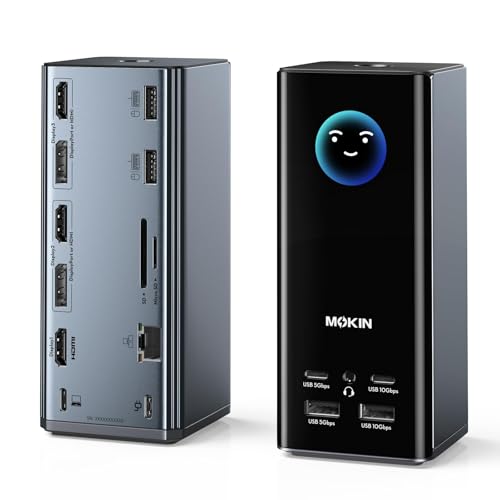
Seventeen stated connections and a double-tap screen lock, for a writer who values one button over a full spec sheet.
Best for: a writer who wants a lock button and a status screen, not a spec sheet Skip it if: you need published weight and dimensions before you buy
The privacy button is the reason this pick exists in a writers' list. Double-tap and your screens go dark. If you write in a shared house, a co-working space or a café corner, that gesture beats fumbling for a keyboard shortcut with an unfinished paragraph on display. No other pick here lists that feature.
MOKiN claims 17 connections in total: 3 HDMI and 2 DisplayPort outputs, 2 ports at 10Gbps, 2 at 5Gbps, and 2 USB 2.0. Three independent 4K @ 60Hz monitors are claimed, and the flexible mix of HDMI and DP means you can drive whatever screens you already own without hunting adapters. An LCD panel reports workstation status, similar in spirit to the Anker.
Here's the catch, and it's a real one. This listing publishes no weight and no dimensions. You know the model number, MODK2403-US-1, and a stated 2 years of warranty, and that's it on the hard figures. Compare that to the 1.18 x 7.87 x 3.54 in you get from Plugable and you're buying with less information. It sits mid-range on price, and only one seller lists it.
Pros:
- Double-tap screen lock for privacy
- Claims triple 4K at 60Hz
- Flexible mix of 3 HDMI and 2 DisplayPort
- LCD status panel built in
- Stated 2 years warranty
Cons:
- No published weight or dimensions
- Fewest hard specifications of any pick
- Only one seller lists it
- Port and display figures are all manufacturer claims
5. Baseus Laptop Docking Station Stand — Most versatile
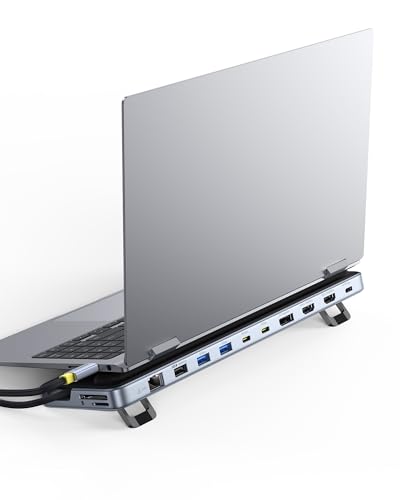
The only pick that raises the laptop and docks it at once, in an 11.2 in bar that clears desk space instead of using it.
Best for: a laptop writer who wants the dock and the riser in one 11.2 in bar Skip it if: your desk already has a separate laptop stand you like
Long writing sessions punish a bad neck angle, and this is the only pick in the group that addresses posture as part of its design. Baseus builds the dock into a stand that elevates the laptop, and the listing credits the same shape with better heat dissipation. At 11.2 x 3.15 x 1 in it runs the width of a laptop's back edge and reclaims the surface underneath.
The stated connection list runs to 12: 3 USB-A ports, 2 USB-C 3.0 ports, Gigabit Ethernet, 2 HDMI at 4K, one DisplayPort at 4K, TF and SD card readers, a 100W PD input port and a screen-lock button. Triple 4K is claimed. The SD and TF readers matter if you record interviews to a card, since you drop the card straight into the dock rather than digging out a reader.
Baseus states 100W input and 85W output on the PD port. That 15W gap is worth noting on a power-hungry laptop under load. This is the second-cheapest pick here, and it's also the slowest seller of the seven, which tells you it's less proven in this set than either Plugable. Like the MOKiN, it publishes no weight.
Pros:
- Doubles as an ergonomic laptop riser
- SD and TF card readers built in
- Stated Gigabit Ethernet and 100W PD input
- Second-cheapest pick in the group
- Screen-lock button included
Cons:
- 100W in but only 85W out
- No published weight
- Slowest seller of the seven here
- Fixed 11.2 in footprint won't suit small desks
6. j5create USB-C Dual HDMI Docking Station — Best upgrade
At 0.34 in thick with a double-sided cable storage compartment, this is the pick that travels between two desks without complaint.

Best for: a writer who carries the dock between a home desk and a shared office Skip it if: you need three displays rather than two
Look at the thickness: 0.34 x 5.43 x 1.28 in. That's flatter than any other pick here by a wide margin, and the double-sided cable storage compartment means the cord tucks into the body rather than trailing loose in a bag. j5create also notes the cable can come out of either side, so it works whether your laptop's USB-C port is on the left or the right.
Display support is stated as up to 4K, 3840 x 2160, on one screen and up to 2K, 2048 x 1152, or 1080p on the other. Ten connections total, including three USB 3.0 ports. Compatibility is listed for Thunderbolt 3 and 4 alongside standard USB-C, on Windows and macOS.
There's a security lock slot, which reads as an office feature but suits any writer leaving a dock on a hot desk. Warranty is stated as 2 years limited manufacturer's.
The trade-off is screens. Two, where four other picks claim three. If you want a manuscript, a browser and a notes window each on its own panel, look at the Plugable UD-3900PDZ or the MOKiN instead. This is the third-cheapest pick here, and it's the second-slowest seller of the seven.
Pros:
- Thinnest body here at 0.34 in
- Double-sided cable storage compartment
- One display up to 3840 x 2160
- Security lock slot for shared desks
- Thunderbolt 3 and 4 compatibility stated
Cons:
- Only two display outputs
- Second display capped at 2048 x 1152
- Slower seller than either Plugable
- No Ethernet port stated in the listing
7. UTECHMIX M.2 NVMe & SATA to USB C Docking Station — Best budget pick
Not a monitor dock at all: a 13.6 g pocket enclosure for backing up finished drafts to a bare SSD.

Best for: a writer archiving finished drafts onto bare SSDs Skip it if: you actually want monitors, Ethernet and USB ports
Be clear about what this is before you buy. It's the cheapest of the seven and it sits in the Hard Drive Accessories enclosures category, not with the docks. It drives no monitors and adds no USB ports. It reads and writes M.2 SSDs, and nothing else.
For a writer, that is still a real job. A finished manuscript, its research folder and years of drafts fit on a single M.2 drive, and a bare SSD plus this enclosure is the cheapest way to hold a physical backup you keep offline. UTECHMIX states support for both NVMe PCIe and SATA NGFF M.2 drives, M and B+M key, in 2230 through 22110 lengths, so an old drive from a retired laptop works too.
The interface is listed as USB 3.2 Gen 2 at up to 10Gbps. Installation is tool-free and hot-swappable, so you rotate drives without a screwdriver. At 13.6 g and 0.44 x 1.44 x 1.44 in, it's smaller than a matchbox. Open-air cooling is credited with holding performance through long transfers, which is what a full-archive copy is.
Warranty is 1 year manufacturer, the shortest in this group, and only one seller lists it. Buy it alongside a real dock, never instead of one.
Pros:
- Cheapest pick in the group by a clear margin
- Supports both NVMe and SATA M.2 drives
- 10Gbps USB 3.2 Gen 2 interface stated
- Tool-free, hot-swappable drive changes
- Tiny at 13.6 g and 0.44 in thick
Cons:
- No video outputs of any kind
- Adds no USB ports or Ethernet
- 1 year warranty, shortest here
- You must supply the SSD separately
- Only one seller lists it
What actually decides a docking station for writing work?
Most guides to the best wireless docking station for writers count ports and stop. That's the wrong metric. A writer plugs in a keyboard, a mouse and maybe a mic, so six USB ports is already generous and seventeen connections is mostly headroom you'll never touch.
Three things actually decide it:
- The video path. Native USB-C Alt Mode works the moment you plug in. DisplayLink needs a driver, and that driver occasionally needs attention after an operating system update. Plugable states driver installation on both picks. Anker's listing names DisplayLink. If a five-minute setup annoys you, that's your filter.
- Refresh rate on the screen holding your document. A 4K panel at 30Hz shows a moving cursor with visible judder. Plugable's UD-3900PDZ claim splits at 1x 4K 30Hz and 2x 1080p 60Hz for exactly this reason: use the 60Hz screen for typing.
- Whether your laptop charges from the same cable. Baseus states 100W in and 85W out. Anker states 140W upstream. Plugable's UD-3900 makes no power delivery claim, so budget for the laptop's own charger.
Port count is the easiest number to compare and the least useful. I'd rank the video path first, every time.
How many screens does a writer really need?
Two. Manuscript on one, research on the other. That covers the vast majority of writing work, and it's why the UD-3900's dual 1920x1200 @ 60Hz is enough for a serious professional.
The third screen earns its place in three specific cases:
- You transcribe interviews. Audio timeline on one screen, transcript on the second, source notes on the third.
- You write to a brief with a live style guide. House rules stay open permanently rather than getting tabbed over.
- You edit while someone comments. A shared document with tracked changes eats a whole panel on its own.
If any of those describe your week, four picks here claim three displays: the Plugable UD-3900PDZ, the Anker Prime, the MOKiN and the Baseus. If none do, the third output is a claim you paid for and won't use. Two 1080p 60Hz panels driven cleanly beat three panels where one stutters.
Screen size matters more than count for prose. A 1920x1200 panel in portrait shows a full page without scrolling, and none of these docks cares which way you rotate a monitor.
What the listings do not tell you
Four gaps worth knowing before you commit to any wireless docking station for writers.
Noise. Only Anker mentions a fan, and only to say you can see its mode on the display. The other six say nothing about active cooling. For a writer, a fan whine three feet away is a genuine problem, and no listing here quantifies it. Passive designs like the j5create at 0.34 in thick and the Baseus stand both credit their shape with heat dissipation, which implies no fan.
Cable length. Not one of the seven publishes it. If your laptop sits to the left of the monitors, a short captive cable dictates your whole layout.
What ships in the box. HDMI cables, Ethernet cables and power bricks are rarely included, and none of these listings itemises them. Assume you supply your own.
Real-world driver behaviour after an update. Plugable states 2 years limited parts and labor and Seattle-based email support on the UD-3900, with lifetime support named on both Plugable models. That support commitment is the closest thing to insurance against a driver problem, and it's a stronger reason to pick Plugable than any port count.
The verdict
The Plugable UD-3900 is the pick I'd default to for the best wireless docking station for writers. One hybrid cable, two 1920x1200 @ 60Hz monitors, Gigabit Ethernet, six USB ports, 0.81 lb, and a stated 2 year limited parts and labor term with lifetime support behind it. For writing, that combination is complete, and its honest published limits mean you know what you're getting before it arrives.
Two conditions flip it. First, your operating system. The UD-3900's listed compatibility path runs through Windows 11 and 10, so if you write on a Mac or a Chromebook, buy the Plugable UD-3900PDZ instead. It's lighter at 0.73 lb, names macOS 11 and later plus ChromeOS, and carries the same stated 2 year term. Second, your power situation. If you want the laptop, a tablet and a phone all charging from the dock, the Anker Prime's stated 140W upstream and 100W front ports do what neither Plugable claims, though you accept 18 months of coverage and a Windows-only listing.
The runner-up's exact advantage over the winner is breadth: three claimed HDMI outputs and three operating systems, against the UD-3900's two screens and one. Its cost is the 4K 30Hz ceiling and a driver dependency on two of those three screens.
FAQ
Is a wireless docking station for writers worth the money?
A wireless docking station for writers is worth it if you dock and undock daily. The value is one cable replacing five, every single morning, plus a second monitor you'd otherwise skip. If your laptop lives permanently on one desk and never moves, individual cables cost less and work fine. Frequency of docking, not port count, decides whether you'll feel the benefit.
Which is better, the Plugable UD-3900 or the Anker Prime?
Better depends on your operating system and your power needs. The Plugable UD-3900 wins on warranty, with a stated 2 years against Anker's 18 months, and on weight at 0.81 lb versus 1.84 lb. Anker wins on power, claiming a 140W upstream port and triple 4K output. Anker's listing names Windows 10 and 11 only, so Mac writers should look at Plugable.
Do these docking stations work with a MacBook?
These docking stations work with a MacBook in two cases here. The Plugable UD-3900PDZ lists macOS 11 and later with driver installation, and the j5create JCD542 lists macOS alongside Thunderbolt 3 and 4 compatibility. The Anker Prime listing names Windows 10 and 11 only. Always check the listing for your exact macOS version before buying, because driver support shifts between releases.
What resolution do I need for writing on two monitors?
For writing on two monitors, 1920x1200 at 60Hz per screen is sufficient and comfortable. That resolution holds a full manuscript page beside a browser window without scrolling. The Plugable UD-3900 delivers exactly that on dual HDMI. Chasing 4K matters for photo and video work, not prose, and a 4K output running at 30Hz will show visible cursor judder while you type.
What is the most common mistake when buying a dock?
The most common mistake is buying for maximum port count instead of the video path. Seventeen connections mean little if two of your three screens depend on a driver you didn't expect to install. Check how each display output is delivered, native Alt Mode or DisplayLink, and check the refresh rate on the screen that will hold your document. Those two facts decide your daily experience.
Start by counting the cables you unplug when you leave your desk. If it's more than two, the Plugable UD-3900 pays for itself in reclaimed minutes within a month, and the stated 2 year parts and labor term plus lifetime support means a driver hiccup after a system update has somewhere to go. Order the dock and one HDMI cable per monitor, since none of these listings promises cables in the box. If you also keep offline copies of finished work, add the UTECHMIX enclosure and a spare M.2 drive. Your archive stops living in one place.