Best Wireless Lightweight Mouse: Logitech G305 Leads

Five wireless mice compared by weight, sensor and battery. The G305 wins at 3.36 oz, but the right pick depends on hand size, click noise and how often you swap batteries.

By Samuel HarrisUpdated 14 min read
On this page
- Best wireless lightweight mouse at a glance
- How I narrowed the field to five
- The specification that actually decides it
- How light is light enough?
- 1. Logitech G305 Lightspeed Wireless Gaming Mouse — Best overall
- 2. VssoPlor Wireless Mouse — Best compact
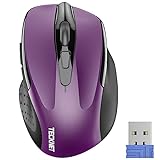
- 3. TECKNET Wireless Mouse — Best budget pick
- 4. Logitech M330 Silent Plus Full Size 2.4 GHz Wireless Mouse — Best for families
- 5. Logitech M185 Compact Ambidextrous 2.4 GHz Wireless Mouse — Best for heavy use
- Batteries: AA, sleep modes, and what the listings claim
- Which pick fits which hand?
- What the listings do not tell you
- The verdict
- FAQ
The best wireless lightweight mouse in this shortlist is the Logitech G305 Lightspeed Wireless Gaming Mouse, at 3.36 oz with a HERO sensor Logitech rates up to 12,000 DPI. If you want the lightest body in the group and a slim profile for a laptop bag, the VssoPlor Wireless Mouse at 2.4 oz is the alternate. Both slot below 4 oz. The rest of this guide handles the trade-offs: click noise, warranty length, hand size, and battery cadence.
Best wireless lightweight mouse at a glance
| Pick | Weight | Notable feature | Price |
|---|---|---|---|
Best overall Logitech G305 Lightspeed Wireless Gaming Mouse |
3.36 oz | HERO sensor, up to 12,000 DPI claim | Check Price |
Best compact VssoPlor Wireless Mouse |
2.4 oz | Slim 4.7 x 2.6 in shell, 1-year warranty | Check Price |
Best budget pick TECKNET Wireless Mouse |
3 oz | 5-level DPI to 2600, 24-month battery claim | Check Price |
Best for families Logitech M330 Silent Plus Full Size 2.4 GHz Wireless Mouse |
3.2 oz | SilentTouch clicks, 1-year limited warranty | Check Price |
Best for heavy use Logitech M185 Compact Ambidextrous 2.4 GHz Wireless Mouse |
4.8 oz | Ambidextrous shape, 3-year limited warranty | Check Price |




How I narrowed the field to five
I started with the listings that publish an actual weight in ounces. That sounds obvious. It is not, because plenty of wireless mice list only shipping weight, which includes the battery, the receiver and the box. Any pick I could not confirm at under 5 oz was cut. What survived is a set that runs from 2.4 oz to 4.8 oz. That two-ounce spread matters more than it sounds. It is the difference between a mouse you notice and one you forget.
I also cut Bluetooth-only mice. Every pick here ships with a USB receiver. Latency on a 2.4 GHz dongle is more predictable than a Bluetooth link, and the receiver frees up the Bluetooth stack for headphones. Three of the five come from Logitech, which is not a bias, it is what the weight filter left standing.
A few honest limits on the screen:
- I did not weigh anything. The figures are the ones the listings publish.
- I could not confirm click force, switch brand or polling rate above what Logitech states for the G305.
- Warranty terms and battery-life claims come from the listings, not from independent testing.
The specification that actually decides it
Most best wireless lightweight mouse guides compare DPI. That is not what decides it. DPI numbers stopped being a differentiator years ago, once entry-level sensors passed 1,000 DPI. Every pick in this set clears that bar. The TECKNET goes to 2,600 DPI. Logitech rates the G305 up to 12,000 DPI. Both are more than you need for a spreadsheet.
The real deciding criterion is weight-to-shell balance: how the ounces are distributed inside a shape that fits your hand. A 2.4 oz mouse feels wrong if the shell is too flat for your palm. A 3.36 oz mouse can feel lighter than a 3 oz one if the balance sits under the arch of your grip. That is why the G305 wins even though the VssoPlor is nearly a full ounce lighter: the G305's 4.6 x 2.45 x 1.5 in body suits a claw grip, and the HERO sensor tracks predictably.
If you use a mouse eight hours a day, a difference of half an ounce is real. If you use one for email and a browser, it is not. Match the tool to the task.
How light is light enough?
Under 4 oz is the practical ceiling for a mouse people call "lightweight". Everything here except the M185 clears that line. Under 3 oz is a different category, closer to what competitive gamers use, and only the VssoPlor at 2.4 oz sits there. The TECKNET at 3 oz is on the edge. The G305 at 3.36 oz and the M330 at 3.2 oz land in what most buyers would call comfortably light without feeling hollow.
Here is the trick with weight numbers on Amazon listings: some include a battery, some do not. The G305 runs on one AA. So does the M185 and the M330. An alkaline AA weighs around 0.8 oz, which the G305's 3.36 oz figure already accounts for since the specification is for the mouse as sold. Compare like for like.
1. Logitech G305 Lightspeed Wireless Gaming Mouse — Best overall
A 3.36 oz body with a proper gaming sensor and a receiver that stores inside the shell.
Best for: gamers and daily drivers who want the lowest weight with a proper sensor Skip it if: you need silent clicks in a shared room
The G305 is the pick that solves for the whole equation, not just the number on the scale. At 3.36 oz it is not the lightest here, but the body measures 4.6 x 2.45 x 1.5 in, which fits a claw or fingertip grip cleanly. Logitech says the HERO sensor delivers up to 12,000 DPI and 400 IPS precision, and that the Lightspeed link runs at a 1 ms report rate. Those are the manufacturer's figures.
The one AA battery is the compromise you accept for the price position. Logitech claims 250 hours of continuous play, extendable to nine months in an Endurance mode set through Logitech G HUB. A rechargeable lithium AA reads the same as an alkaline to the mouse. The nano receiver stores inside the shell, which matters if you commute with a laptop. This is the most expensive pick here, and only two sellers list it, but it is also the one that pairs low weight with a sensor a gamer would keep.
Pros:
- Lowest weight paired with a proper HERO sensor
- 1 ms report rate claim on the Lightspeed link
- Receiver stores inside the mouse body
- Up to 12,000 DPI sensitivity claim
- Compact 4.6 x 2.45 x 1.5 in shell
Cons:
- Clicks are not silenced
- Warranty terms require a service request
- Only two sellers list this model
- Right-hand shape, not ambidextrous
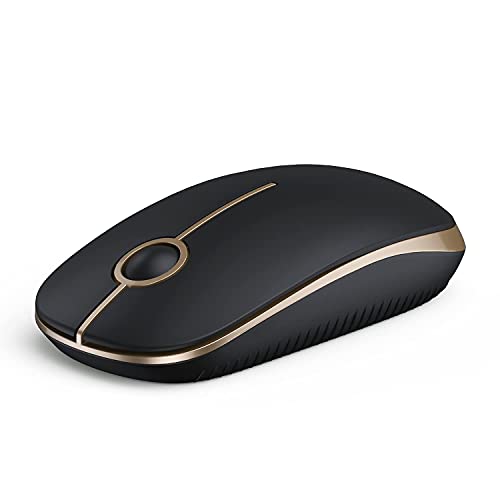
2. VssoPlor Wireless Mouse — Best compact
The lightest pick here at 2.4 oz, in a slim 4.7 x 2.6 in shell built for a laptop bag.
Best for: small bags and cramped desks where every ounce matters Skip it if: you have large hands or a heavy palm grip
The VssoPlor is the featherweight of the group. At 2.4 oz it undercuts the G305 by nearly an ounce, and the 4.7 x 2.6 in footprint is genuinely slim. VssoPlor says the 2.4 GHz link works to 10 m and that the receiver stows inside the mouse when not in use. The listing describes a smooth frosted surface and quiet clicks, and an auto-sleep mode that triggers after five minutes of inactivity. Compatibility is listed for Windows 7 through 10 and macOS 10.4 or later.
The trade-offs are real. This is a flat shell, not a contoured one, which is fine for fingertip use on a couch or a hotel desk but tiring for a full workday. The warranty is one year, and only a single seller lists it. There is no published DPI ceiling. If your priority is the lowest possible weight in a shape you can drop in a jacket pocket, this is the answer. If your priority is an eight-hour daily driver, look further down the list.
Pros:
- Lowest weight in the set at 2.4 oz
- Slim 4.7 x 2.6 in shell suits travel
- Receiver stores inside the body
- Auto-sleep after five minutes idle
- Quiet click design per the listing
Cons:
- Flat shell tires large hands
- No published DPI figure
- Only one seller lists it
- One-year warranty
3. TECKNET Wireless Mouse — Best budget pick
Three ounces, five DPI steps to 2,600, and a 24-month battery-life claim.

Best for: a second mouse for a laptop bag or a spare workstation Skip it if: you want a multi-year warranty
The TECKNET is the cheapest of the five and one of only two picks under 3.2 oz. It weighs 3 oz in a 4.21 x 2.68 x 1.52 in body, which is close enough to the G305's footprint that it can serve as a travel double. TECKNET lists five DPI levels: 800, 1200, 1600, 2000 and 2600. That is enough range for most office work and light photo editing. The listing claims a 33 ft wireless range on some copy and up to 49 ft on others, so treat both as ballpark.
The 24-month battery-life claim assumes the on/off switch gets used and the power-saving mode does its job. Real-world results depend on how long you leave the mouse asleep on your desk. The warranty is 12 months, which is the shortest of the Logitech and near-Logitech options here. Only one seller lists it. As a spare, or as a first wireless mouse for someone who has not decided how much they want to spend on peripherals, it earns its place.
Pros:
- Cheapest pick in the set
- Three ounces in an ergonomic shell
- Five DPI levels up to 2,600
- 24-month battery-life claim
- USB-A dongle works across Windows, Mac, Chrome OS, Linux
Cons:
- Only 12-month warranty
- Single seller listing
- Range figures conflict inside the listing
- Purple colour will not suit every desk
4. Logitech M330 Silent Plus Full Size 2.4 GHz Wireless Mouse — Best for families
A 3.2 oz body with SilentTouch clicks Logitech says cut over 90 percent of the click sound.

Best for: shared home offices and late-night work in quiet rooms Skip it if: you are left-handed
The M330 is the pick to reach for when someone else in the room can hear your mouse. Logitech's SilentTouch mechanism, the listing says, reduces over 90 percent of clicking sounds. The rest of the specification is standard Logitech: contoured right-handed shape, one AA battery, up to 18 months of battery life per Logitech's claim, and a 33 ft wireless range. The body is 4.15 x 2.67 x 1.51 in and 3.2 oz, which puts it a hair lighter than the G305.
Two trade-offs decide whether this belongs on your desk. First, it is a right-hand shape only, so left-handed buyers should skip it and take the M185 instead. Second, it is a premium price position in this set with no gaming sensor and no G HUB software. What you are paying for is the silence and the Logitech warranty, which runs 12 months. If the room is the constraint rather than the game, that is a fair trade. Two sellers list it, which is better than the single-seller options here.
Pros:
- SilentTouch clicks per Logitech's claim
- 3.2 oz in a full-size contoured shell
- 18-month battery-life claim on one AA
- 33 ft wireless range claim
- Broad OS compatibility
Cons:
- Right-hand only, no ambidextrous version
- Premium price position without a gaming sensor
- 12-month warranty
- No adjustable DPI on the mouse body
5. Logitech M185 Compact Ambidextrous 2.4 GHz Wireless Mouse — Best for heavy use
The only ambidextrous pick here, with the longest published warranty at three years.

Best for: buyers who want the longest published warranty and ambidextrous shape Skip it if: you want the featherweight feel of a sub-3 oz body
The M185 is the heaviest pick at 4.8 oz. It earns a spot for two reasons a scale cannot show. It is the only ambidextrous shape in the group, which matters if the household has a left-handed user or if the mouse gets shared. And it is the only pick with a three-year limited warranty, three times the length of the M330's and TECKNET's, and longer than the VssoPlor's. Logitech says the battery lasts up to a year on one AA, and the receiver is a nano USB dongle that stays in the port.
At 2.36 x 1.54 x 3.89 in, this is a genuinely compact body, just a heavier one than the others. That extra weight makes the mouse feel planted, which some people prefer for spreadsheet work and photo editing. The trade-off is that it is not what most buyers picture when they hear the word "lightweight". Model 910-002225 has been on the market since 2011, which explains the mature warranty terms and the stable design. Two sellers list it.
Pros:
- Only ambidextrous body in the set
- Three-year limited warranty
- One-year battery-life claim on a single AA
- Compact 3.89 in length
- Two sellers listed
Cons:
- Heaviest pick at 4.8 oz
- No adjustable DPI on the mouse
- No silent-click design
- Older 2011 model
Batteries: AA, sleep modes, and what the listings claim
Three of the five picks use one AA battery. That is a feature for anyone who keeps a drawer of alkalines or rechargeables. It is a mild negative for anyone who prefers a built-in lithium cell and a USB-C port for recharging. Nothing in this set has that, so if it is a hard requirement, none of these picks fits.
Battery-life claims across the listings, in order of what the manufacturer states:
- TECKNET: up to 24 months, aided by an on/off switch.
- Logitech M330: up to 18 months.
- Logitech M185: up to 1 year.
- Logitech G305: up to 9 months in Endurance mode via G HUB, or 250 hours of continuous play.
- VssoPlor: no month figure published, only an auto-sleep description.
Treat all of these as ceilings, not floors. Auto-sleep works only if the mouse is left alone. A mouse that stays on all day, on a desk where it gets bumped every few minutes, will drain faster than the box promises. If you commute with the mouse, use the physical on/off switch where the pick has one.
Which pick fits which hand?
Hand size and grip style change the answer more than the specification sheet does. The G305 at 4.6 x 2.45 x 1.5 in suits a medium hand in a claw or fingertip grip. The M330 at 4.15 x 2.67 x 1.51 in is a wider, palm-friendly full-size shape for right-handers. The M185, small at 3.89 in long, works for either hand and for shared use. The TECKNET at 4.21 x 2.68 x 1.52 in is an ergonomic contour built around a right-hand palm. The VssoPlor is the flat outlier at 4.7 x 2.6 x 0.04 in, better for fingertip grips than palms.
If you do not know your grip style, try this in thirty seconds. Rest your hand on your current mouse. If your palm sits on the shell and your fingers curl fully, you are a palm griper: pick the M330 or the M185. If your palm floats and your fingers make an arch, you are a claw griper: pick the G305. If your palm is well behind the mouse and only your fingertips make contact, you are a fingertip user: pick the VssoPlor or the TECKNET.
What the listings do not tell you
A few things you will not find in any of these product pages. None of the five publishes a click-force figure or a switch lifespan in millions of actuations. None publishes an independently measured polling rate, though Logitech quotes 1 ms for the G305. None publishes a warranty procedure timeline, and one, the G305, notes that warranty terms have to be requested from customer service.
Two more absences worth flagging. First, no receiver-loss policy is spelled out. If you lose a nano dongle, replacing it means calling the manufacturer or buying a new mouse. Second, no operating-temperature range is stated for any of the five, which matters only if you plan to use one in a garage workshop or an unheated attic. In a normal home or office it is a non-issue.
The verdict
The best wireless lightweight mouse for most buyers is the Logitech G305 Lightspeed Wireless Gaming Mouse. It pairs a 3.36 oz body with a HERO sensor Logitech rates up to 12,000 DPI, a 1 ms report rate claim on the Lightspeed link, and receiver storage inside the shell. It costs more than the other picks here and only two sellers list it, but nothing else in this shortlist matches its combination of low weight and a proper sensor.
Two conditions flip the pick. If you work in a shared room and click noise is the constraint, the Logitech M330 Silent Plus is the buy: 3.2 oz, SilentTouch clicks, an 18-month battery-life claim. If you want the featherweight feel above everything else, the VssoPlor at 2.4 oz undercuts the G305 by nearly a full ounce, though the flat shell suits smaller hands and fingertip grips.
The best wireless lightweight mouse for heavy use, where longevity and ambidextrous shape matter more than the last ounce, is the M185 with its three-year limited warranty. And the best wireless lightweight mouse for a spare drawer or a laptop bag on a strict budget is the TECKNET, the cheapest of the five at 3 oz.
FAQ
Is a lightweight mouse worth it for office work?
Is a lightweight mouse worth it depends on how many hours you spend using one. If you move a mouse for eight hours a day, half an ounce of weight is a real difference by hour six. If you use one for email and browsing, the ergonomic shape matters more than the weight. A 3.2 to 3.4 oz mouse like the M330 or G305 hits a comfortable middle ground for most desks.
How does the Logitech G305 compare to the M330 for everyday use?
How does the Logitech G305 compare to the M330 comes down to sensor versus silence. The G305 is 3.36 oz with a HERO sensor Logitech rates to 12,000 DPI and a 1 ms report rate claim. The M330 is 3.2 oz with SilentTouch clicks the listing says cut over 90 percent of the click sound. Pick the G305 for precision, the M330 for a quiet room.
Can I use these wireless mice with a MacBook?
Can I use these wireless mice with a MacBook, yes, every pick here lists broad OS compatibility. The TECKNET, M330 and M185 name Windows, macOS, Chrome OS and Linux. The VssoPlor lists Windows 7 through 10 and macOS 10.4 or later. The G305 uses a Lightspeed receiver that works via USB-A. If your MacBook has only USB-C ports, budget for a small adapter or a USB-C hub.
What is the lightest wireless mouse in this shortlist?
What is the lightest wireless mouse in this shortlist is the VssoPlor at 2.4 oz. It comes in a slim 4.7 x 2.6 in shell with an auto-sleep mode after five minutes idle and a receiver that stores inside the body. It is the pick for a laptop bag or a small desk, though the flat shape suits fingertip grips better than palm grips.
What should I avoid when buying a lightweight wireless mouse?
What should I avoid when buying a lightweight wireless mouse is paying for a spec you will not use. High DPI ceilings above 3,000 add nothing for office work. So does a 1 ms report rate for anyone who is not gaming. Watch for mice that publish only shipping weight, warranties shorter than a year, and shells too flat for your grip style. A featherweight mouse in the wrong shape gets uncomfortable fast.
If you are on the fence, order the Logitech G305 first and use it as your benchmark for a week. Notice how the weight sits in your hand, how the click feels, how often you reach for the DPI cycle. That single week of use tells you whether you actually want lighter, quieter, cheaper or ambidextrous. The G305 wins the default slot because it makes fewer compromises than the others: a real sensor, a low weight, a compact receiver home, and a shape most hands accept. Whichever direction you drift, the other four picks each cover one specific constraint the G305 does not.