Best Split Keyboard for a Student's Small Desk

Six one-piece split keyboards ranked for dorm desks and lecture-hall laptops, judged on published width, connection type and warranty length rather than marketing copy.

By Samuel HarrisUpdated 17 min read
On this page
- Best split keyboard for students at a glance
- How I screened these split keyboards for students
- 1. Arteck Split Ergonomic Keyboard with Palm Rest — Best overall
- 2. Nulea Ergonomic Split Keyboard — Best for heavy use
- 3. Perixx PERIBOARD-512B Wired Ergonomic Keyboard — Best for pros
- 4. Frixalox Wired Ergonomic Split Keyboard with RGB Backlight — Runner-up
- 5. X9 Performance Wired Ergonomic Keyboard — Best for beginners
- 6. Arteck Ergonomic Keyboard with Cushioned Wrist Palm Rest — Best budget pick
- Does a split keyboard actually help with a student workload?
- Will it fit on a dorm desk?
- Wired or wireless for a student split keyboard?
- What more money buys in this set
- What the listings do not tell you
- The verdict
- FAQ
The best split keyboard for students is the Arteck HW315, because at 16.5 in wide it is the narrowest board here and still ships with a 2-year warranty, the longest coverage in this set. If you need a wired connection with no batteries to think about, the Nulea HA398 is the better buy with its dual USB-A and USB-C plug. Both are one-piece split boards, not two separate halves.
Price positions in this category map to features in an unusual way. The entry tier here buys you wired simplicity or multi-device pairing but almost no published measurements. The middle tier buys backlighting, a numpad and stated weights. The top tier buys either the shortest footprint with the longest warranty, or the widest full-size layout on the list. Nothing here costs enough to buy a true two-piece programmable split, so treat this as a comfort upgrade over a flat board, not a mechanical hobbyist purchase.
Best split keyboard for students at a glance
| Pick | Width | Connection | Price |
|---|---|---|---|
Best overall Arteck Split Ergonomic Keyboard with Palm Rest |
16.5 in | 2.4G wireless | Check Price |
Best for heavy use Nulea Ergonomic Split Keyboard |
Not published | Wired USB-A + USB-C | Check Price |
Best for pros Perixx PERIBOARD-512B Wired Ergonomic Keyboard |
18.9 in | Wired USB | Check Price |
| 17.1 in | Wired USB-A, 5.6 ft | Check Price | |
Best for beginners X9 Performance Wired Ergonomic Keyboard |
19 in | Wired USB, 5 ft | Check Price |
Best budget pick Arteck Ergonomic Keyboard with Cushioned Wrist Palm Rest |
Not published | Bluetooth + 2 receivers | Check Price |


How I screened these split keyboards for students
I started from buyer profiles, not from a spec sheet. Students are not one group. A statistics major lives in the number pad. A humanities major writes 4,000 words a week and cares about key feel. A commuter needs the board to move between a laptop and a desktop monitor without re-pairing anything.
So I mapped each pick to one of five profiles, then checked the published data to see which one actually served it.
- The tight-desk student. Dorm desks are shallow and shared with a laptop. Width decides everything, so the 16.5 in Arteck HW315 wins that slot.
- The all-day typist. Needs a plug that fits whatever port the machine has. The Nulea HA398's dual-headed cable covers USB-A and USB-C.
- The tactile writer. Perixx describes long key travel with audible confirmation, closest to a mechanical feel in this group.
- The night owl. Frixalox lists 17 lighting effects, the only backlit board here.
- The first-timer. X9 publishes a 110-key layout with 17 shortcuts, the most conventional full-size arrangement.
What got cut: anything I could not tie to a published measurement or a stated connection type. Two boards here publish no dimensions at all, and both dropped in the ranking as a result.
One honest note on the search itself. The word "students" is not a specification any manufacturer prints. None of these six is built or marketed for coursework, and none of them claims to be. Judge them on width, wiring and warranty, which are things you can check.
1. Arteck Split Ergonomic Keyboard with Palm Rest — Best overall
The narrowest board here with the longest warranty, which is the combination a shared desk actually needs.
Best for: a cramped dorm desk that still needs wireless Skip it if: you need a number pad for spreadsheets or stats work
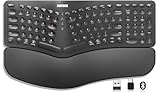
Look at the width column again. At 16.5 x 9.6 in with a 1.02 in profile, the HW315 is 2.5 in narrower than the X9 and 2.4 in narrower than the Perixx. On a 30 in dorm desk that is the difference between fitting a mouse beside it and not. The 1.02 in height is also the lowest published figure in this set, which matters when you slide the board under a monitor riser.
Wireless is 2.4G through a nano receiver that stores in the back of the keyboard. Arteck says a single charge lasts six months at two hours of daily use. That claim is the manufacturer's, not a measurement, but a rechargeable lithium cell means no AA hunting at midnight.
The 2-year warranty is the standout. Three boards here publish 12 months, one publishes nothing at all. Doubling the coverage window on a board you'll carry between a dorm and home is worth real money.
The trade-off is the price position. This is the most expensive pick here and it gives up the number pad that the Frixalox and X9 both include. If your coursework is numeric, that omission stings more than the narrow footprint helps.
Pros:
- Narrowest published width in this set at 16.5 in
- Lowest profile here at 1.02 in
- 2-year warranty, double most rivals
- Rechargeable battery, no disposables
- Receiver stores in the keyboard body
Cons:
- Most expensive pick in this group
- No number pad, unlike three others here
- Single wireless mode, no Bluetooth fallback
- Only two sellers list it
2. Nulea Ergonomic Split Keyboard — Best for heavy use
One cable head fits both a USB-A tower and a USB-C MacBook, which removes the dongle problem entirely.

Best for: someone typing on a MacBook or iPad Pro all day Skip it if: you want a keyboard that hides scuffs and coffee marks
The HA398 is the only board here with a stated 2-in-1 plug. Nulea says the same cable serves traditional USB-A desktops and USB-C devices including MacBook and iPad Pro. If you write in the library on a laptop and edit at a desktop at home, that single detail is worth more than any lighting mode.
It is also the second-cheapest of the six, and one of only two boards priced at the entry level. Nulea lists dedicated media hotkeys for both Windows and macOS, plus a full-size layout and spherically dished keycaps that the company describes as matching fingertip contours. Attribute all of that to the listing rather than to a test bench.
Two gaps hold it back from the top spot. There are no published dimensions, so you cannot check it against your desk before it arrives, and that is a real problem in a category where width is the deciding number. The warranty reads as 12 months.
White also shows wear. Every other board here is black, and a light keyboard living in a backpack and a dining hall picks up marks that a black one hides. Cosmetic, but you'll notice by second semester.
Pros:
- Only pick with a dual USB-A and USB-C head
- Second-cheapest of the six
- Media hotkeys mapped for Windows and macOS
- Wired, so nothing to charge
Cons:
- No published width, depth or height
- 12-month warranty against Arteck's 2 years
- White finish shows wear faster than black
- No numeric key count published
3. Perixx PERIBOARD-512B Wired Ergonomic Keyboard — Best for pros
The only board here that publishes a key-feel comparison, and the one to buy if you write for hours at a stretch.

Best for: a heavy typist who wants tactile, audible keys Skip it if: you share a quiet room or study space
Perixx describes extended key travel with tactile feedback and audible confirmation, comparable to brown mechanical switches. No other listing here makes a switch-feel comparison at all. For anyone drafting long essays, key feel decides comfort more than any curve in the plastic does.
The physical numbers back up the seriousness. At 2.28 lb this is the heaviest board in the set, 0.19 lb above the Frixalox and the only pick over two pounds with a published figure. Weight means it stays planted. The 1.72 in height and stepped, curved rows are what Perixx calls an old-school design, built from ABS with membrane switches.
The 2023 release date is the only one published here, which tells you this is a current model rather than a listing that has been sitting for years.
Perixx is unusually direct about the downside: the listing itself says the shape needs a short adjustment period, and most people adapt in one to two weeks. Respect that. The 18.9 in width is the second-widest here, and audible keys in a shared dorm room will annoy a roommate at 1am. Warranty is 12 months, half the Arteck's.
Pros:
- Only board here with a published switch-feel comparison
- Heaviest at 2.28 lb, so it stays put
- Full dimensions and 2023 release date published
- Stepped curved rows for a natural hand angle
Cons:
- Audible keys are poor for shared quiet spaces
- Second-widest here at 18.9 in
- Listing itself warns of a 1 to 2 week adjustment
- 12-month warranty only
4. Frixalox Wired Ergonomic Split Keyboard with RGB Backlight — Runner-up
The only backlit board in this group, with adjustable kickstands and a numpad in a body that stays under 17.5 in.

Best for: late-night typing in a dim room Skip it if: you want the shortest board on this list
Backlighting is the whole argument here. Frixalox lists 10 dynamic rainbow modes and 7 solid colours for 17 customisable effects, including breathing, wave, gradient and static. Nobody else in this set publishes any illumination at all. If you type after your roommate turns the lights off, that is the feature that decides it.
The rest of the sheet is solid rather than exciting. It measures 1.1 x 17.1 x 9.4 in and weighs 2.09 lb, making it the third-narrowest board here and the second-heaviest. Two pairs of adjustable kickstands let you set the tilt, which no other pick here mentions. The cable is a 5.6 ft USB-A, the longest published lead in the set, and the listing claims plug-and-play compatibility with Windows, macOS, Chrome OS and Linux with no drivers.
You also get a number pad and 17 multimedia shortcuts for volume, tracks and screen brightness.
Against the Arteck, it loses on footprint and coverage: 0.6 in wider, warranty stated as one year rather than two, and a cable running across your desk. Only one seller lists it, so if it goes out of stock there is no second source.
Pros:
- Only backlit pick, with 17 lighting effects
- Longest published cable at 5.6 ft
- Two pairs of adjustable kickstands for tilt
- Numpad plus 17 media shortcuts
- Full dimensions and weight published
Cons:
- 0.6 in wider than the top pick
- One-year warranty against Arteck's two
- Wired only, cable clutter on a small desk
- Just one seller lists it
5. X9 Performance Wired Ergonomic Keyboard — Best for beginners
The most conventional full-size layout here, at the cost of being the widest board in the set.

Best for: a first-time split keyboard buyer on a wide desk Skip it if: your desk is under 19 in of usable width
X9 publishes an exact key count, and that is genuinely useful. A 110-key layout with 17 shortcuts and a numeric keypad means nothing is missing and nothing has been doubled up onto a function layer. For a first split keyboard, a familiar map lowers the adjustment period more than any curve does. Everything sits where your fingers already expect it.
The listing describes a wave layout with an integrated cushion on the wrist rest, and a 5 ft cable that plugs into PC or Chrome machines with no driver install.
Now the number that matters. At 19 x 9.85 in this is the widest and deepest board in the group, 2.5 in wider than the Arteck. The 1.5 in height is second only to the Perixx. Measure your desk before you order, because on a standard dorm surface a 19 in board plus a mouse leaves very little room for a notebook.
It also publishes no warranty at all, the only pick here with that gap, and no weight figure. Pairing the second-highest price position with the least coverage is a hard sell against the Nulea, which costs less and states 12 months.
Pros:
- Exact 110-key count with numpad published
- 17 dedicated shortcut keys
- Plug-and-play on PC and Chrome, no drivers
- Integrated cushioned wrist rest
Cons:
- Widest board here at 19 in
- No published warranty at all
- Second-highest price position for fewer specs
- No published weight
6. Arteck Ergonomic Keyboard with Cushioned Wrist Palm Rest — Best budget pick
Three simultaneous device connections for the lowest price here, if you can accept a listing with almost no published specs.

Best for: juggling a laptop, tablet and phone from one board Skip it if: you want published dimensions before you buy
This is the cheapest of the six, and its argument is connectivity. Arteck says it holds three devices at once: 2.4G over a USB-A receiver, 2.4G over a USB-C receiver, and Bluetooth. No other pick here offers more than one mode. If you take notes on a tablet in lecture and write essays on a laptop at night, switching boards between them stops being a chore.
Battery life is stated as six months per charge at two hours of daily use, matching the HW315's claim. The cushioned wrist rest and split layout follow the same pattern as its stablemate.
Here is why it sits last. The listing publishes almost nothing measurable. No dimensions, no weight, no warranty, no model number, no colour. Compare that to the HW315 above, which gives width, depth, height, model and a 2-year term. For a board you have to fit on a shared desk, buying blind on footprint is a real risk, and only one seller lists it.
Buy it for the three-device trick and the low price. Do not buy it expecting to know what arrives.
Pros:
- Cheapest pick in this set
- Three simultaneous connections, unique here
- USB-A and USB-C receivers both included
- Rechargeable cell, six-month claim
Cons:
- No published dimensions, weight or warranty
- No model number listed
- Only one seller stocks it
- Fewest published specs of all six
Does a split keyboard actually help with a student workload?
A split keyboard is a one-piece board with the key field divided into left and right zones, angled so your forearms sit closer to their natural line. That is all it is. Five of these six describe reduced wrist bending as the goal, and Perixx goes further with stepped curved rows and dished keycaps.
What it does not do is make you type faster. Every listing here frames the benefit as comfort during long sessions, not speed. If you are writing a thesis chapter over six hours, comfort is the thing that decides whether you finish.
Two honest caveats:
- There is an adjustment period. Perixx states one to two weeks in its own listing. Expect a slower first week on any of these.
- A curve is not a cure. These are membrane and dished-key boards, not medical devices, and no listing here makes a clinical claim.
For a student split keyboard, the practical win is simple. You spend more hours at a keyboard than most workers do, on worse furniture, in worse light. A board that lets your shoulders drop is worth having.
Will it fit on a dorm desk?
This is the question that separates these six, and it is the one buyers skip. Four of the picks publish a width. Here they are, shortest first:
- Arteck HW315: 16.5 in
- Frixalox ES1000-A: 17.1 in
- Perixx PERIBOARD-512B: 18.9 in
- X9 Performance: 19 in
That is a 2.5 in spread from end to end, which sounds trivial until you add a mouse. Give a mouse 8 in of travel and the X9 needs 27 in of clear desk. The Arteck needs 24.5 in. On the standard shallow desk in a residence hall, that gap is the whole decision.
Depth matters too. The Arteck's 9.6 in and the Frixalox's 9.4 in leave room in front for a notebook. The X9's 9.85 in leaves less.
Do this before you order. Clear your desk, measure the usable width with a ruler, and subtract the space your laptop occupies if it stays open beside the board. Then pick from the list above. The Nulea and the budget Arteck publish no dimensions at all, which is a genuine reason to prefer one of the four that do.
Wired or wireless for a student split keyboard?
Wired wins for reliability, wireless wins for a moving life. Four of these six are wired, two are wireless, and the split maps cleanly onto how you work.
Choose wired if your board lives permanently on one desk. Frixalox states zero input lag over a 5.6 ft USB-A cable with no pairing, batteries or drivers. Nulea's dual-head cable removes the port question entirely. X9 and Perixx both plug in and go.
Choose wireless if the board moves. Both Arteck picks claim six months per charge at two hours of daily use, and the HW315 tucks its nano receiver into the keyboard body so you can throw it in a bag without losing the dongle.
The budget Arteck is the interesting case. Three simultaneous connections mean it serves a laptop, a tablet and a phone from one board, which no wired pick can do. That flexibility is why it earns a place despite thin published specs.
Cable length is worth checking if your tower sits on the floor. The 5.6 ft Frixalox lead is the longest published here; the X9's is 5 ft.
What more money buys in this set
Not much, and that is worth knowing before you stretch your budget on the best split keyboard for students.
The entry tier gets you either three-device wireless switching or a dual USB-A and USB-C plug. Both entry picks publish the fewest specifications of the six: no dimensions on either, and one of them lists no warranty, model or colour.
The middle tier buys published measurements. Perixx and Frixalox both give width, depth, height and weight, both state a one-year warranty, and one adds 17 lighting effects plus adjustable kickstands. If you want to know what you are getting before it ships, this is where that begins.
The top tier splits in two directions. The X9 spends its extra money on the widest full-size layout and a stated 110-key count, but publishes no warranty. The Arteck HW315 spends it on the narrowest footprint, the lowest profile and a 2-year term.
Notice what money does not buy anywhere here: mechanical switches, programmable layers, or two genuinely separate halves. Every pick in this set is a one-piece board with a fixed split. If that is what you actually want, this whole price range is the wrong place to shop.
What the listings do not tell you
Six listings, and the gaps are consistent enough to be useful.
Actual noise level. Perixx compares its key feel to brown mechanical switches with audible confirmation, which tells you it is loud without telling you how loud. Nobody publishes a decibel figure. In a shared room, that unknown matters.
Split angle. Every board here says "split" and "natural position". Not one publishes the degrees of separation or tent angle. Two boards described identically can feel very different.
Keycap legend durability. Nothing here states whether the legends are printed, laser-etched or doubleshot. On a board you use for four years of coursework, worn letters are a real outcome.
Palm rest material. Five listings say cushioned or integrated. None names the foam, the cover, or whether it is replaceable.
Weight, for two picks. Both Arteck boards and the Nulea publish no weight. If you carry one to a library daily, that is information you'd want.
None of this makes the picks bad. It does mean you should buy on the numbers that are published, which is why width, connection type and warranty length carry the ranking here.
The verdict
If your desk is short and your gear moves, buy the Arteck HW315. At 16.5 x 9.6 x 1.02 in it is the smallest footprint here by a clear margin, the receiver stores inside the body, and the 2-year warranty is double what most rivals state. That combination is what a dorm room actually demands.
If your board stays on one desk and you switch between a MacBook and a Windows machine, buy the Nulea HA398. Its dual-head USB-A and USB-C cable is unique in this group, it is the second-cheapest pick, and wired means nothing to charge before a 2am deadline.
The cutoff is 24.5 in of clear desk width. Below that, the Arteck's narrow body is the only comfortable answer once you add a mouse. Above it, the field opens up and you should choose on connection type instead.
The Nulea's specific advantage over the Arteck is port flexibility with zero setup. One cable, two plug types, no receiver to lose and no battery to run down mid-essay. What it gives up is published dimensions and a year of warranty, which is precisely the trade you are making.
FAQ
Is a split keyboard worth it for a student?
A split keyboard is worth it for a student who types for several hours a day rather than in short bursts. Every listing here frames the benefit as comfort over long sessions, not faster typing. If you write long papers on a laptop with your wrists angled inward, the payoff is real. For light note-taking, a flat board is fine.
What is the cheapest split keyboard for students in this group?
The cheapest split keyboard for students here is the Arteck multi-device board, which sits at the entry level alongside the Nulea HA398. It buys you three simultaneous connections: 2.4G over USB-A, 2.4G over USB-C, and Bluetooth. The catch is thin published data. No dimensions, no weight, no warranty and no model number appear on the listing.
How wide is each keyboard and will it fit my desk?
How wide each keyboard runs varies by 2.5 in across this set. The Arteck HW315 is 16.5 in, the Frixalox 17.1 in, the Perixx 18.9 in and the X9 19 in. Add roughly 8 in for a mouse. Measure your usable desk width first, because two picks here publish no dimensions at all.
Arteck HW315 or Nulea HA398: which should I pick?
Choose between the Arteck HW315 and the Nulea HA398 on connection type. The Arteck is 2.4G wireless, 16.5 in wide, and carries a 2-year warranty. The Nulea is wired with a dual USB-A and USB-C head, costs less, and states 12 months. Wireless and a small desk favour Arteck; multi-machine port flexibility favours Nulea.
What mistake do first-time split keyboard buyers make?
The mistake first-time split keyboard buyers make is ignoring width and expecting instant comfort. A 19 in board plus a mouse needs 27 in of clear desk, which a dorm surface may not have. Perixx also states in its own listing that adaptation takes one to two weeks. Plan for a slower first week rather than judging on day one.
Measure your desk tonight, then order from the four picks that publish dimensions. That single step eliminates most of the regret in this category. The Arteck HW315 is the sensible default not because it is loaded with features, but because it asks the least of your desk and gives the longest warranty back, which is the right trade when your workspace changes every September. Add a numpad-equipped pick like the Frixalox instead if your coursework runs on spreadsheets, and skip the whole category if you type fewer than an hour a day.